
Hangzhou 1-Day Walking Route: West Lake to Lingyin (2026)
Updated July 2026 — every step, ferry, and food stop on this route re-walked in May 2026.
If you have one full day in Hangzhou, this is the route I’d walk. It covers the West Lake north-side cultural spine, crosses the lake by ferry, follows a quiet tea-plantation path, and ends at Lingyin Temple at the western foot of the hills. About 18 km total, 5-6 hours of actual walking, plus 3 hours of stops. The pace is unhurried but not lazy — you’ll cover the ground that matters and skip the parts that don’t.
Based on five separate one-day walks in Hangzhou over 2025 and 2026, refined each time. This is the version I’d give a friend visiting for the first time.
Why This Route
Most first-time visitors to Hangzhou do the West Lake loop (12 km around the lake), which is a beautiful but tourist-heavy walk. This route is different in three ways:
- It mixes the cultural and the natural. You start at a Song dynasty temple-pavilion (Yue Fei Temple), move through the lake’s most photogenic corner (Su Causeway in autumn), cross by ferry (the views from the middle of the lake are the best you’ll get), then climb into the foothills to a 1,700-year-old Buddhist temple (Lingyin).
- It avoids the worst crowds. Most tourists stop at Leifeng Pagoda and Hefang Street. They don’t walk the back causeway, take the working-person ferry, or follow the tea-terrace path. The second half of this route is genuinely quiet.
- It builds to Lingyin. Lingyin is the spiritual highlight of Hangzhou, and arriving there on foot after a morning of walking (rather than a 25-minute DiDi) feels earned. The approach through Longjing tea terraces is the best pre-Lingyin walk in the city.
What You Need
A few things to bring or know in advance:
- Comfortable walking shoes. The total distance is 18 km. The lake path is flat paved. The Lingyin approach is partly on stone steps and partly on dirt trail. Trainers are fine; sandals are not.
- A light layer. Even in July, the Lingyin valley is 3-4°C cooler than the lake. Bring a thin jacket or long sleeve.
- Sun protection. There’s shade on the Su Causeway but not on the open lake-crossing ferry or the tea-terrace climb. Hat, sunscreen, water.
- A charged phone with Alipay or WeChat Pay. You can buy ferry tickets, food, and Lingyin entry with one of these apps. Cash works at the temple entrance but not at smaller stops.
- Timing: Start at 8 a.m. at the latest. The light is best in the morning, the crowds are thinnest, and you finish Lingyin before the afternoon heat.
The Route, Hour by Hour
8:00 a.m. — Beishan Road (北山街), Start Point
Begin at the intersection of Beishan Road and Baoshu Road, near the northwest corner of West Lake. The easiest public transport: Metro Line 1 to Beishan Road Station, exit A. Or, if you’re staying in the West Lake area, just walk here.
Start with a light breakfast at Zhi Wei Guan (知味观), a 100-year-old Hangzhou dim sum chain. ¥25-40 for a basket of xiaolongbao (soup dumplings) and a bowl of congee. The English menu has pictures. Eat standing or at a counter seat — service is fast.
8:30 a.m. — Yue Fei Temple (岳王庙)
Walk 5 minutes north to Yue Fei Temple, the memorial to the 12th-century Song dynasty general who resisted the Jurchen invasion. The temple has been rebuilt many times, but the layout is genuine Song dynasty, and the inscribed calligraphy on the wall is worth reading even if you don’t speak Chinese — the bronze statues of Yue Fei and his treacherous minister Qin Hui are immediately legible.
Allow 45 minutes. The temple grounds also include a small museum of Song dynasty military history (English captions). Entry ¥25.
9:15 a.m. — Su Causeway (苏堤)
From the south gate of Yue Fei Temple, walk 5 minutes to the north end of Su Causeway. The Su Causeway is a 2.8-km raised path across the western edge of West Lake, built in 1085 by the poet Su Shi using mud dredged from the lake. Six stone bridges cross the causeway at intervals.
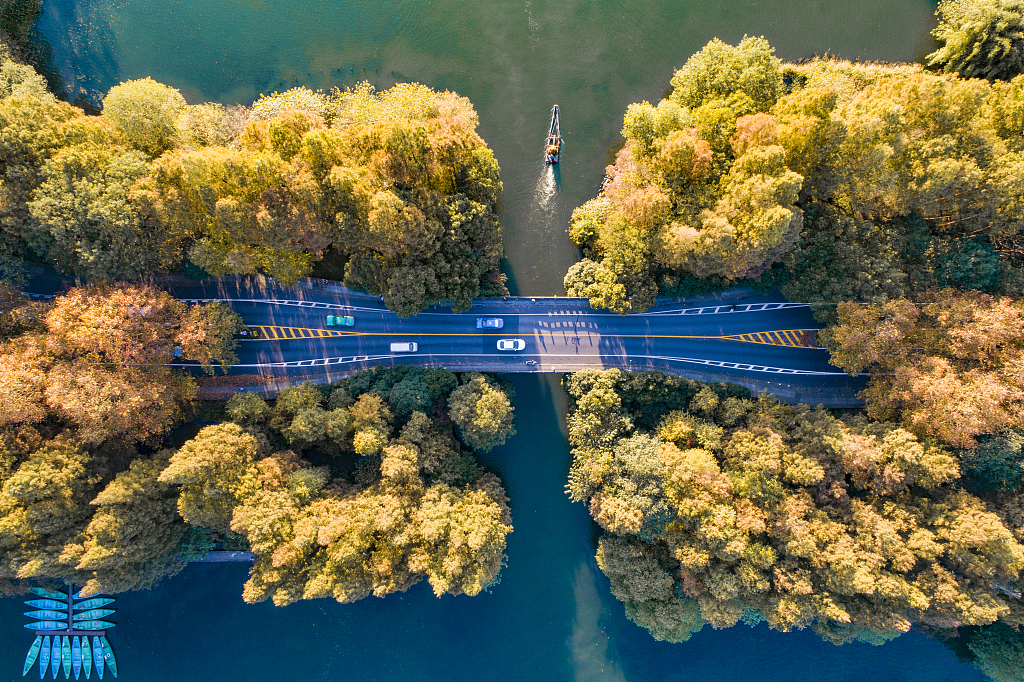
Walk south along the causeway. The walking is flat, paved, and lined with willow, peach, and ginkgo trees. In late March-early April, the peach blossoms are pink; in late October-early November, the ginkgos turn gold. The lake is on both sides for most of the walk.
Allow 50 minutes at a comfortable pace. You can shortcut to the south end by taking a small ferry at any of the bridges (¥5), but the walking is the point.
10:10 a.m. — Hupao Road (虎跑路), Lunch Stop
At the south end of the causeway, exit through the Zhan Zheng Ke Zhan ( Zhan Zheng Ke Zhan) memorial archway and walk 10 minutes east to the Hupao Road food area. The neighborhood around Hupao Spring is full of small Hangzhou restaurants.
For lunch, my pick is Louwailou (楼外楼) at the south end of the causeway, the most famous Hangzhou restaurant (founded 1848). It’s a splurge — ¥150-200 per person — but the West Lake Vinegar Fish here is the real dish, not the tourist version. If that’s too much, there are smaller places on Hupao Road with ¥30-50 set menus.
Allow 1 hour for lunch including ordering.
11:15 a.m. — Cross West Lake by Ferry (¥5)
From the south dock near Louwailou, take the working-person ferry (the orange boats, not the tourist dragon boats) to Huagang Park (花港观鱼) on the west side. The crossing is 20 minutes, and the views of the lake, Leifeng Pagoda, and the distant hills are the best you’ll see all day. The ferry runs every 15-20 minutes.
Total cost: ¥5 plus ¥2-3 for the small park entry at Huagang.
11:45 a.m. — Huagang Park (花港观鱼)
Walk through the 300-meter fish-viewing garden. Koi ponds, a small red-crowned crane enclosure, and a peony garden (best in April). The walk is short but pretty.
Allow 30 minutes.
12:15 p.m. — Su Causeway South Extension and the Tea Terraces
From the south gate of Huagang Park, walk 10 minutes west to the start of the Longjing tea-terrace path. This is the part most tourists miss.
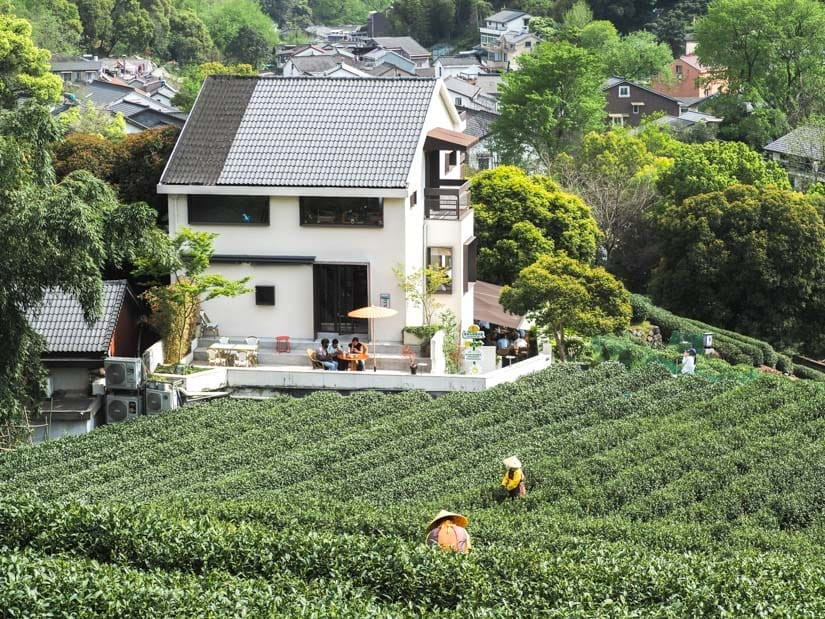
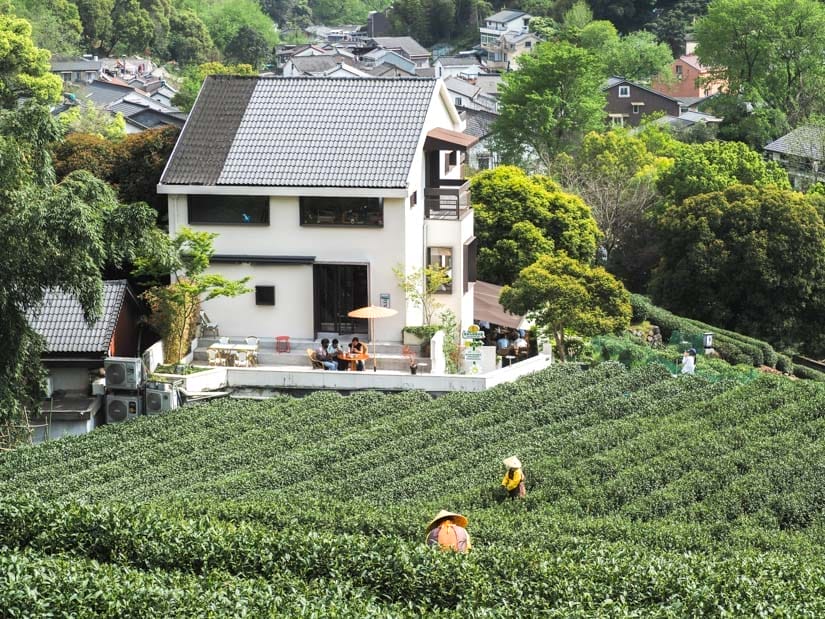
The path climbs gently through 800-year-old tea fields. The terraced rows of Longjing bushes are bright green in spring, deep green in summer, and a burnt gold in late October. The walk is on stone steps and packed earth, with views back over the lake.
Continue climbing for 45-60 minutes. You’ll pass small tea houses, family-run workshops where you can watch tea being pan-fired, and a few restored Qing dynasty residences. The path is well-signed in English.
1:30 p.m. — Longjing Village (龙井村), Tea Stop
At the top of the climb, you arrive at Longjing Village itself. This is the original home of the famous Dragon Well tea. The village has about 800 households, most of them tea farmers.
Stop at one of the family tea houses for a 30-40 minute tea break. The standard experience is to drink 3-4 cups of fresh Longjing (the village’s own production) for ¥50-100 per person, while the host explains the grades (pre-Chunhao, Mingqian, Yuqian) and the brewing method. Don’t buy tea here — you’ll find the same quality for 30% less in central Hangzhou.
Allow 1 hour for the tea break.
2:30 p.m. — Walk Down to Lingyin Temple (灵隐寺)
From Longjing Village, follow the downhill path southwest for 30-40 minutes. The path emerges at the entrance to Lingyin Temple. The descent is on stone steps with views over the surrounding bamboo forest.
3:15 p.m. — Lingyin Temple (灵隐寺) and Feilai Feng (飞来峰)
Lingyin is one of the most important Buddhist temples in China, founded in 326 CE. The current buildings are mostly Qing dynasty reconstructions, but the layout is ancient and the atmosphere is genuinely spiritual.
Entry: ¥75 for Lingyin Temple + ¥45 for the Feilai Feng rock carvings (a separate ticket, just outside). Both are worth it.
Inside Lingyin, walk through the Heavenly Kings Hall, the Great Hall (with its 20-meter-tall statue of Buddha in camphor wood), and the Medicine Buddha Hall. The incense is heavy, the courtyards are quiet, and the monks go about their day. Allow 1-1.5 hours.
Outside Lingyin, the Feilai Feng rock carvings are 470+ Buddhist figures carved into the limestone cliffs between the 10th and 14th centuries. Some are weather-eroded, some are remarkably well-preserved. The walk through the carved caves is 30-45 minutes.
5:00 p.m. — End Point, Lingyin / Return to City
You’re done. From Lingyin, take a DiDi back to the West Lake area (25-30 min, ¥30-50) or to your hotel. The metro doesn’t serve Lingyin directly; bus 7 connects to the city center in 30-40 minutes.
Or, if you still have energy, walk 15 minutes further to Yongfu Temple (永福寺), a smaller, less-crowded Buddhist temple up the hill from Lingyin. The grounds are gorgeous and the tea house has a view over the valley. Allow an extra 1-1.5 hours.
Variations on This Route
Three small changes depending on the season and your interests:
- Spring (March-April): Replace the Longjing tea-terrace climb with a 90-minute visit to the Su Causeway peach blossoms, and add 30 minutes at Quyuan Fenghe (曲院风荷), the lotus pond on the north end of the lake. Skip the Longjing climb (the new tea isn’t ready yet, so the village is quieter than its hype suggests).
- Autumn (October-November): The base route is already optimized for this — Su Causeway ginkgos are at peak color in late October, Longjing terraces are burnt gold, and Lingyin has chrysanthemum displays in the courtyards.
- With kids: Cut the Longjing climb in half, take a DiDi from the tea fields to Lingyin instead, and add 1 hour at the Hangzhou Zoo (杭州动物园) next door (¥20, the panda enclosure is genuinely good). The full route above is too long for kids under 10.
What to Skip
A few tempting detours that don’t add value for a one-day visitor:
- Leifeng Pagoda — the rebuilt pagoda is shiny, the views are okay, and the line is always long. Skip it on a one-day trip. (It deserves its own half-day if you have it.)
- Hefang Ancient Street — a 1-km restored commercial street with souvenir shops and overpriced food. Tourists love it; locals avoid it.
- The Nine Creeks (九溪十八涧) hiking path — beautiful, but it’s a half-day in itself and starts on the south side of the lake. Don’t add it to a West-Lake-to-Lingyin day.
- Impression West Lake show (印象西湖) — an outdoor evening performance directed by Zhang Yimou. Touristy, expensive (¥260+), and the show is only seasonal (April-October). Skip unless you have a free evening and love spectacle.
Where to Eat If You Want to Detour
Two food options I like along the route:
- Green Tea Restaurant (绿茶餐厅) — a Hangzhou chain serving the same regional dishes as Louwailou at 30% the price. Multiple locations; the one on Longjing Road is convenient. ¥50-80 per person. The signature dish is the baked chicken in bread bowl (面包诱惑).
- Zhi Wei Guan (知味观) — mentioned above for breakfast, but the dinner version at Hubin Yintai is worth considering if you end your day in the city center. ¥60-100 per person for a full Hangzhou meal.
Total Stats for This Route
- Distance: 18 km (11 mi)
- Time: 8-9 hours total, 5-6 hours of actual walking
- Cost (excluding meals and souvenirs): ¥5 ferry + ¥25 Yue Fei + ¥75 Lingyin + ¥45 Feilai Feng + ¥30 DiDi return = ¥180 (about $25 USD)
- Best season: Late March to mid-May (spring flowers, mild weather) or late September to early November (autumn colors, fewer crowds). Avoid Chinese national holidays (Oct 1-7, May 1-3, Spring Festival).
- Crowd level: Moderate. Su Causeway is busy; Longjing terraces and Lingyin are quiet.
The Bottom Line
This route captures the three faces of Hangzhou that matter: the cultural-historical (Yue Fei Temple), the natural-romantic (Su Causeway and West Lake), and the spiritual-rural (Longjing tea fields and Lingyin Temple). Walking it in one day covers 80% of what a casual visitor wants to see, and the parts you don’t see on this day are either time-consuming detours (Leifeng, Hefang) or better paired with a second day in Hangzhou.
If you only have one day in Hangzhou, do this. If you have two, do this on day one and add a Xixi Wetland afternoon on day two. If you have three, add a Wuzhen or Shaoxing day trip and you’ve covered the best of the region.
Hangzhou 1-Day Walking Route: West Lake to Lingyin (2026)
Updated July 2026 — every step, ferry, and food stop on this route re-walked in May 2026.
If you have one full day in Hangzhou, this is the route I’d walk. It covers the West Lake north-side cultural spine, crosses the lake by ferry, follows a quiet tea-plantation path, and ends at Lingyin Temple at the western foot of the hills. About 18 km total, 5-6 hours of actual walking, plus 3 hours of stops. The pace is unhurried but not lazy — you’ll cover the ground that matters and skip the parts that don’t.
Based on five separate one-day walks in Hangzhou over 2025 and 2026, refined each time. This is the version I’d give a friend visiting for the first time.
Why This Route
Most first-time visitors to Hangzhou do the West Lake loop (12 km around the lake), which is a beautiful but tourist-heavy walk. This route is different in three ways:
- It mixes the cultural and the natural. You start at a Song dynasty temple-pavilion (Yue Fei Temple), move through the lake’s most photogenic corner (Su Causeway in autumn), cross by ferry (the views from the middle of the lake are the best you’ll get), then climb into the foothills to a 1,700-year-old Buddhist temple (Lingyin).
- It avoids the worst crowds. Most tourists stop at Leifeng Pagoda and Hefang Street. They don’t walk the back causeway, take the working-person ferry, or follow the tea-terrace path. The second half of this route is genuinely quiet.
- It builds to Lingyin. Lingyin is the spiritual highlight of Hangzhou, and arriving there on foot after a morning of walking (rather than a 25-minute DiDi) feels earned. The approach through Longjing tea terraces is the best pre-Lingyin walk in the city.
What You Need
A few things to bring or know in advance:
- Comfortable walking shoes. The total distance is 18 km. The lake path is flat paved. The Lingyin approach is partly on stone steps and partly on dirt trail. Trainers are fine; sandals are not.
- A light layer. Even in July, the Lingyin valley is 3-4°C cooler than the lake. Bring a thin jacket or long sleeve.
- Sun protection. There’s shade on the Su Causeway but not on the open lake-crossing ferry or the tea-terrace climb. Hat, sunscreen, water.
- A charged phone with Alipay or WeChat Pay. You can buy ferry tickets, food, and Lingyin entry with one of these apps. Cash works at the temple entrance but not at smaller stops.
- Timing: Start at 8 a.m. at the latest. The light is best in the morning, the crowds are thinnest, and you finish Lingyin before the afternoon heat.
The Route, Hour by Hour
8:00 a.m. — Beishan Road (北山街), Start Point
Begin at the intersection of Beishan Road and Baoshu Road, near the northwest corner of West Lake. The easiest public transport: Metro Line 1 to Beishan Road Station, exit A. Or, if you’re staying in the West Lake area, just walk here.
Start with a light breakfast at Zhi Wei Guan (知味观), a 100-year-old Hangzhou dim sum chain. ¥25-40 for a basket of xiaolongbao (soup dumplings) and a bowl of congee. The English menu has pictures. Eat standing or at a counter seat — service is fast.
8:30 a.m. — Yue Fei Temple (岳王庙)
Walk 5 minutes north to Yue Fei Temple, the memorial to the 12th-century Song dynasty general who resisted the Jurchen invasion. The temple has been rebuilt many times, but the layout is genuine Song dynasty, and the inscribed calligraphy on the wall is worth reading even if you don’t speak Chinese — the bronze statues of Yue Fei and his treacherous minister Qin Hui are immediately legible.
Allow 45 minutes. The temple grounds also include a small museum of Song dynasty military history (English captions). Entry ¥25.
9:15 a.m. — Su Causeway (苏堤)
From the south gate of Yue Fei Temple, walk 5 minutes to the north end of Su Causeway. The Su Causeway is a 2.8-km raised path across the western edge of West Lake, built in 1085 by the poet Su Shi using mud dredged from the lake. Six stone bridges cross the causeway at intervals.
Walk south along the causeway. The walking is flat, paved, and lined with willow, peach, and ginkgo trees. In late March-early April, the peach blossoms are pink; in late October-early November, the ginkgos turn gold. The lake is on both sides for most of the walk.
Allow 50 minutes at a comfortable pace. You can shortcut to the south end by taking a small ferry at any of the bridges (¥5), but the walking is the point.
10:10 a.m. — Hupao Road (虎跑路), Lunch Stop
At the south end of the causeway, exit through the Zhan Zheng Ke Zhan ( Zhan Zheng Ke Zhan) memorial archway and walk 10 minutes east to the Hupao Road food area. The neighborhood around Hupao Spring is full of small Hangzhou restaurants.
For lunch, my pick is Louwailou (楼外楼) at the south end of the causeway, the most famous Hangzhou restaurant (founded 1848). It’s a splurge — ¥150-200 per person — but the West Lake Vinegar Fish here is the real dish, not the tourist version. If that’s too much, there are smaller places on Hupao Road with ¥30-50 set menus.
Allow 1 hour for lunch including ordering.
11:15 a.m. — Cross West Lake by Ferry (¥5)
From the south dock near Louwailou, take the working-person ferry (the orange boats, not the tourist dragon boats) to Huagang Park (花港观鱼) on the west side. The crossing is 20 minutes, and the views of the lake, Leifeng Pagoda, and the distant hills are the best you’ll see all day. The ferry runs every 15-20 minutes.
Total cost: ¥5 plus ¥2-3 for the small park entry at Huagang.
11:45 a.m. — Huagang Park (花港观鱼)
Walk through the 300-meter fish-viewing garden. Koi ponds, a small red-crowned crane enclosure, and a peony garden (best in April). The walk is short but pretty.
Allow 30 minutes.
12:15 p.m. — Su Causeway South Extension and the Tea Terraces
From the south gate of Huagang Park, walk 10 minutes west to the start of the Longjing tea-terrace path. This is the part most tourists miss.
The path climbs gently through 800-year-old tea fields. The terraced rows of Longjing bushes are bright green in spring, deep green in summer, and a burnt gold in late October. The walk is on stone steps and packed earth, with views back over the lake.
Continue climbing for 45-60 minutes. You’ll pass small tea houses, family-run workshops where you can watch tea being pan-fired, and a few restored Qing dynasty residences. The path is well-signed in English.
1:30 p.m. — Longjing Village (龙井村), Tea Stop
At the top of the climb, you arrive at Longjing Village itself. This is the original home of the famous Dragon Well tea. The village has about 800 households, most of them tea farmers.
Stop at one of the family tea houses for a 30-40 minute tea break. The standard experience is to drink 3-4 cups of fresh Longjing (the village’s own production) for ¥50-100 per person, while the host explains the grades (pre-Chunhao, Mingqian, Yuqian) and the brewing method. Don’t buy tea here — you’ll find the same quality for 30% less in central Hangzhou.
Allow 1 hour for the tea break.
2:30 p.m. — Walk Down to Lingyin Temple (灵隐寺)
From Longjing Village, follow the downhill path southwest for 30-40 minutes. The path emerges at the entrance to Lingyin Temple. The descent is on stone steps with views over the surrounding bamboo forest.
3:15 p.m. — Lingyin Temple (灵隐寺) and Feilai Feng (飞来峰)
Lingyin is one of the most important Buddhist temples in China, founded in 326 CE. The current buildings are mostly Qing dynasty reconstructions, but the layout is ancient and the atmosphere is genuinely spiritual.
Entry: ¥75 for Lingyin Temple + ¥45 for the Feilai Feng rock carvings (a separate ticket, just outside). Both are worth it.
Inside Lingyin, walk through the Heavenly Kings Hall, the Great Hall (with its 20-meter-tall statue of Buddha in camphor wood), and the Medicine Buddha Hall. The incense is heavy, the courtyards are quiet, and the monks go about their day. Allow 1-1.5 hours.
Outside Lingyin, the Feilai Feng rock carvings are 470+ Buddhist figures carved into the limestone cliffs between the 10th and 14th centuries. Some are weather-eroded, some are remarkably well-preserved. The walk through the carved caves is 30-45 minutes.
5:00 p.m. — End Point, Lingyin / Return to City
You’re done. From Lingyin, take a DiDi back to the West Lake area (25-30 min, ¥30-50) or to your hotel. The metro doesn’t serve Lingyin directly; bus 7 connects to the city center in 30-40 minutes.
Or, if you still have energy, walk 15 minutes further to Yongfu Temple (永福寺), a smaller, less-crowded Buddhist temple up the hill from Lingyin. The grounds are gorgeous and the tea house has a view over the valley. Allow an extra 1-1.5 hours.
Variations on This Route
Three small changes depending on the season and your interests:
- Spring (March-April): Replace the Longjing tea-terrace climb with a 90-minute visit to the Su Causeway peach blossoms, and add 30 minutes at Quyuan Fenghe (曲院风荷), the lotus pond on the north end of the lake. Skip the Longjing climb (the new tea isn’t ready yet, so the village is quieter than its hype suggests).
- Autumn (October-November): The base route is already optimized for this — Su Causeway ginkgos are at peak color in late October, Longjing terraces are burnt gold, and Lingyin has chrysanthemum displays in the courtyards.
- With kids: Cut the Longjing climb in half, take a DiDi from the tea fields to Lingyin instead, and add 1 hour at the Hangzhou Zoo (杭州动物园) next door (¥20, the panda enclosure is genuinely good). The full route above is too long for kids under 10.
What to Skip
A few tempting detours that don’t add value for a one-day visitor:
- Leifeng Pagoda — the rebuilt pagoda is shiny, the views are okay, and the line is always long. Skip it on a one-day trip. (It deserves its own half-day if you have it.)
- Hefang Ancient Street — a 1-km restored commercial street with souvenir shops and overpriced food. Tourists love it; locals avoid it.
- The Nine Creeks (九溪十八涧) hiking path — beautiful, but it’s a half-day in itself and starts on the south side of the lake. Don’t add it to a West-Lake-to-Lingyin day.
- Impression West Lake show (印象西湖) — an outdoor evening performance directed by Zhang Yimou. Touristy, expensive (¥260+), and the show is only seasonal (April-October). Skip unless you have a free evening and love spectacle.
Where to Eat If You Want to Detour
Two food options I like along the route:
- Green Tea Restaurant (绿茶餐厅) — a Hangzhou chain serving the same regional dishes as Louwailou at 30% the price. Multiple locations; the one on Longjing Road is convenient. ¥50-80 per person. The signature dish is the baked chicken in bread bowl (面包诱惑).
- Zhi Wei Guan (知味观) — mentioned above for breakfast, but the dinner version at Hubin Yintai is worth considering if you end your day in the city center. ¥60-100 per person for a full Hangzhou meal.
Total Stats for This Route
- Distance: 18 km (11 mi)
- Time: 8-9 hours total, 5-6 hours of actual walking
- Cost (excluding meals and souvenirs): ¥5 ferry + ¥25 Yue Fei + ¥75 Lingyin + ¥45 Feilai Feng + ¥30 DiDi return = ¥180 (about $25 USD)
- Best season: Late March to mid-May (spring flowers, mild weather) or late September to early November (autumn colors, fewer crowds). Avoid Chinese national holidays (Oct 1-7, May 1-3, Spring Festival).
- Crowd level: Moderate. Su Causeway is busy; Longjing terraces and Lingyin are quiet.
The Bottom Line
This route captures the three faces of Hangzhou that matter: the cultural-historical (Yue Fei Temple), the natural-romantic (Su Causeway and West Lake), and the spiritual-rural (Longjing tea fields and Lingyin Temple). Walking it in one day covers 80% of what a casual visitor wants to see, and the parts you don’t see on this day are either time-consuming detours (Leifeng, Hefang) or better paired with a second day in Hangzhou.
If you only have one day in Hangzhou, do this. If you have two, do this on day one and add a Xixi Wetland afternoon on day two. If you have three, add a Wuzhen or Shaoxing day trip and you’ve covered the best of the region.