Longjing Tea Plantation Guide 2026: Eight Imperial Bushes, Tea Villages & How to Buy Real Longjing
Updated July 2026 – tea grades, village status, and the National Tea Museum re-checked against 2026 sources.
Longjing (龙井), or Dragon Well, is the most famous Chinese green tea and the reason most visitors come to the western hills of Hangzhou. The real story is more interesting than the marketing: the protected area where genuine Shi Feng Longjing is grown is a 4-square-kilometer zone across 10 villages, the picking is still hand-done in conical hats, the roasting is still done by hand in heated iron pans, and the genuine article is genuinely different from the supermarket version. This is the only place in China where you can walk through working tea fields, see the harvest, watch the roasting, and buy the same tea the Emperor Qianlong drank in 1751.
The bad news: Longjing is the most-faked premium tea in China. Anything labeled “Longjing” in a West Lake gift shop, a Shanghai supermarket, or a Taobao listing is likely from a different province – usually Sichuan or Guizhou – grown to look like Longjing but with weaker flavor. The good news: if you visit the actual villages, the fakes are obvious, and you can buy direct from a working farm at half the gift-shop price.
What “Real” Longjing Means: The Protected Zone
Genuine West Lake Longjing (西湖龙井) comes from a 168-square-kilometer protected zone in the western hills, divided into three sub-regions: Shi Feng (狮峰, Lion Peak), Mei Jia Wu (梅家坞), and Yun Qi (云栖). The Shi Feng sub-region – which includes Longjing Village itself, plus Shili Lang, Jiuxi, and the Lion Peak ridge – is the original and most prestigious. Shi Feng tea has a flatter, more yellow-green leaf and a sweeter, more floral aroma than the other two regions.
The protected designation is enforced: only tea grown in these villages can be labeled “West Lake Longjing.” Tea from the same variety grown in Hangzhou’s other districts is “Qiantang Longjing” (钱塘龙井) – a tier below. Tea grown outside Hangzhou is just “Longjing-style” (龙井茶) and the protected designation doesn’t apply. The price gap between these tiers is 2-5x for comparable quality.
The 10 Tea Villages
Within the Shi Feng and Mei Jia Wu zones, the ten producing villages (from north to south) are: Longjing (龙井村), Shili Lang (十里琅珰), Jiuxi (九溪), Manjuelong (满觉陇), Hupao (虎跑), Yangjiabu (杨家埠), Maojiabu (茅家埠), Lingyin (灵隐), Fajing (法净), and the Mei Jia Wu cluster (梅家坞). Longjing Village itself is the most visited and the most marketed, but the tea is comparable across all ten – some say the Manjuelong and Hupao teas are slightly less sweet because of the lower elevation, but the difference is small enough that a non-expert won’t catch it.
The practical difference between the villages: Longjing Village has more tea houses and direct-sale stalls. Mei Jia Wu is a quieter working village with fewer tourists. Jiuxi is the easiest to reach without a DiDi – it’s on the bus and metro route. Manjuelong is best in late October for the osmanthus fragrance (桂花龙井, a specialty blend).
The Eight Imperial Bushes (十八棵御茶)
The Eight Imperial Bushes (十八棵御茶) are 18 specific ancient tea plants on the south slope of Lion Peak Ridge, planted during the Southern Song dynasty and designated imperial-grade by Emperor Qianlong during his 1751 visit to Hangzhou. They’re a working tea resource, not a museum – the leaves are still picked each spring, processed by hand, and sold in extremely limited quantities (a few hundred grams per year).
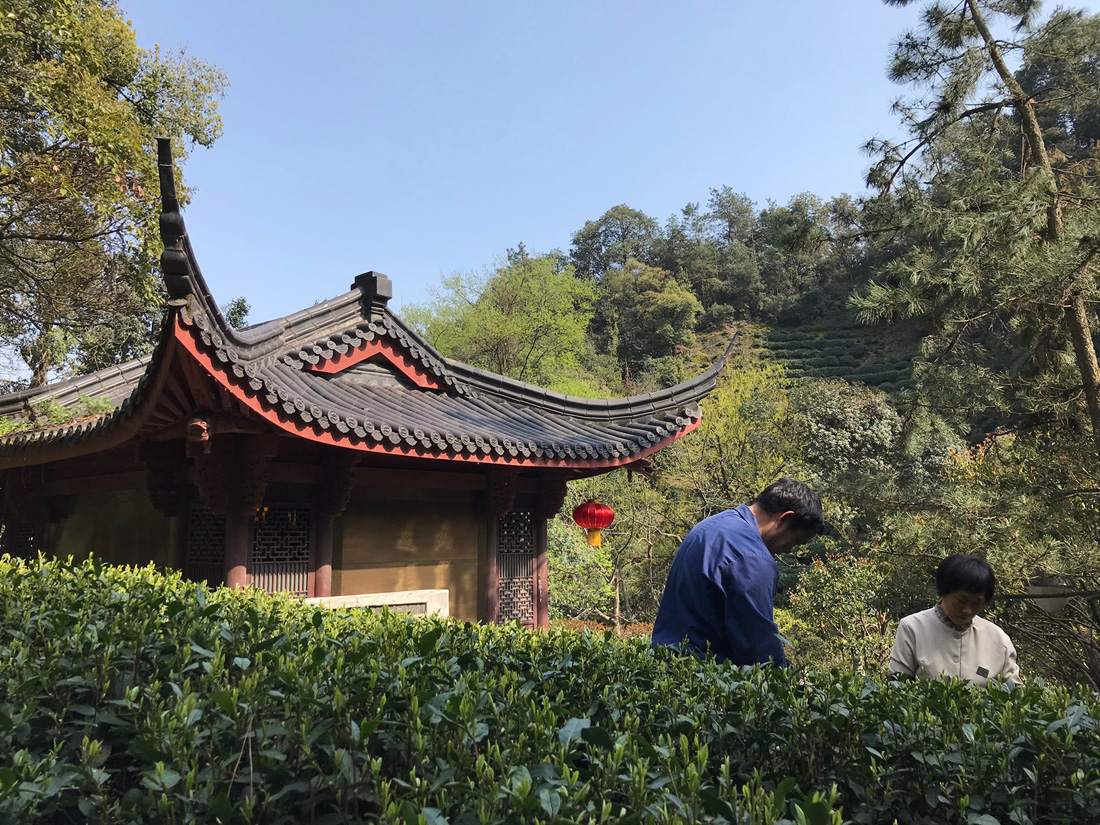
The site is at the upper end of the Longjing Village path, marked with a stone stele and a small pavilion. The 18 bushes themselves are roped off (you can’t get close enough to touch) but the viewpoint and the surrounding old-growth tea terraces are the most atmospheric section of any Longjing-area walk. Plan 20-30 minutes here.
What you’ll see: a flat stone platform, a stone marker that reads “Qianlong Imperial Visit Site” in Chinese, the 18 bushes on a south-facing slope, and an uninterrupted view over the city to the east. The interpretive sign is in Chinese only – bring a translation app if you want the historical context.
How to get there: Walk up from Longjing Village, allow 25-30 minutes from the village entrance. Or take a DiDi directly to “Eight Imperial Tea Bushes” (十八棵御茶) – the road ends at a small parking area 100 meters from the site. The path is partly stone steps; not accessible for wheelchairs.
The China National Tea Museum (中国茶叶博物馆)
The China National Tea Museum has two buildings on Longjing Road, both free, both worth a visit. The museum is the cleanest source of Longjing education in the city and the gift shop is one of the few places that sells verified-genuine Longjing at a reasonable price.
Building 1 (south): tea history and culture. Exhibits cover the origin of Chinese tea drinking, the spread of tea culture to Japan and Korea, and the historical significance of Longjing in particular. Allow 45-60 minutes. Most signage is in Chinese and English.
Building 2 (north): tea production and varieties. More technical, with displays on tea processing, regional varieties, and a working tea-roasting demonstration in the back (10-15 minutes, several times a day, free).
Gift shop: Sells verified 2026 Longjing at 600-1500 RMB for 250g. More expensive than buying direct from a farm but the chain of custody is clear. Best option if you don’t have time to go to a village.
How to get there: Bus 27, 87, or Y2 from the West Lake shore to the Tea Museum stop. Or a 10-minute DiDi from Lingyin Temple. Free entry. Open 8:30 a.m. to 5:00 p.m. (last entry 4:30 p.m.), closed Mondays.
How Longjing Tea Is Made: The Hand-Roasting
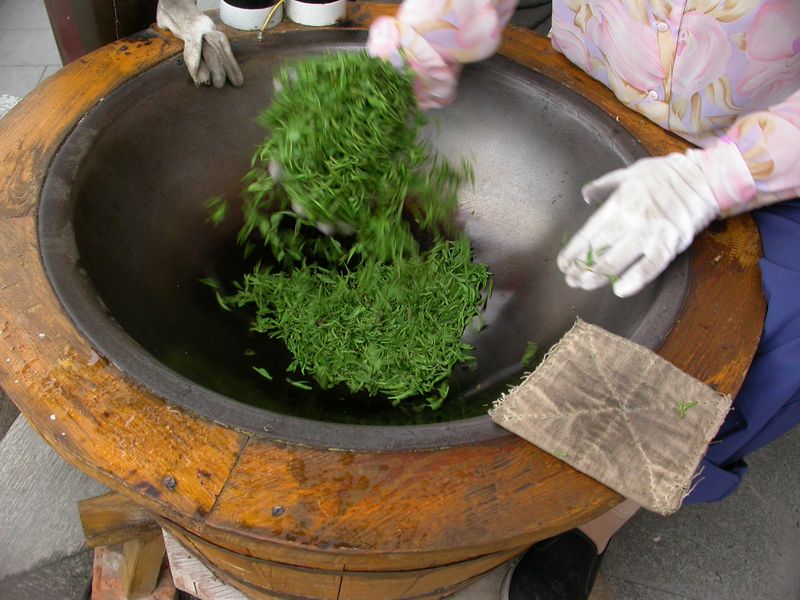
Longjing is a green tea, which means the leaves are not fermented. The processing is de-enzyming (kill-green), shaping, and drying. The hand-shaping step is the part that takes 5+ years to learn: the roaster presses the heated leaves against a curved iron pan with the palm of the hand, gradually flattening them into the characteristic Longjing shape (long, flat, smooth, yellow-green).
The hand-roasting demonstration at the China National Tea Museum (Building 2) runs several times daily, lasts 10-15 minutes, and is free. The roaster works in 200-300g batches, with the pan at 80-100°C. It’s not staged – this is how the village families still process their premium tea, just done at the museum for visitors to see.
The good tea villages (Longjing, Manjuelong, Shili Lang) still hand-roast the premium grade. The standard grade and below is machine-roasted, which produces consistent but less aromatic leaf. The 600+ RMB/250g Longjing you buy direct from a farm is hand-roasted; the 200-300 RMB/250g gift-shop Longjing is machine-roasted and the difference is real.
Tea Grades: What You’re Actually Buying
Longjing is graded by harvest timing and leaf quality. The price difference between grades is significant – 5-10x from the cheapest to the most expensive.
- Ming Qian Longjing (明前龙井, pre-Qingming): Picked before April 4-5. The youngest, most tender leaves. The most expensive grade. 600-1500 RMB / 250g in 2026 for Shi Feng origin.
- Yu Qian Longjing (雨前龙井, pre-rain): Picked before the Plum Rain starts (typically early-to-mid April). Slightly larger leaves, similar flavor profile. 400-800 RMB / 250g. This is the grade most locals buy.
- Summer Longjing (夏茶): Picked in June-August. More astringent, less aromatic. 200-400 RMB / 250g. The supermarket default.
- Autumn Longjing (秋茶): Picked in September-October. Slightly more astringent than spring but still good. 300-500 RMB / 250g. Best for daily drinking.
The grade is not always labeled. A vendor selling “Longjing” at 100 RMB / 250g is selling summer harvest. A vendor selling “Ming Qian Longjing” at 100 RMB / 250g is selling something else entirely – either a different tea, an older harvest, or a different village.
The Village Tea House Experience
The Longjing Village tea houses are a working part of the village economy, not a tourist setup. Every family that has tea fields has a small tea house – 5-15 seats, a few wooden tables, a glass of fresh Longjing set down in front of you. The host will explain the tea (in Chinese, with some basic English), pour water at 80°C (never boiling – boiling water burns the leaves), and leave you to drink.
What to expect: 50-100 RMB per person for 3-4 cups of fresh Longjing in a 30-45 minute session. Most tea houses are open 8 a.m. – 6 p.m. The price is for the tea and the setting, not a guided experience.
Etiquette: sit where you’re directed, don’t bring outside food, ask before taking photos of the host, and if the conversation turns to buying tea, only buy what you actually want to take home. The aggressive sales-pressure reputation is overstated but it does happen in the higher-traffic tea houses on the main village road.
Which tea houses: the ones 200+ meters up from the main village road (away from the parking areas) are quieter and more local. Walk uphill past the first cluster and pick one that looks family-run rather than a tour-group stop.
How to Buy Real Longjing (And Avoid the Fakes)
Three rules that will save you from a bad purchase:
- Buy from a working farm, not a gift shop. A working farm has a tea field visible, a working roaster, and a family that lives on site. A gift shop has plastic display tins and “Imperial Grade” labels. Same tea, 2-3x price difference.
- Ask to see the loose leaf and smell it. Real Longjing has a fresh chestnut-floral aroma. Fakes or older harvest smell grassy or flat. A vendor who won’t open a fresh tin is hiding something.
- Pay 600-1500 RMB / 250g for Ming Qian Longjing in 2026. Anything below 400 RMB / 250g is not Ming Qian, probably not from Shi Feng, possibly not even Longjing. Anything above 2000 RMB / 250g in a village is paying for the tea house experience, not the leaf quality.
Best places to buy direct: Longjing Village, Mei Jia Wu Village, the National Tea Museum gift shop, the China Tea Shop chain (官方店) on Hubin Road. The Hangzhou supermarket chains (Century Mart, RT-Mart) sell machine-roasted summer Longjing at 100-300 RMB / 250g – fine for daily drinking, not the premium grade.
When to Visit: Timing the Harvest
The Longjing area is worth visiting year-round but the timing matters:
- Late March to early April (Ming Qian harvest): Pickers in the fields, you can watch the harvest happen. Tea houses are busy. Most atmospheric visit.
- Mid-April to early May (Yu Qian harvest): Still busy with pickers but the crowds thin out after April 15. Cheaper tea houses.
- June to August (summer): Tea is still produced but the harvest is the lowest grade. The hills are hot and humid. Skip unless you’re combining with another Hangzhou visit.
- Late September to early November (autumn): Cooler, less crowded, the osmanthus (桂花) bloom in Manjuelong is the highlight. Osmanthus-scented Longjing (桂花龙井) is the autumn specialty.
- December to February (winter): Quiet, cold, some tea houses close. The tea terraces are empty. Skip unless you want the off-season calm.
What to Skip
- The “tea ceremony” shows at Hefang Ancient Street: These are tourist demonstrations, not real tea culture. Skip.
- Buying Longjing at the airport: Airport tea is either overpriced or fake. The gift shop tins in the Hangzhou airport duty-free start at 1500 RMB / 250g and the actual content is unverified.
- Longjing tea-flavored ice cream: Sold at the West Lake shore, mostly green tea flavoring with a Longjing label. Not worth the 20-30 RMB.
- The Lingyin Temple tea house: Overpriced, less atmospheric than the village tea houses, and the tea is the same as everywhere else.
Common Mistakes
- Coming to Longjing Village without cash or Alipay. The village tea houses and direct sales are cash or Alipay. Foreign credit cards work at the National Tea Museum but not at family farms.
- Confusing the China Tea Shop chain (中国茶叶) with the China National Tea Museum. The chain stores are commercial, the museum is non-profit. Both sell real Longjing but the museum has the chain-of-custody guarantee.
- Drinking the tea too quickly. A proper Longjing session is 3-4 infusions of the same leaves, each 1-2 minutes. Drinking it as a single cup misses the point.
- Buying “Imperial Grade” (御茶级) without checking the source. The label is meaningless unless it’s backed by a specific producer and harvest date. The 18 Imperial Bushes produce a few hundred grams per year – they’re sold out by April, period.
The Bottom Line
Longjing tea is the only Chinese tea worth a dedicated trip. The protected zone is small, the villages are walkable, the harvest is real, and the difference between the genuine article and the gift-shop version is obvious after one cup. Plan 3-4 hours: walk the village, see the Eight Imperial Bushes, drink at a family tea house, buy direct from a farm. Cost: 100-200 RMB per person for the experience, 600-1500 RMB / 250g for real Shi Feng Ming Qian Longjing to take home.
Total Stats
- Protected Longjing area: 168 sq km, 3 sub-regions, 10 villages
- Ming Qian harvest: late March to April 4-5
- Real Shi Feng Ming Qian price 2026: 600-1500 RMB / 250g
- Tea house session: 50-100 RMB per person, 30-45 min
- National Tea Museum entry: free, closed Mondays
Longjing Tea Plantation Guide 2026: Eight Imperial Bushes, Tea Villages & How to Buy Real Longjing
Updated July 2026 – tea grades, village status, and the National Tea Museum re-checked against 2026 sources.
Longjing (龙井), or Dragon Well, is the most famous Chinese green tea and the reason most visitors come to the western hills of Hangzhou. The real story is more interesting than the marketing: the protected area where genuine Shi Feng Longjing is grown is a 4-square-kilometer zone across 10 villages, the picking is still hand-done in conical hats, the roasting is still done by hand in heated iron pans, and the genuine article is genuinely different from the supermarket version. This is the only place in China where you can walk through working tea fields, see the harvest, watch the roasting, and buy the same tea the Emperor Qianlong drank in 1751.
The bad news: Longjing is the most-faked premium tea in China. Anything labeled “Longjing” in a West Lake gift shop, a Shanghai supermarket, or a Taobao listing is likely from a different province – usually Sichuan or Guizhou – grown to look like Longjing but with weaker flavor. The good news: if you visit the actual villages, the fakes are obvious, and you can buy direct from a working farm at half the gift-shop price.
What “Real” Longjing Means: The Protected Zone
Genuine West Lake Longjing (西湖龙井) comes from a 168-square-kilometer protected zone in the western hills, divided into three sub-regions: Shi Feng (狮峰, Lion Peak), Mei Jia Wu (梅家坞), and Yun Qi (云栖). The Shi Feng sub-region – which includes Longjing Village itself, plus Shili Lang, Jiuxi, and the Lion Peak ridge – is the original and most prestigious. Shi Feng tea has a flatter, more yellow-green leaf and a sweeter, more floral aroma than the other two regions.
The protected designation is enforced: only tea grown in these villages can be labeled “West Lake Longjing.” Tea from the same variety grown in Hangzhou’s other districts is “Qiantang Longjing” (钱塘龙井) – a tier below. Tea grown outside Hangzhou is just “Longjing-style” (龙井茶) and the protected designation doesn’t apply. The price gap between these tiers is 2-5x for comparable quality.
The 10 Tea Villages
Within the Shi Feng and Mei Jia Wu zones, the ten producing villages (from north to south) are: Longjing (龙井村), Shili Lang (十里琅珰), Jiuxi (九溪), Manjuelong (满觉陇), Hupao (虎跑), Yangjiabu (杨家埠), Maojiabu (茅家埠), Lingyin (灵隐), Fajing (法净), and the Mei Jia Wu cluster (梅家坞). Longjing Village itself is the most visited and the most marketed, but the tea is comparable across all ten – some say the Manjuelong and Hupao teas are slightly less sweet because of the lower elevation, but the difference is small enough that a non-expert won’t catch it.
The practical difference between the villages: Longjing Village has more tea houses and direct-sale stalls. Mei Jia Wu is a quieter working village with fewer tourists. Jiuxi is the easiest to reach without a DiDi – it’s on the bus and metro route. Manjuelong is best in late October for the osmanthus fragrance (桂花龙井, a specialty blend).
The Eight Imperial Bushes (十八棵御茶)
The Eight Imperial Bushes (十八棵御茶) are 18 specific ancient tea plants on the south slope of Lion Peak Ridge, planted during the Southern Song dynasty and designated imperial-grade by Emperor Qianlong during his 1751 visit to Hangzhou. They’re a working tea resource, not a museum – the leaves are still picked each spring, processed by hand, and sold in extremely limited quantities (a few hundred grams per year).
The site is at the upper end of the Longjing Village path, marked with a stone stele and a small pavilion. The 18 bushes themselves are roped off (you can’t get close enough to touch) but the viewpoint and the surrounding old-growth tea terraces are the most atmospheric section of any Longjing-area walk. Plan 20-30 minutes here.
What you’ll see: a flat stone platform, a stone marker that reads “Qianlong Imperial Visit Site” in Chinese, the 18 bushes on a south-facing slope, and an uninterrupted view over the city to the east. The interpretive sign is in Chinese only – bring a translation app if you want the historical context.
How to get there: Walk up from Longjing Village, allow 25-30 minutes from the village entrance. Or take a DiDi directly to “Eight Imperial Tea Bushes” (十八棵御茶) – the road ends at a small parking area 100 meters from the site. The path is partly stone steps; not accessible for wheelchairs.
The China National Tea Museum (中国茶叶博物馆)
The China National Tea Museum has two buildings on Longjing Road, both free, both worth a visit. The museum is the cleanest source of Longjing education in the city and the gift shop is one of the few places that sells verified-genuine Longjing at a reasonable price.
Building 1 (south): tea history and culture. Exhibits cover the origin of Chinese tea drinking, the spread of tea culture to Japan and Korea, and the historical significance of Longjing in particular. Allow 45-60 minutes. Most signage is in Chinese and English.
Building 2 (north): tea production and varieties. More technical, with displays on tea processing, regional varieties, and a working tea-roasting demonstration in the back (10-15 minutes, several times a day, free).
Gift shop: Sells verified 2026 Longjing at 600-1500 RMB for 250g. More expensive than buying direct from a farm but the chain of custody is clear. Best option if you don’t have time to go to a village.
How to get there: Bus 27, 87, or Y2 from the West Lake shore to the Tea Museum stop. Or a 10-minute DiDi from Lingyin Temple. Free entry. Open 8:30 a.m. to 5:00 p.m. (last entry 4:30 p.m.), closed Mondays.
How Longjing Tea Is Made: The Hand-Roasting
Longjing is a green tea, which means the leaves are not fermented. The processing is de-enzyming (kill-green), shaping, and drying. The hand-shaping step is the part that takes 5+ years to learn: the roaster presses the heated leaves against a curved iron pan with the palm of the hand, gradually flattening them into the characteristic Longjing shape (long, flat, smooth, yellow-green).
The hand-roasting demonstration at the China National Tea Museum (Building 2) runs several times daily, lasts 10-15 minutes, and is free. The roaster works in 200-300g batches, with the pan at 80-100°C. It’s not staged – this is how the village families still process their premium tea, just done at the museum for visitors to see.
The good tea villages (Longjing, Manjuelong, Shili Lang) still hand-roast the premium grade. The standard grade and below is machine-roasted, which produces consistent but less aromatic leaf. The 600+ RMB/250g Longjing you buy direct from a farm is hand-roasted; the 200-300 RMB/250g gift-shop Longjing is machine-roasted and the difference is real.
Tea Grades: What You’re Actually Buying
Longjing is graded by harvest timing and leaf quality. The price difference between grades is significant – 5-10x from the cheapest to the most expensive.
- Ming Qian Longjing (明前龙井, pre-Qingming): Picked before April 4-5. The youngest, most tender leaves. The most expensive grade. 600-1500 RMB / 250g in 2026 for Shi Feng origin.
- Yu Qian Longjing (雨前龙井, pre-rain): Picked before the Plum Rain starts (typically early-to-mid April). Slightly larger leaves, similar flavor profile. 400-800 RMB / 250g. This is the grade most locals buy.
- Summer Longjing (夏茶): Picked in June-August. More astringent, less aromatic. 200-400 RMB / 250g. The supermarket default.
- Autumn Longjing (秋茶): Picked in September-October. Slightly more astringent than spring but still good. 300-500 RMB / 250g. Best for daily drinking.
The grade is not always labeled. A vendor selling “Longjing” at 100 RMB / 250g is selling summer harvest. A vendor selling “Ming Qian Longjing” at 100 RMB / 250g is selling something else entirely – either a different tea, an older harvest, or a different village.
The Village Tea House Experience
The Longjing Village tea houses are a working part of the village economy, not a tourist setup. Every family that has tea fields has a small tea house – 5-15 seats, a few wooden tables, a glass of fresh Longjing set down in front of you. The host will explain the tea (in Chinese, with some basic English), pour water at 80°C (never boiling – boiling water burns the leaves), and leave you to drink.
What to expect: 50-100 RMB per person for 3-4 cups of fresh Longjing in a 30-45 minute session. Most tea houses are open 8 a.m. – 6 p.m. The price is for the tea and the setting, not a guided experience.
Etiquette: sit where you’re directed, don’t bring outside food, ask before taking photos of the host, and if the conversation turns to buying tea, only buy what you actually want to take home. The aggressive sales-pressure reputation is overstated but it does happen in the higher-traffic tea houses on the main village road.
Which tea houses: the ones 200+ meters up from the main village road (away from the parking areas) are quieter and more local. Walk uphill past the first cluster and pick one that looks family-run rather than a tour-group stop.
How to Buy Real Longjing (And Avoid the Fakes)
Three rules that will save you from a bad purchase:
- Buy from a working farm, not a gift shop. A working farm has a tea field visible, a working roaster, and a family that lives on site. A gift shop has plastic display tins and “Imperial Grade” labels. Same tea, 2-3x price difference.
- Ask to see the loose leaf and smell it. Real Longjing has a fresh chestnut-floral aroma. Fakes or older harvest smell grassy or flat. A vendor who won’t open a fresh tin is hiding something.
- Pay 600-1500 RMB / 250g for Ming Qian Longjing in 2026. Anything below 400 RMB / 250g is not Ming Qian, probably not from Shi Feng, possibly not even Longjing. Anything above 2000 RMB / 250g in a village is paying for the tea house experience, not the leaf quality.
Best places to buy direct: Longjing Village, Mei Jia Wu Village, the National Tea Museum gift shop, the China Tea Shop chain (官方店) on Hubin Road. The Hangzhou supermarket chains (Century Mart, RT-Mart) sell machine-roasted summer Longjing at 100-300 RMB / 250g – fine for daily drinking, not the premium grade.
When to Visit: Timing the Harvest
The Longjing area is worth visiting year-round but the timing matters:
- Late March to early April (Ming Qian harvest): Pickers in the fields, you can watch the harvest happen. Tea houses are busy. Most atmospheric visit.
- Mid-April to early May (Yu Qian harvest): Still busy with pickers but the crowds thin out after April 15. Cheaper tea houses.
- June to August (summer): Tea is still produced but the harvest is the lowest grade. The hills are hot and humid. Skip unless you’re combining with another Hangzhou visit.
- Late September to early November (autumn): Cooler, less crowded, the osmanthus (桂花) bloom in Manjuelong is the highlight. Osmanthus-scented Longjing (桂花龙井) is the autumn specialty.
- December to February (winter): Quiet, cold, some tea houses close. The tea terraces are empty. Skip unless you want the off-season calm.
What to Skip
- The “tea ceremony” shows at Hefang Ancient Street: These are tourist demonstrations, not real tea culture. Skip.
- Buying Longjing at the airport: Airport tea is either overpriced or fake. The gift shop tins in the Hangzhou airport duty-free start at 1500 RMB / 250g and the actual content is unverified.
- Longjing tea-flavored ice cream: Sold at the West Lake shore, mostly green tea flavoring with a Longjing label. Not worth the 20-30 RMB.
- The Lingyin Temple tea house: Overpriced, less atmospheric than the village tea houses, and the tea is the same as everywhere else.
Common Mistakes
- Coming to Longjing Village without cash or Alipay. The village tea houses and direct sales are cash or Alipay. Foreign credit cards work at the National Tea Museum but not at family farms.
- Confusing the China Tea Shop chain (中国茶叶) with the China National Tea Museum. The chain stores are commercial, the museum is non-profit. Both sell real Longjing but the museum has the chain-of-custody guarantee.
- Drinking the tea too quickly. A proper Longjing session is 3-4 infusions of the same leaves, each 1-2 minutes. Drinking it as a single cup misses the point.
- Buying “Imperial Grade” (御茶级) without checking the source. The label is meaningless unless it’s backed by a specific producer and harvest date. The 18 Imperial Bushes produce a few hundred grams per year – they’re sold out by April, period.
The Bottom Line
Longjing tea is the only Chinese tea worth a dedicated trip. The protected zone is small, the villages are walkable, the harvest is real, and the difference between the genuine article and the gift-shop version is obvious after one cup. Plan 3-4 hours: walk the village, see the Eight Imperial Bushes, drink at a family tea house, buy direct from a farm. Cost: 100-200 RMB per person for the experience, 600-1500 RMB / 250g for real Shi Feng Ming Qian Longjing to take home.
Total Stats
- Protected Longjing area: 168 sq km, 3 sub-regions, 10 villages
- Ming Qian harvest: late March to April 4-5
- Real Shi Feng Ming Qian price 2026: 600-1500 RMB / 250g
- Tea house session: 50-100 RMB per person, 30-45 min
- National Tea Museum entry: free, closed Mondays
Longjing Tea Plantation Guide 2026: Eight Imperial Bushes, Tea Villages & How to Buy Real Longjing
Updated July 2026 – tea grades, village status, and the National Tea Museum re-checked against 2026 sources.
Longjing (龙井), or Dragon Well, is the most famous Chinese green tea and the reason most visitors come to the western hills of Hangzhou. The real story is more interesting than the marketing: the protected area where genuine Shi Feng Longjing is grown is a 4-square-kilometer zone across 10 villages, the picking is still hand-done in conical hats, the roasting is still done by hand in heated iron pans, and the genuine article is genuinely different from the supermarket version. This is the only place in China where you can walk through working tea fields, see the harvest, watch the roasting, and buy the same tea the Emperor Qianlong drank in 1751.
The bad news: Longjing is the most-faked premium tea in China. Anything labeled “Longjing” in a West Lake gift shop, a Shanghai supermarket, or a Taobao listing is likely from a different province – usually Sichuan or Guizhou – grown to look like Longjing but with weaker flavor. The good news: if you visit the actual villages, the fakes are obvious, and you can buy direct from a working farm at half the gift-shop price.
What “Real” Longjing Means: The Protected Zone
Genuine West Lake Longjing (西湖龙井) comes from a 168-square-kilometer protected zone in the western hills, divided into three sub-regions: Shi Feng (狮峰, Lion Peak), Mei Jia Wu (梅家坞), and Yun Qi (云栖). The Shi Feng sub-region – which includes Longjing Village itself, plus Shili Lang, Jiuxi, and the Lion Peak ridge – is the original and most prestigious. Shi Feng tea has a flatter, more yellow-green leaf and a sweeter, more floral aroma than the other two regions.
The protected designation is enforced: only tea grown in these villages can be labeled “West Lake Longjing.” Tea from the same variety grown in Hangzhou’s other districts is “Qiantang Longjing” (钱塘龙井) – a tier below. Tea grown outside Hangzhou is just “Longjing-style” (龙井茶) and the protected designation doesn’t apply. The price gap between these tiers is 2-5x for comparable quality.
The 10 Tea Villages
Within the Shi Feng and Mei Jia Wu zones, the ten producing villages (from north to south) are: Longjing (龙井村), Shili Lang (十里琅珰), Jiuxi (九溪), Manjuelong (满觉陇), Hupao (虎跑), Yangjiabu (杨家埠), Maojiabu (茅家埠), Lingyin (灵隐), Fajing (法净), and the Mei Jia Wu cluster (梅家坞). Longjing Village itself is the most visited and the most marketed, but the tea is comparable across all ten – some say the Manjuelong and Hupao teas are slightly less sweet because of the lower elevation, but the difference is small enough that a non-expert won’t catch it.
The practical difference between the villages: Longjing Village has more tea houses and direct-sale stalls. Mei Jia Wu is a quieter working village with fewer tourists. Jiuxi is the easiest to reach without a DiDi – it’s on the bus and metro route. Manjuelong is best in late October for the osmanthus fragrance (桂花龙井, a specialty blend).
The Eight Imperial Bushes (十八棵御茶)
The Eight Imperial Bushes (十八棵御茶) are 18 specific ancient tea plants on the south slope of Lion Peak Ridge, planted during the Southern Song dynasty and designated imperial-grade by Emperor Qianlong during his 1751 visit to Hangzhou. They’re a working tea resource, not a museum – the leaves are still picked each spring, processed by hand, and sold in extremely limited quantities (a few hundred grams per year).
The site is at the upper end of the Longjing Village path, marked with a stone stele and a small pavilion. The 18 bushes themselves are roped off (you can’t get close enough to touch) but the viewpoint and the surrounding old-growth tea terraces are the most atmospheric section of any Longjing-area walk. Plan 20-30 minutes here.
What you’ll see: a flat stone platform, a stone marker that reads “Qianlong Imperial Visit Site” in Chinese, the 18 bushes on a south-facing slope, and an uninterrupted view over the city to the east. The interpretive sign is in Chinese only – bring a translation app if you want the historical context.
How to get there: Walk up from Longjing Village, allow 25-30 minutes from the village entrance. Or take a DiDi directly to “Eight Imperial Tea Bushes” (十八棵御茶) – the road ends at a small parking area 100 meters from the site. The path is partly stone steps; not accessible for wheelchairs.
The China National Tea Museum (中国茶叶博物馆)
The China National Tea Museum has two buildings on Longjing Road, both free, both worth a visit. The museum is the cleanest source of Longjing education in the city and the gift shop is one of the few places that sells verified-genuine Longjing at a reasonable price.
Building 1 (south): tea history and culture. Exhibits cover the origin of Chinese tea drinking, the spread of tea culture to Japan and Korea, and the historical significance of Longjing in particular. Allow 45-60 minutes. Most signage is in Chinese and English.
Building 2 (north): tea production and varieties. More technical, with displays on tea processing, regional varieties, and a working tea-roasting demonstration in the back (10-15 minutes, several times a day, free).
Gift shop: Sells verified 2026 Longjing at 600-1500 RMB for 250g. More expensive than buying direct from a farm but the chain of custody is clear. Best option if you don’t have time to go to a village.
How to get there: Bus 27, 87, or Y2 from the West Lake shore to the Tea Museum stop. Or a 10-minute DiDi from Lingyin Temple. Free entry. Open 8:30 a.m. to 5:00 p.m. (last entry 4:30 p.m.), closed Mondays.
How Longjing Tea Is Made: The Hand-Roasting
Longjing is a green tea, which means the leaves are not fermented. The processing is de-enzyming (kill-green), shaping, and drying. The hand-shaping step is the part that takes 5+ years to learn: the roaster presses the heated leaves against a curved iron pan with the palm of the hand, gradually flattening them into the characteristic Longjing shape (long, flat, smooth, yellow-green).
The hand-roasting demonstration at the China National Tea Museum (Building 2) runs several times daily, lasts 10-15 minutes, and is free. The roaster works in 200-300g batches, with the pan at 80-100°C. It’s not staged – this is how the village families still process their premium tea, just done at the museum for visitors to see.
The good tea villages (Longjing, Manjuelong, Shili Lang) still hand-roast the premium grade. The standard grade and below is machine-roasted, which produces consistent but less aromatic leaf. The 600+ RMB/250g Longjing you buy direct from a farm is hand-roasted; the 200-300 RMB/250g gift-shop Longjing is machine-roasted and the difference is real.
Tea Grades: What You’re Actually Buying
Longjing is graded by harvest timing and leaf quality. The price difference between grades is significant – 5-10x from the cheapest to the most expensive.
- Ming Qian Longjing (明前龙井, pre-Qingming): Picked before April 4-5. The youngest, most tender leaves. The most expensive grade. 600-1500 RMB / 250g in 2026 for Shi Feng origin.
- Yu Qian Longjing (雨前龙井, pre-rain): Picked before the Plum Rain starts (typically early-to-mid April). Slightly larger leaves, similar flavor profile. 400-800 RMB / 250g. This is the grade most locals buy.
- Summer Longjing (夏茶): Picked in June-August. More astringent, less aromatic. 200-400 RMB / 250g. The supermarket default.
- Autumn Longjing (秋茶): Picked in September-October. Slightly more astringent than spring but still good. 300-500 RMB / 250g. Best for daily drinking.
The grade is not always labeled. A vendor selling “Longjing” at 100 RMB / 250g is selling summer harvest. A vendor selling “Ming Qian Longjing” at 100 RMB / 250g is selling something else entirely – either a different tea, an older harvest, or a different village.
The Village Tea House Experience
The Longjing Village tea houses are a working part of the village economy, not a tourist setup. Every family that has tea fields has a small tea house – 5-15 seats, a few wooden tables, a glass of fresh Longjing set down in front of you. The host will explain the tea (in Chinese, with some basic English), pour water at 80°C (never boiling – boiling water burns the leaves), and leave you to drink.
What to expect: 50-100 RMB per person for 3-4 cups of fresh Longjing in a 30-45 minute session. Most tea houses are open 8 a.m. – 6 p.m. The price is for the tea and the setting, not a guided experience.
Etiquette: sit where you’re directed, don’t bring outside food, ask before taking photos of the host, and if the conversation turns to buying tea, only buy what you actually want to take home. The aggressive sales-pressure reputation is overstated but it does happen in the higher-traffic tea houses on the main village road.
Which tea houses: the ones 200+ meters up from the main village road (away from the parking areas) are quieter and more local. Walk uphill past the first cluster and pick one that looks family-run rather than a tour-group stop.
How to Buy Real Longjing (And Avoid the Fakes)
Three rules that will save you from a bad purchase:
- Buy from a working farm, not a gift shop. A working farm has a tea field visible, a working roaster, and a family that lives on site. A gift shop has plastic display tins and “Imperial Grade” labels. Same tea, 2-3x price difference.
- Ask to see the loose leaf and smell it. Real Longjing has a fresh chestnut-floral aroma. Fakes or older harvest smell grassy or flat. A vendor who won’t open a fresh tin is hiding something.
- Pay 600-1500 RMB / 250g for Ming Qian Longjing in 2026. Anything below 400 RMB / 250g is not Ming Qian, probably not from Shi Feng, possibly not even Longjing. Anything above 2000 RMB / 250g in a village is paying for the tea house experience, not the leaf quality.
Best places to buy direct: Longjing Village, Mei Jia Wu Village, the National Tea Museum gift shop, the China Tea Shop chain (官方店) on Hubin Road. The Hangzhou supermarket chains (Century Mart, RT-Mart) sell machine-roasted summer Longjing at 100-300 RMB / 250g – fine for daily drinking, not the premium grade.
When to Visit: Timing the Harvest
The Longjing area is worth visiting year-round but the timing matters:
- Late March to early April (Ming Qian harvest): Pickers in the fields, you can watch the harvest happen. Tea houses are busy. Most atmospheric visit.
- Mid-April to early May (Yu Qian harvest): Still busy with pickers but the crowds thin out after April 15. Cheaper tea houses.
- June to August (summer): Tea is still produced but the harvest is the lowest grade. The hills are hot and humid. Skip unless you’re combining with another Hangzhou visit.
- Late September to early November (autumn): Cooler, less crowded, the osmanthus (桂花) bloom in Manjuelong is the highlight. Osmanthus-scented Longjing (桂花龙井) is the autumn specialty.
- December to February (winter): Quiet, cold, some tea houses close. The tea terraces are empty. Skip unless you want the off-season calm.
What to Skip
- The “tea ceremony” shows at Hefang Ancient Street: These are tourist demonstrations, not real tea culture. Skip.
- Buying Longjing at the airport: Airport tea is either overpriced or fake. The gift shop tins in the Hangzhou airport duty-free start at 1500 RMB / 250g and the actual content is unverified.
- Longjing tea-flavored ice cream: Sold at the West Lake shore, mostly green tea flavoring with a Longjing label. Not worth the 20-30 RMB.
- The Lingyin Temple tea house: Overpriced, less atmospheric than the village tea houses, and the tea is the same as everywhere else.
Common Mistakes
- Coming to Longjing Village without cash or Alipay. The village tea houses and direct sales are cash or Alipay. Foreign credit cards work at the National Tea Museum but not at family farms.
- Confusing the China Tea Shop chain (中国茶叶) with the China National Tea Museum. The chain stores are commercial, the museum is non-profit. Both sell real Longjing but the museum has the chain-of-custody guarantee.
- Drinking the tea too quickly. A proper Longjing session is 3-4 infusions of the same leaves, each 1-2 minutes. Drinking it as a single cup misses the point.
- Buying “Imperial Grade” (御茶级) without checking the source. The label is meaningless unless it’s backed by a specific producer and harvest date. The 18 Imperial Bushes produce a few hundred grams per year – they’re sold out by April, period.
The Bottom Line
Longjing tea is the only Chinese tea worth a dedicated trip. The protected zone is small, the villages are walkable, the harvest is real, and the difference between the genuine article and the gift-shop version is obvious after one cup. Plan 3-4 hours: walk the village, see the Eight Imperial Bushes, drink at a family tea house, buy direct from a farm. Cost: 100-200 RMB per person for the experience, 600-1500 RMB / 250g for real Shi Feng Ming Qian Longjing to take home.
Total Stats
- Protected Longjing area: 168 sq km, 3 sub-regions, 10 villages
- Ming Qian harvest: late March to April 4-5
- Real Shi Feng Ming Qian price 2026: 600-1500 RMB / 250g
- Tea house session: 50-100 RMB per person, 30-45 min
- National Tea Museum entry: free, closed Mondays
Longjing Tea Plantation Guide 2026: Eight Imperial Bushes, Tea Villages & How to Buy Real Longjing
Updated July 2026 – tea grades, village status, and the National Tea Museum re-checked against 2026 sources.
Longjing (龙井), or Dragon Well, is the most famous Chinese green tea and the reason most visitors come to the western hills of Hangzhou. The real story is more interesting than the marketing: the protected area where genuine Shi Feng Longjing is grown is a 4-square-kilometer zone across 10 villages, the picking is still hand-done in conical hats, the roasting is still done by hand in heated iron pans, and the genuine article is genuinely different from the supermarket version. This is the only place in China where you can walk through working tea fields, see the harvest, watch the roasting, and buy the same tea the Emperor Qianlong drank in 1751.
The bad news: Longjing is the most-faked premium tea in China. Anything labeled “Longjing” in a West Lake gift shop, a Shanghai supermarket, or a Taobao listing is likely from a different province – usually Sichuan or Guizhou – grown to look like Longjing but with weaker flavor. The good news: if you visit the actual villages, the fakes are obvious, and you can buy direct from a working farm at half the gift-shop price.
What “Real” Longjing Means: The Protected Zone
Genuine West Lake Longjing (西湖龙井) comes from a 168-square-kilometer protected zone in the western hills, divided into three sub-regions: Shi Feng (狮峰, Lion Peak), Mei Jia Wu (梅家坞), and Yun Qi (云栖). The Shi Feng sub-region – which includes Longjing Village itself, plus Shili Lang, Jiuxi, and the Lion Peak ridge – is the original and most prestigious. Shi Feng tea has a flatter, more yellow-green leaf and a sweeter, more floral aroma than the other two regions.
The protected designation is enforced: only tea grown in these villages can be labeled “West Lake Longjing.” Tea from the same variety grown in Hangzhou’s other districts is “Qiantang Longjing” (钱塘龙井) – a tier below. Tea grown outside Hangzhou is just “Longjing-style” (龙井茶) and the protected designation doesn’t apply. The price gap between these tiers is 2-5x for comparable quality.
The 10 Tea Villages
Within the Shi Feng and Mei Jia Wu zones, the ten producing villages (from north to south) are: Longjing (龙井村), Shili Lang (十里琅珰), Jiuxi (九溪), Manjuelong (满觉陇), Hupao (虎跑), Yangjiabu (杨家埠), Maojiabu (茅家埠), Lingyin (灵隐), Fajing (法净), and the Mei Jia Wu cluster (梅家坞). Longjing Village itself is the most visited and the most marketed, but the tea is comparable across all ten – some say the Manjuelong and Hupao teas are slightly less sweet because of the lower elevation, but the difference is small enough that a non-expert won’t catch it.
The practical difference between the villages: Longjing Village has more tea houses and direct-sale stalls. Mei Jia Wu is a quieter working village with fewer tourists. Jiuxi is the easiest to reach without a DiDi – it’s on the bus and metro route. Manjuelong is best in late October for the osmanthus fragrance (桂花龙井, a specialty blend).
The Eight Imperial Bushes (十八棵御茶)
The Eight Imperial Bushes (十八棵御茶) are 18 specific ancient tea plants on the south slope of Lion Peak Ridge, planted during the Southern Song dynasty and designated imperial-grade by Emperor Qianlong during his 1751 visit to Hangzhou. They’re a working tea resource, not a museum – the leaves are still picked each spring, processed by hand, and sold in extremely limited quantities (a few hundred grams per year).
The site is at the upper end of the Longjing Village path, marked with a stone stele and a small pavilion. The 18 bushes themselves are roped off (you can’t get close enough to touch) but the viewpoint and the surrounding old-growth tea terraces are the most atmospheric section of any Longjing-area walk. Plan 20-30 minutes here.
What you’ll see: a flat stone platform, a stone marker that reads “Qianlong Imperial Visit Site” in Chinese, the 18 bushes on a south-facing slope, and an uninterrupted view over the city to the east. The interpretive sign is in Chinese only – bring a translation app if you want the historical context.
How to get there: Walk up from Longjing Village, allow 25-30 minutes from the village entrance. Or take a DiDi directly to “Eight Imperial Tea Bushes” (十八棵御茶) – the road ends at a small parking area 100 meters from the site. The path is partly stone steps; not accessible for wheelchairs.
The China National Tea Museum (中国茶叶博物馆)
The China National Tea Museum has two buildings on Longjing Road, both free, both worth a visit. The museum is the cleanest source of Longjing education in the city and the gift shop is one of the few places that sells verified-genuine Longjing at a reasonable price.
Building 1 (south): tea history and culture. Exhibits cover the origin of Chinese tea drinking, the spread of tea culture to Japan and Korea, and the historical significance of Longjing in particular. Allow 45-60 minutes. Most signage is in Chinese and English.
Building 2 (north): tea production and varieties. More technical, with displays on tea processing, regional varieties, and a working tea-roasting demonstration in the back (10-15 minutes, several times a day, free).
Gift shop: Sells verified 2026 Longjing at 600-1500 RMB for 250g. More expensive than buying direct from a farm but the chain of custody is clear. Best option if you don’t have time to go to a village.
How to get there: Bus 27, 87, or Y2 from the West Lake shore to the Tea Museum stop. Or a 10-minute DiDi from Lingyin Temple. Free entry. Open 8:30 a.m. to 5:00 p.m. (last entry 4:30 p.m.), closed Mondays.
How Longjing Tea Is Made: The Hand-Roasting
Longjing is a green tea, which means the leaves are not fermented. The processing is de-enzyming (kill-green), shaping, and drying. The hand-shaping step is the part that takes 5+ years to learn: the roaster presses the heated leaves against a curved iron pan with the palm of the hand, gradually flattening them into the characteristic Longjing shape (long, flat, smooth, yellow-green).
The hand-roasting demonstration at the China National Tea Museum (Building 2) runs several times daily, lasts 10-15 minutes, and is free. The roaster works in 200-300g batches, with the pan at 80-100°C. It’s not staged – this is how the village families still process their premium tea, just done at the museum for visitors to see.
The good tea villages (Longjing, Manjuelong, Shili Lang) still hand-roast the premium grade. The standard grade and below is machine-roasted, which produces consistent but less aromatic leaf. The 600+ RMB/250g Longjing you buy direct from a farm is hand-roasted; the 200-300 RMB/250g gift-shop Longjing is machine-roasted and the difference is real.
Tea Grades: What You’re Actually Buying
Longjing is graded by harvest timing and leaf quality. The price difference between grades is significant – 5-10x from the cheapest to the most expensive.
- Ming Qian Longjing (明前龙井, pre-Qingming): Picked before April 4-5. The youngest, most tender leaves. The most expensive grade. 600-1500 RMB / 250g in 2026 for Shi Feng origin.
- Yu Qian Longjing (雨前龙井, pre-rain): Picked before the Plum Rain starts (typically early-to-mid April). Slightly larger leaves, similar flavor profile. 400-800 RMB / 250g. This is the grade most locals buy.
- Summer Longjing (夏茶): Picked in June-August. More astringent, less aromatic. 200-400 RMB / 250g. The supermarket default.
- Autumn Longjing (秋茶): Picked in September-October. Slightly more astringent than spring but still good. 300-500 RMB / 250g. Best for daily drinking.
The grade is not always labeled. A vendor selling “Longjing” at 100 RMB / 250g is selling summer harvest. A vendor selling “Ming Qian Longjing” at 100 RMB / 250g is selling something else entirely – either a different tea, an older harvest, or a different village.
The Village Tea House Experience
The Longjing Village tea houses are a working part of the village economy, not a tourist setup. Every family that has tea fields has a small tea house – 5-15 seats, a few wooden tables, a glass of fresh Longjing set down in front of you. The host will explain the tea (in Chinese, with some basic English), pour water at 80°C (never boiling – boiling water burns the leaves), and leave you to drink.
What to expect: 50-100 RMB per person for 3-4 cups of fresh Longjing in a 30-45 minute session. Most tea houses are open 8 a.m. – 6 p.m. The price is for the tea and the setting, not a guided experience.
Etiquette: sit where you’re directed, don’t bring outside food, ask before taking photos of the host, and if the conversation turns to buying tea, only buy what you actually want to take home. The aggressive sales-pressure reputation is overstated but it does happen in the higher-traffic tea houses on the main village road.
Which tea houses: the ones 200+ meters up from the main village road (away from the parking areas) are quieter and more local. Walk uphill past the first cluster and pick one that looks family-run rather than a tour-group stop.
How to Buy Real Longjing (And Avoid the Fakes)
Three rules that will save you from a bad purchase:
- Buy from a working farm, not a gift shop. A working farm has a tea field visible, a working roaster, and a family that lives on site. A gift shop has plastic display tins and “Imperial Grade” labels. Same tea, 2-3x price difference.
- Ask to see the loose leaf and smell it. Real Longjing has a fresh chestnut-floral aroma. Fakes or older harvest smell grassy or flat. A vendor who won’t open a fresh tin is hiding something.
- Pay 600-1500 RMB / 250g for Ming Qian Longjing in 2026. Anything below 400 RMB / 250g is not Ming Qian, probably not from Shi Feng, possibly not even Longjing. Anything above 2000 RMB / 250g in a village is paying for the tea house experience, not the leaf quality.
Best places to buy direct: Longjing Village, Mei Jia Wu Village, the National Tea Museum gift shop, the China Tea Shop chain (官方店) on Hubin Road. The Hangzhou supermarket chains (Century Mart, RT-Mart) sell machine-roasted summer Longjing at 100-300 RMB / 250g – fine for daily drinking, not the premium grade.
When to Visit: Timing the Harvest
The Longjing area is worth visiting year-round but the timing matters:
- Late March to early April (Ming Qian harvest): Pickers in the fields, you can watch the harvest happen. Tea houses are busy. Most atmospheric visit.
- Mid-April to early May (Yu Qian harvest): Still busy with pickers but the crowds thin out after April 15. Cheaper tea houses.
- June to August (summer): Tea is still produced but the harvest is the lowest grade. The hills are hot and humid. Skip unless you’re combining with another Hangzhou visit.
- Late September to early November (autumn): Cooler, less crowded, the osmanthus (桂花) bloom in Manjuelong is the highlight. Osmanthus-scented Longjing (桂花龙井) is the autumn specialty.
- December to February (winter): Quiet, cold, some tea houses close. The tea terraces are empty. Skip unless you want the off-season calm.
What to Skip
- The “tea ceremony” shows at Hefang Ancient Street: These are tourist demonstrations, not real tea culture. Skip.
- Buying Longjing at the airport: Airport tea is either overpriced or fake. The gift shop tins in the Hangzhou airport duty-free start at 1500 RMB / 250g and the actual content is unverified.
- Longjing tea-flavored ice cream: Sold at the West Lake shore, mostly green tea flavoring with a Longjing label. Not worth the 20-30 RMB.
- The Lingyin Temple tea house: Overpriced, less atmospheric than the village tea houses, and the tea is the same as everywhere else.
Common Mistakes
- Coming to Longjing Village without cash or Alipay. The village tea houses and direct sales are cash or Alipay. Foreign credit cards work at the National Tea Museum but not at family farms.
- Confusing the China Tea Shop chain (中国茶叶) with the China National Tea Museum. The chain stores are commercial, the museum is non-profit. Both sell real Longjing but the museum has the chain-of-custody guarantee.
- Drinking the tea too quickly. A proper Longjing session is 3-4 infusions of the same leaves, each 1-2 minutes. Drinking it as a single cup misses the point.
- Buying “Imperial Grade” (御茶级) without checking the source. The label is meaningless unless it’s backed by a specific producer and harvest date. The 18 Imperial Bushes produce a few hundred grams per year – they’re sold out by April, period.
The Bottom Line
Longjing tea is the only Chinese tea worth a dedicated trip. The protected zone is small, the villages are walkable, the harvest is real, and the difference between the genuine article and the gift-shop version is obvious after one cup. Plan 3-4 hours: walk the village, see the Eight Imperial Bushes, drink at a family tea house, buy direct from a farm. Cost: 100-200 RMB per person for the experience, 600-1500 RMB / 250g for real Shi Feng Ming Qian Longjing to take home.
Total Stats
- Protected Longjing area: 168 sq km, 3 sub-regions, 10 villages
- Ming Qian harvest: late March to April 4-5
- Real Shi Feng Ming Qian price 2026: 600-1500 RMB / 250g
- Tea house session: 50-100 RMB per person, 30-45 min
- National Tea Museum entry: free, closed Mondays