Getting Around Hangzhou: Metro, Bike, DiDi, and Walking
Updated July 2026 — metro line changes, DiDi setup tips, and bike-rental apps verified.
Hangzhou is one of the easiest Chinese cities to navigate as a visitor. The central area is flat, the metro is clean and modern, the public bike system is famous across China, and ride-hailing works seamlessly once you have the apps set up. You can cover the main tourist sites (West Lake, Lingyin Temple, Hefang Street, the tea fields) without ever needing a taxi — as long as you understand how the pieces fit together.
This guide covers every realistic way to get around Hangzhou, the apps you’ll need, what each costs, and the routes that actually work for the main sights.
At a Glance: How to Get From A to B
| Trip | Best option | Time | Cost |
|---|---|---|---|
| Hangzhou East Station to West Lake | Metro Line 1 + walk | 30 min | ¥3-4 |
| Hangzhou Xiaoshan Airport to city center | Metro Line 1 or Airport Express | 45-60 min | ¥8-9 |
| West Lake to Lingyin Temple | Bus 7 or DiDi | 30 min | ¥2-25 |
| West Lake to Longjing Tea Village | Bus 27 or DiDi | 25-30 min | ¥2-25 |
| West Lake to Hefang Street | Walk or short DiDi | 15-25 min | ¥0-15 |
| Around West Lake itself | Public bike or walk | 2-4 hours | ¥0-2 |
| Hangzhou to Wuzhen day trip | Tourist bus or train + transfer | 1.5-2 hours | ¥60-150 |
The Metro: Clean, Cheap, and English-Friendly
Hangzhou’s metro is the fastest way to cover longer distances. As of mid-2026 there are 12 operating lines, with more under construction. For tourists, the relevant lines are:
- Line 1 (red): runs east-west from Hangzhou East Railway Station through the city center (near West Lake) and on to the airport. This is the line you’ll use most.
- Line 2 (orange): runs north-south, useful for getting to the High-Speed Rail Station and some southern hotels.
- Line 3, 4, 5, 10: connecting lines that mostly matter for residents but occasionally useful for specific destinations.
- Line 7: connects to Lingyin Temple area via Longxiangqiao station, then a 10-minute walk or short bus.
How to ride the metro
Buying tickets: use the ticket machines at any station. They have an English button at the top right of the screen. Tap your destination, insert cash (¥5, ¥10, ¥20 notes or ¥1 coins), get a green plastic token. Tap the token at the entry gate, drop it in the slot at the exit gate when you leave. Fares are ¥2-9 depending on distance.
Paying with your phone: this is what locals do, and it works with foreign cards now. Set up one of these before you arrive:
- Alipay: open the app, go to “Transport” (出行), tap “Hangzhou Metro”, scan the QR code at the gate. Foreign Visa, Mastercard, and JCB cards work directly in Alipay with no Chinese bank account needed.
- WeChat: similar setup under “Services” → “Travel” or via the “WeChat Pay HK” mini-program. Foreign cards accepted.
- UnionPay: tap-to-pay works at gates marked with the UnionPay logo if your card has a contactless symbol.
Once set up, you just walk through the gates — no ticket, no line, no fumbling with cash.
Metro etiquette and rules
- Security check at every station. Bags go through an x-ray, no exceptions. Avoid bringing large knives, lighters, or pressurised containers.
- No eating or drinking. Even water bottles should be closed and out of sight. Fines up to ¥200.
- Stand right on escalators. Locals stand on the right and walk on the left on escalators. Follow the flow.
- Priority seats. The seats at the ends of each car are reserved for elderly, pregnant, or disabled passengers. Even if the train is full, locals will not sit there.
- English announcements. Every stop is announced in Mandarin and English. The in-train LED display also cycles through Chinese, English, and the next stop.
Stops you’ll actually use
- Longxiangqiao (龙翔桥): Line 1, exits right at the southeast corner of West Lake. Most central for the lake.
- Dingan Road (定安路): Line 1, walkable to Hefang Street and the southern lakeshore.
- Wulin Square (武林广场): Line 1, downtown commercial area, lots of hotels.
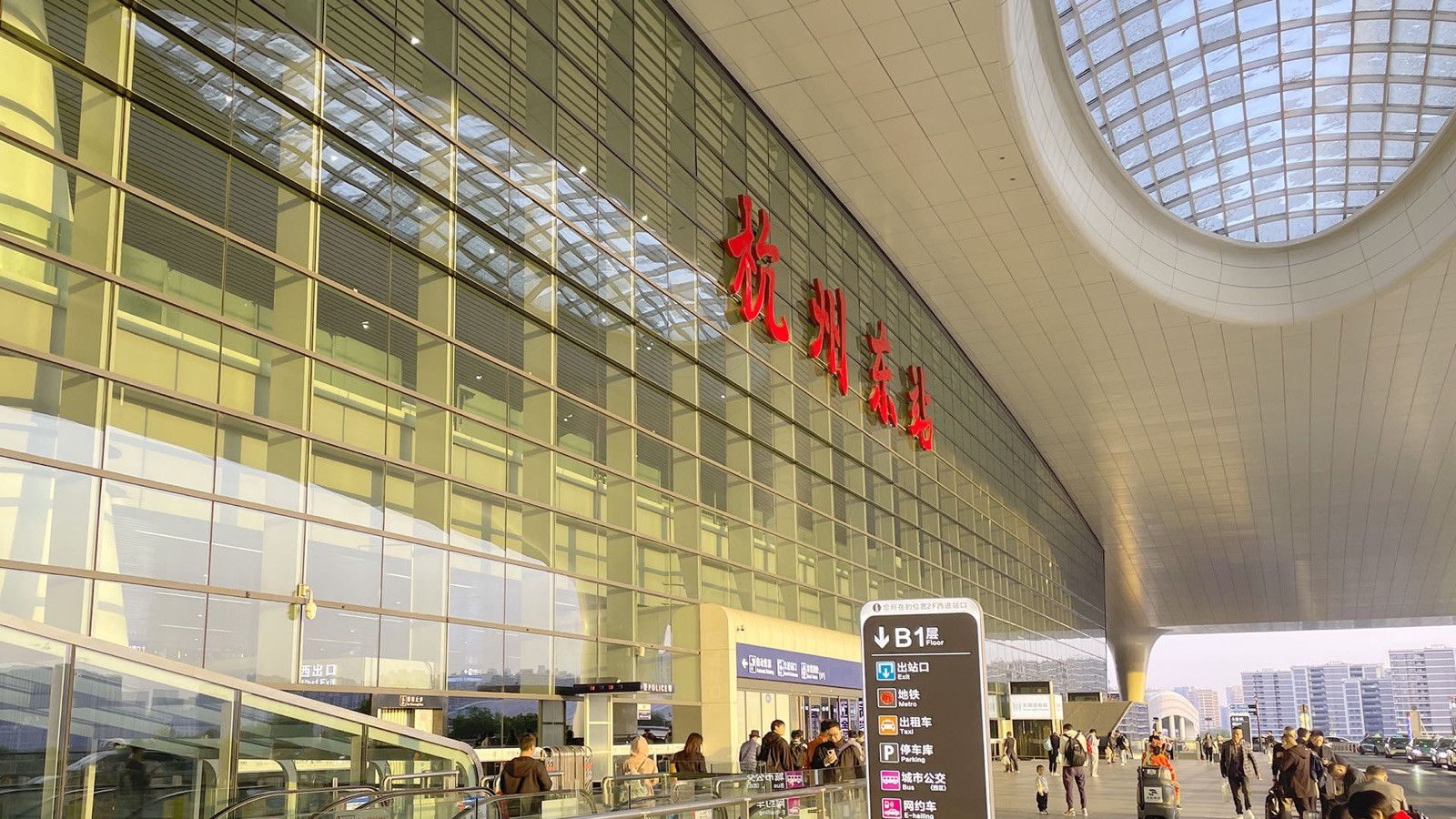
- Hangzhou East Station (火车东站): Line 1 and Line 4, the main bullet train station.
- Hangzhou Railway Station (城站): Line 1, the older central station, still used for some trains.
- East Railway Station South (火车东站南): Line 4, for the south square of East Station.
Public Bikes: Hangzhou’s Signature Way to See West Lake
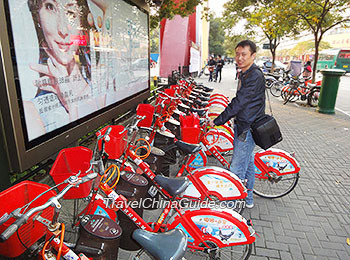
Hangzhou has one of the oldest and best public bike systems in the world. The current system is run by Meituan Bike (the green bikes) and HelloRide (the blue bikes), and they have thousands of stations plus GPS-locked bikes you can leave anywhere. Riding around the West Lake loop on a public bike is one of the most enjoyable ways to see the city.
How to rent a bike
Option 1: Meituan Bike (recommended for tourists)
- Open the Meituan app (download before you arrive, or get it from the App Store / Google Play — works internationally).
- Add a foreign Visa, Mastercard, or JCB card to the in-app wallet.
- Scan the QR code on the bike’s handlebar with the app.
- The bike unlocks. Ride it. Park it. Lock it manually when you finish.
Option 2: HelloRide (more English-friendly interface)
- Download the HelloRide app or use the Hello Inc. mini-program inside Alipay.
- Add a foreign card to the wallet.
- Scan the bike’s QR code, ride, lock.
Pricing: ¥1.5 for the first 15 minutes, then ¥0.5 per additional 15-minute block. Most West Lake loops take 1.5-2.5 hours and cost ¥4-6 total. The system caps at ¥10 per day, so a full day of bike-riding won’t run away with your budget.
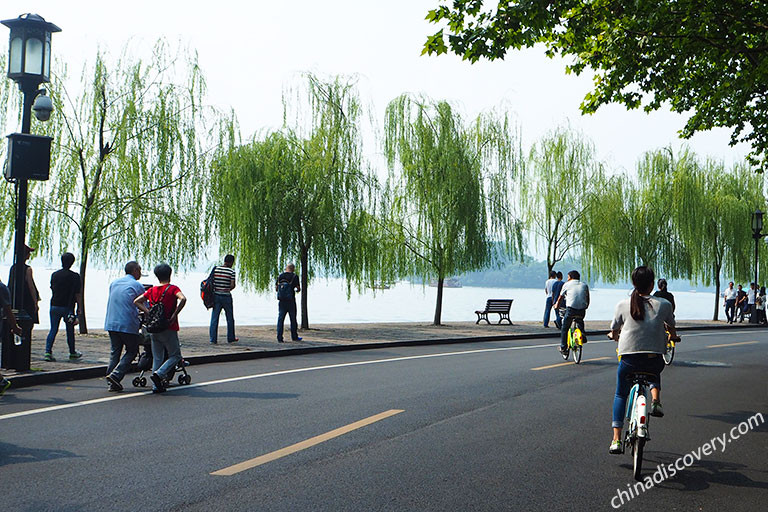
Where the bike paths are: the entire perimeter of West Lake has a dedicated bike-and-pedestrian path separated from car traffic. The path is well-marked, well-maintained, and goes through 90% of the lakeside sights. Avoid riding the section between Beishan Road and the Su Causeway on weekend afternoons — it gets very crowded with both cyclists and pedestrians.
Bike routes tourists love
- Full West Lake loop (15 km, 2-3 hours): flat, paved the whole way, passes all ten “Ten Scenes” of West Lake. Start at the Music Fountain plaza and go counterclockwise (less crowded direction).
- Su Causeway only (3 km, 30-40 min one way): the most photographed causeway. Best at sunrise or late afternoon.
- Beishan Road (3 km, 30-40 min one way): the quieter north shore with the tallow trees in autumn and several small temples and historical houses.
- Grand Canal bike path (10 km round trip from Wulin Gate): flat and scenic, runs along the UNESCO World Heritage canal with several historic bridges.
DiDi: When You Need a Car
DiDi is China’s Uber. It’s cheap, reliable, and the easiest way to get from the metro to a specific hotel, or to reach places the metro doesn’t cover (Lingyin Temple, Longjing Village, Liuhe Pagoda). Most drivers don’t speak English, but the app handles everything via GPS and the destination is pre-set, so you don’t need to talk.
How to use DiDi as a foreigner
- Download the DiDi app (international version: “DiDi” with the orange logo, not the Chinese-only version).
- Add a foreign Visa, Mastercard, or JCB card. The app fully supports international cards as of 2024.
- Type your destination in English (or paste a Chinese address — the app handles both).
- Choose your service tier:
- Express (快车): 4-seat sedan, cheapest, most common. ¥15-30 for most tourist trips.
- Premier (优享): nicer cars, slightly more expensive, ¥25-45 for tourist trips.
- Taxi (出租车): metered Hangzhou taxis, same price as Express.
- Wait for the driver. The app shows the license plate, driver’s name, and car model. Match all three before getting in.
Realistic fares for tourists: airport to West Lake area ¥70-100, West Lake to Lingyin Temple ¥20-30, West Lake to Longjing Village ¥20-30, evening 20-minute trip across the city ¥25-40. You will not need a taxi more than 2-3 times per day in Hangzhou, so the daily transport budget is genuinely low.
DiDi etiquette
- The driver will call or message if they can’t find you. The app translates the message into your language automatically — tap the chat icon to see the translation.
- You don’t tip in China. The fare is the fare.
- Always buckle up. The back seat has seatbelts but most locals don’t use them; you should.
- If you leave something in the car, the app has a “lost and found” link that contacts the driver directly. They almost always return it for free.
Walking: The Best Mode for the Center
Hangzhou’s central area is genuinely walkable. The entire south and east sides of West Lake are pedestrian-only, and most of the points of interest in the city center cluster within a 2-3 km radius. Hefang Street, the Song Dynasty Imperial Street, the southern lakeshore, Liuhe Pagoda, and the Broken Bridge area are all easily combined on foot.
The main walking routes tourists love:
- Su Causeway (3 km one way): the most famous West Lake walk, lined with willows and peach trees.
- Hefang Street to Qinghefang Old Street (1.5 km): historic shopping street, mostly pedestrian, lots of tea shops and snack stalls.
- Nanshan Road (3 km): the south shore of West Lake, quieter than the Su Causeway, with several smaller temples and pavilions.
- Grand Canal cultural corridor (4 km): along the historic canal from Wulin Gate to the Gongchen Bridge, with museums, tea houses, and old warehouses converted to shops.
Taxis: Still an Option, but Slower than DiDi
You can hail a taxi on the street in Hangzhou, but most drivers only speak Chinese and you’ll need to know your destination in characters or show a map. The cars are red with a green-roof light on top. Meters start at ¥11 (¥12 at night, 11 p.m. to 5 a.m.), and most tourist trips cost ¥20-50.
For most tourists, DiDi is faster, easier, and sometimes cheaper than hailing. Use a regular taxi only if you can’t get a DiDi (rare except during rush hour or bad weather).
How to Get to Wuzhen for a Day Trip
Wuzhen is the most popular day trip from Hangzhou. Two options:
Option 1: Tourist bus (easiest) — the Hangzhou Tourism Distribution Center near West Lake runs direct buses to Wuzhen daily at 8:00, 9:00, and 10:00 a.m. The bus takes 1.5-2 hours, drops you at the Wuzhen entrance, and returns at 3:00 and 4:00 p.m. Round-trip fare is ¥130-180 depending on the season. Buy tickets the day before at the center (cash or Alipay).
Option 2: Train + DiDi (cheaper, more flexible) — take a high-speed train from Hangzhou East to Tongxiang Station (25 minutes, ¥30-40), then a DiDi to Wuzhen (20 minutes, ¥40-50). Total round trip ¥140-180 but you control your schedule.
Apps to Install Before You Arrive
Set these up before you leave home, ideally with your card added:
- Alipay — metro, bike, DiDi, and most payments.
- DiDi (international version) — ride-hailing.
- Meituan — bikes, food delivery, attraction tickets.
- HelloRide — alternative bike app, useful if Meituan doesn’t have bikes nearby.
- Apple Maps or Google Maps — both work in Hangzhou for walking, cycling, and metro directions. Google Maps requires a VPN in mainland China but works for trip planning before/after your trip.
- Translate app — Apple’s built-in Translate or Google Translate both have Chinese ↔ English text and voice translation. Useful for taxis, restaurants, and asking for help.
The Bottom Line
You can do 90% of a Hangzhou trip using the metro, public bikes, and walking. Add DiDi for the days you want a car (Lingyin Temple, Longjing Village, evening plans, or airport). Skip regular taxis. Install Alipay and DiDi before you arrive, add your foreign card, and you’ll move through the city like a local. The total daily transport cost for a moderate tourist is ¥20-40 — about the price of a coffee back home.