
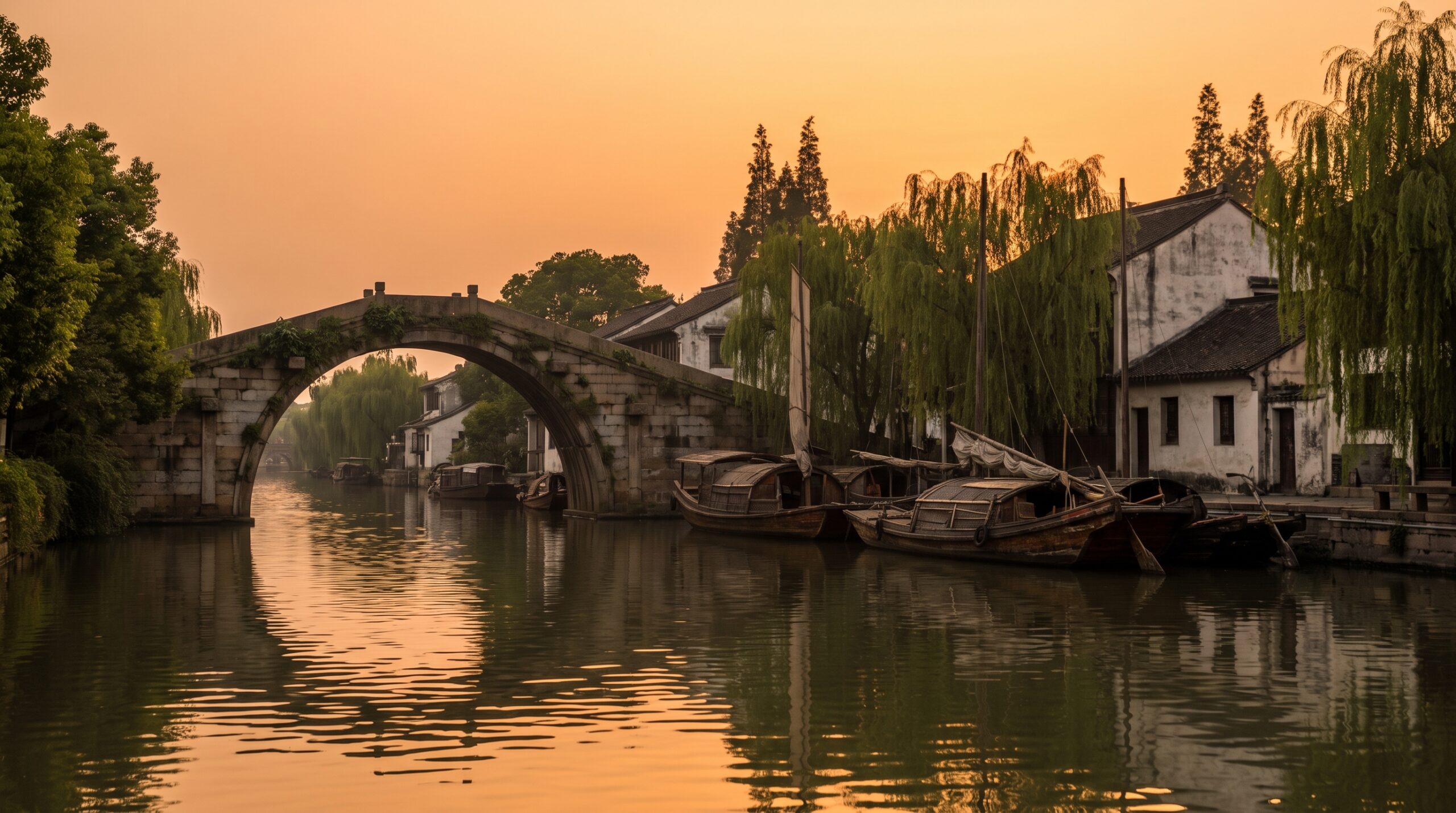
The Beijing-Hangzhou Grand Canal is the oldest and longest artificial waterway in the world — 1,794 km, dug in sections from the 5th century BC and linked together under the Sui dynasty emperor Yang Guang in 610 AD. UNESCO added it to the World Heritage list in 2014, and the Hangzhou section is the southern end. Most travelers never see it, which is a mistake: the canal in Hangzhou is short, walkable, and unlike anything else in the city.
This guide covers the part of the canal that’s actually in Hangzhou (the last 100 km or so of the whole waterway), the historic bridges and warehouses that survived modernization, the working barges still hauling construction material, the night boat ride, and how to combine the canal with West Lake, the Hefang Ancient Street, and the Wulin Square area on a single afternoon.
The Hangzhou Section of the Grand Canal
The Grand Canal enters Hangzhou from the north, loops through the Gongshu district, passes the Wulin Square area, and ends at the Xiangji Temple basin near the city’s southwest corner. The walkable, scenic part runs from the Grand Canal Cultural Square (运河文化广场) in the north to the Xiangji Temple (香积寺) in the south, about 6 km. Most of it is paved riverside path with intermittent heritage markers.
This is not West Lake. The canal is working infrastructure: the barges still carry sand and steel, the warehouses are now restaurants and galleries, the bridges are still load-bearing. The vibe is industrial, real, and a hundred years off the polished tourist trail. If West Lake is Hangzhou’s postcard, the canal is Hangzhou’s working life.
The Five Bridges and What to See at Each
Six bridges span the canal in central Hangzhou. Each is different, and the riverside path passes all of them in a north-to-south walk.
- Gongchen Bridge (拱宸桥) at the north end is the oldest, built in 1631, with a single high stone arch that locals have walked across for 400 years. The bridgehead is the most-photographed canal spot in the city. Below the bridge is the Canal Museum (中国京杭大运河博物馆) — free, well-presented, gives the whole 1,700-year history in about 90 minutes.
- Wenhua Bridge (文化桥) a few hundred meters south is unremarkable on its own, but the eastern bank here holds the Hangzhou Knife, Scissors, and Sword Museum (中国刀剪剑博物馆) — three connected museums in restored Qing-era warehouses. Free, almost never crowded.
- Chaoyang Bridge (朝阳桥) is a modern pedestrian bridge. Skip unless you’re continuing the walk.
- Zhaohui Bridge (潮汇桥) marks the boundary of the older, restored canal-side district. The west bank here is the Qiaoxi Historic Block (桥西历史街区) — small lanes with Qing-era houses now converted to teahouses, antique shops, and a couple of small museums (the Umbrella Museum, the Fan Museum).
- Wulin Bridge (武林桥) is right next to Wulin Square, the city’s main commercial crossroads. The contrast — the working canal under a six-lane overpass — is jarring and worth seeing once.
- Wantang Bridge (望堂桥) is the southernmost and the gateway to the Xiangji Temple basin.
The whole 6 km north-to-south walk takes 90 minutes at a relaxed pace with stops, half a day if you go inside the museums.
The Xiangji Temple and the Canal’s End
Xiangji Temple (香积寺) is a Tang-dynasty Buddhist temple at the southern terminus of the Hangzhou canal section. The current buildings were reconstructed in the 2000s but follow the original Tang layout, and the stone pagoda at the back is genuinely old. The temple is small, the entry is free, and the side halls hold a small but interesting exhibition on canal trade. Plan 30-45 minutes.
Adjacent to the temple is a small canal basin where the working barges tie up overnight. You will see them here — squat wooden boats, many decades old, sometimes loaded with sand from upriver, sometimes empty. Photography is fine but stay on the public path. The canal is still a navigable waterway and the boatmen work here.
From Xiangji Temple, you can walk another 30 minutes south to the Jinghang Grand Canal terminal marker (京杭大运河终点标志) at the boundary of the old and new canals. It’s a small monument, easy to miss, and the only marker of the southern end of the longest canal in the world.
The Night Cruise
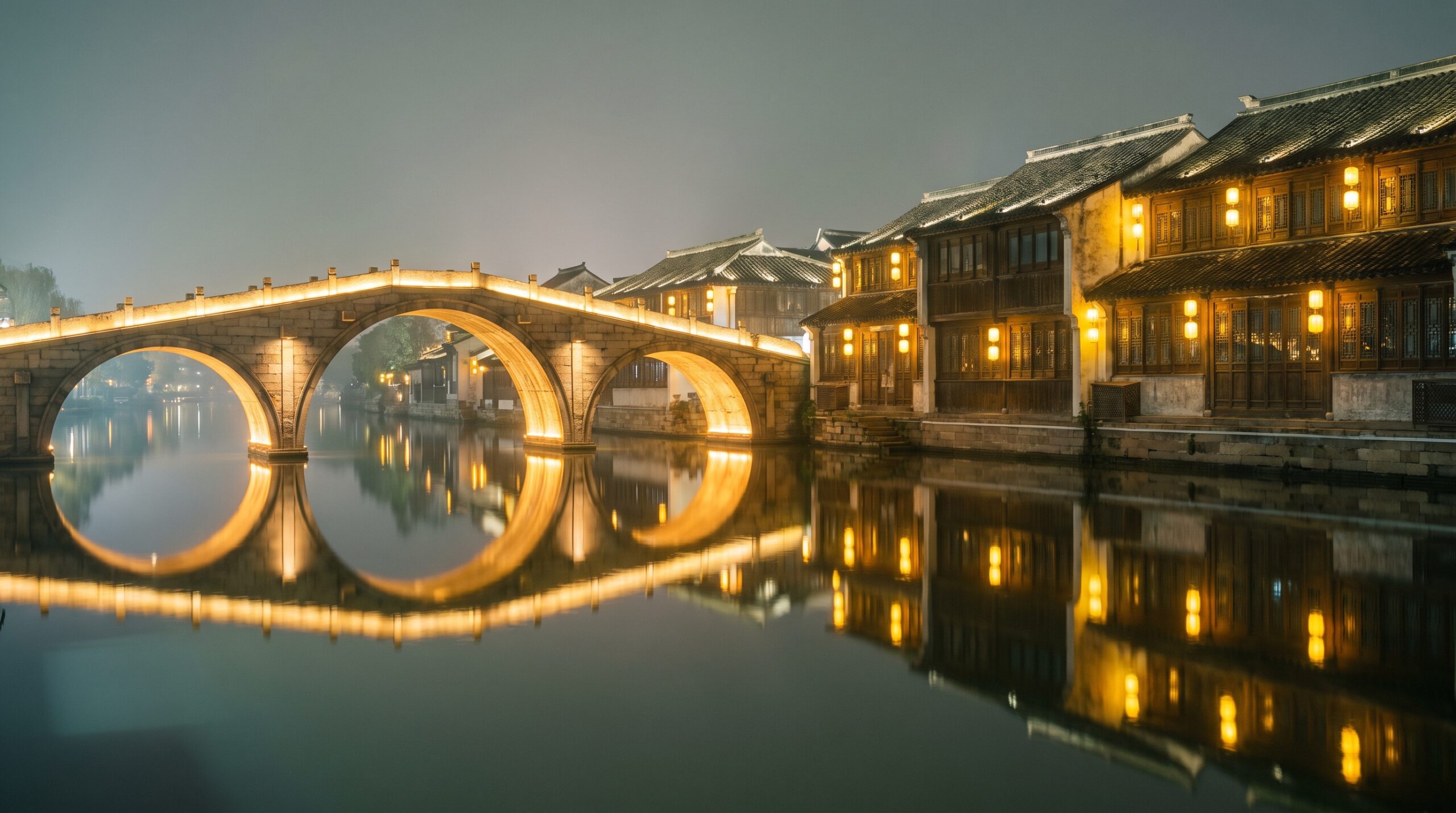
The Grand Canal night cruise (运河夜游) runs from the Gongchen Bridge area, takes about 50 minutes, and gives a totally different view of the canal than the daytime walk. The boats are covered, the bridges are lit, and the working warehouses are framed against the city lights. Tickets are 80-120 yuan per person, bookable through the canal cruise website or any hotel concierge.
There are two departures a night, usually 19:00 and 20:30, and the boat holds about 50 people. The 19:00 departure catches the last of the dusk light, the 20:30 is fully dark. Pick the 19:00 if you want to see the bridges, the 20:30 if you want to see the lit warehouse facades.
The cruise is best combined with dinner in the Qiaoxi historic block — a small restaurant called Zhi Wei Xuan (知味观) in the block serves the canal-side version of the city’s classic Dongpo pork, slow-braised for 6 hours, and it’s the most authentic version of the dish in town. Expect a 30-40 minute wait at dinner peak.
Combining the Canal with Hefang Street and Wulin Square
The canal sits in the geographic middle of three of Hangzhou’s most-visited areas: Hefang Ancient Street to the south, West Lake to the west, and Wulin Square to the east. A logical day combining them:
- Morning: Canal walk from Gongchen Bridge south to Xiangji Temple (3 hours including museums).
- Lunch: Qiaoxi historic block, Zhi Wei Xuan or one of the smaller canal-side restaurants.
- Afternoon: Metro or DiDi from the canal to Hefang Ancient Street (15 minutes). Walk the street, the night market, and the adjoining Dingan Road district.
- Evening: Canal night cruise, starting at Gongchen Bridge (10 minutes from Hefang by DiDi). Or skip the cruise and eat dinner at Wulin Square instead.
For a slower version that gives the canal a full day, the Hangzhou 1-day walking route weaves the canal, West Lake, and Hefang into a single 12 km loop that starts at the canal museum and ends at the Broken Bridge.
Getting There and Getting Around
The canal is not on a metro line, but the south end is a 10-minute walk from Xiangji Temple station (香积寺路站) on Line 3. The north end is reached by bus or DiDi — the closest metro station is Datieguan (打铁关) on Line 1, about 1.5 km from Gongchen Bridge.
Driving in this area is not recommended: the one-way system around the Qiaoxi historic block is confusing and parking is expensive. DiDi to the canal museum, walk south, DiDi home is the easiest pattern.
If you only have time for one piece of the canal, the Gongchen Bridge to Qiaoxi historic block section (about 2 km, 90 minutes including the Canal Museum) is the most concentrated and the easiest to fit into a half-day.
What to Skip
The “Grand Canal Cultural Square” at the very north is a modern plaza with a giant stone sculpture of a canal boat — it’s the default photo background for tour groups, but the plaza itself is a five-minute walk and the sculpture is unremarkable. The pedestrian shopping streets between Gongchen Bridge and Wulin Square are mostly chain retail. The Canal Cruise during the day is fine but not as atmospheric as the night version.
The Canal Museum is worth the time. The Knife-Scissors-Sword museum complex is worth 30-45 minutes if you have any interest in the tools. The Umbrella Museum and Fan Museum are small and skippable unless their specific topic appeals.
The Grand Canal is Hangzhou’s underrated second story — the working, lived-in, 1,400-year-old waterway that the city is built on. Give it a half-day at minimum, and you’ll see a side of Hangzhou that most visitors never do. For the broader Hangzhou context, the main guide covers how the canal fits into the city’s full layout.