Lingyin Temple: The Complete Guide for Foreign Visitors (2026)
Updated July 2026 — admission prices, opening hours, and best visit times verified.
Lingyin Temple (灵隐寺, “Temple of the Soul’s Retreat”) is the most important Buddhist temple in Zhejiang province and one of the four great Zen monasteries in China. Founded in 326 AD by an Indian monk named Huili, it is a working temple with active monks, real incense, and 1,700 years of continuous practice. Foreign visitors who skip it miss the single most spiritually significant place in Hangzhou.
This guide covers the history, the architecture, what each hall contains, how to behave respectfully, and how to combine the visit with the adjacent Feilai Peak (飞来峰) stone carvings, which are part of the same combined ticket. For more on how Lingyin fits into a longer Hangzhou trip, our 3-day Hangzhou itinerary and 5-day Hangzhou + Wuzhen itinerary both include a full Lingyin morning.
Before You Go: The Practical Basics
Location and how to get there
Lingyin Temple sits in the foothills of the northern mountains, about 5 km west of West Lake. It is not walkable from the lake (it’s a 90-minute walk through suburban traffic) but easy to reach:
- Taxi / DiDi — 25 minutes from anywhere near West Lake, ¥30-50. The most common option for foreign visitors.
- Bus — Bus 7 or 324 from the city center, 30-45 minutes, ¥2. The bus is fine but the temple is in the suburbs and the walk from the bus stop to the entrance is 10 minutes.
- Bike — rentable in the city, 30-40 minutes ride including some hill climbing. Doable if you’re reasonably fit; not recommended in the heat of summer.
Opening hours and admission
Lingyin Temple is open 7:00 AM to 6:30 PM daily, last entry at 6:00 PM. The combined Lingyin + Feilai Peak ticket is ¥75 (about $10). The Lingyin-only ticket (if you don’t want the Feilai carvings) is ¥30.
The best time to arrive is 8:00 AM, right when it opens. The morning light is good, the morning chanting is happening (you can usually hear it from the main courtyard), and you will beat the tour bus crowds that arrive after 10 AM.
Avoid weekends and Chinese public holidays (especially Lunar New Year, Qingming, and the first and fifteenth days of each lunar month, which are Buddhist holy days that draw huge local crowds).
Dress code and what to bring
Lingyin is a working religious site, not a museum. Modest dress is required — shoulders and knees covered. If you forget, the temple rents wraps at the entrance for a small donation (¥10).
Bring small bills and coins for incense, donations, and the vegetarian lunch. Bring water in summer. Wear comfortable shoes — there are stairs and uneven ground in the side halls. Photography is allowed in the courtyards but not in the main halls with active Buddha statues; respect the posted signs.
History: 1,700 Years in 5 Minutes
Lingyin was founded in 326 AD by the Indian monk Huili (慧理), who according to tradition was drawn to the West Lake foothills by the presence of a “hidden spirit.” He declared that the surrounding peaks had flown from India to be near this spiritually charged site, and named the temple Lingyin — “Temple where the soul takes refuge.”
The temple grew through the Tang and Song dynasties, reaching its peak in the Southern Song period (1127-1279) when Hangzhou was the imperial capital. At that point Lingyin had nine multi-story halls, 3,000 monks, and 70+ branch temples in the surrounding mountains. It was the spiritual center of southern Chinese Buddhism.
It was destroyed and rebuilt many times. The most significant destruction was in 1913, when the main halls were burned during the warlord era, and again during the Cultural Revolution in the 1960s when many statues and texts were damaged. The current buildings are largely Song and Qing dynasty reconstructions, restored between 1949 and 2010.
The single most important relic is the 20-meter Shakyamuni statue in the Great Hall, carved in 1956 from 24 pieces of camphor wood. At the time of its installation it was the largest wooden Buddhist statue in the world, and it remains one of the largest wooden Buddhist statues in China.
The Main Complex: Hall by Hall
Lingyin is laid out along a north-south axis on a hillside. You enter from the south, climb gradually, and exit at the north into Feilai Peak. The main halls, in order:
1. Hall of the Four Heavenly Kings (天王殿)
The first hall, with the large smiling Maitreya (the “laughing Buddha”) in the center and the four guardian kings facing the four cardinal directions. The Maitreya statue here is unusual — a 1932 piece carved from a single camphor tree. The face is the one you see in almost every photograph of Lingyin, so start here.
2. Great Hall of the Buddha (大雄宝殿)
The spiritual heart of Lingyin. The 20-meter Shakyamuni statue sits on a lotus throne in the center, flanked by disciples and the Twenty Devas. The hall was rebuilt in 1956 with steel reinforcement to support the wooden statue. Stand in the back of the hall for a few minutes — the scale is genuinely humbling.
3. Hall of the Medicine Buddha (药师殿)
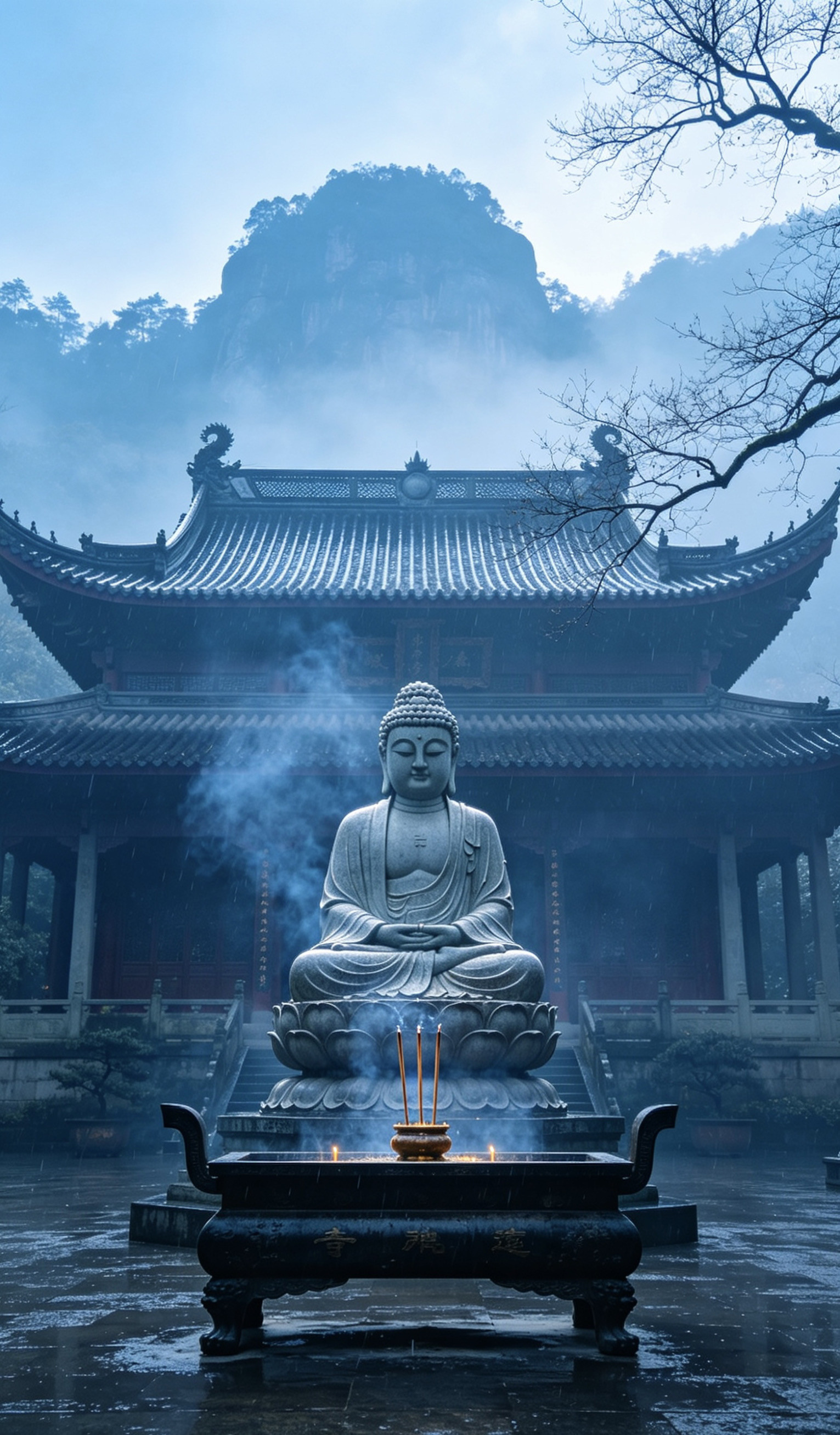
Behind the Great Hall, this hall holds the Bhaisajyaguru (Medicine Buddha) statue. The Bhaisajyaguru is the Buddha of healing and is one of the most popular figures in Chinese folk Buddhism — devotees pray here for the health of sick family members. The hall is worth a 5-minute stop even for non-Buddhists; the architectural details (wooden beams carved with medicinal plants) are exceptional.
4. Hall of the Five Hundred Arhats (五百罗汉堂)
The most photographed hall after the Great Hall. The Five Hundred Arhats are the enlightened disciples of the historical Buddha, each with a unique face and pose. The Lingyin set, completed in 1990, has 500 individually carved and painted life-size bronze statues. Allow 20-30 minutes to walk the full circuit and find your “birth-year arhat” — a Chinese tradition says the arhat whose pose matches your birth year will bring you good luck.
5. Pavilion of the Soul’s Retreat (灵隐殿 — the original 326 AD site)
The actual founding spot, marked by a small pavilion at the highest point of the complex. Less architecturally impressive than the main halls but spiritually the most important spot in the temple. Quiet, often empty, a good place to sit for 10 minutes after the crowds in the lower halls.
Feilai Peak: The Stone Carvings
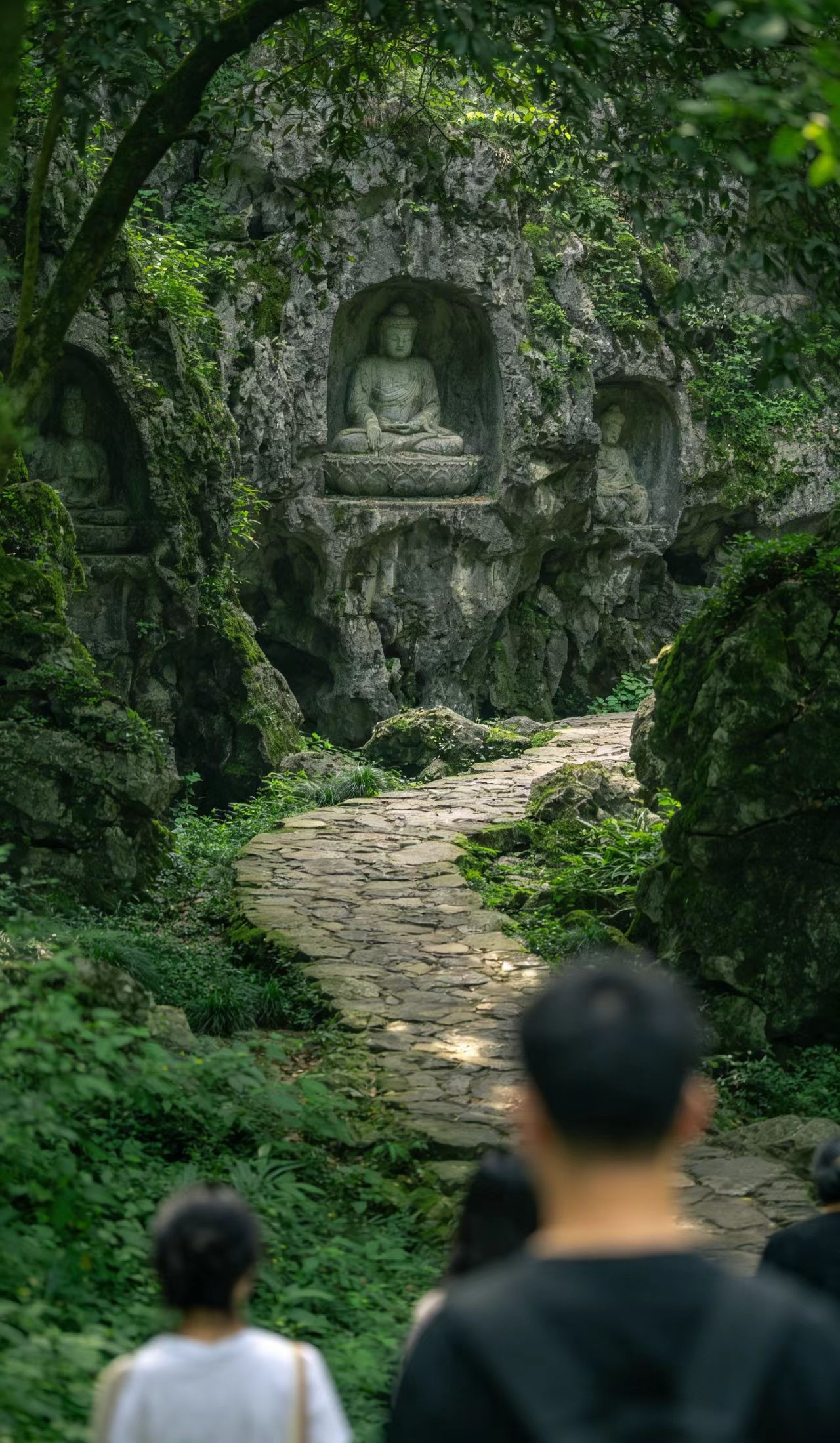
After exiting the temple proper, you walk into the Feilai Peak (飞来峰) stone carving complex. This is part of the combined ticket and worth at least an hour.
Feilai Peak is a 209-meter limestone hill covered with Buddhist, Taoist, and Confucian carvings from the 10th to 14th centuries — 470+ figures in total, ranging from 10 cm to 10 meters tall. The most famous single piece is a seated Maitreya carved in 1027, one of the largest Song-dynasty Buddha carvings in China.
The carvings are arranged along a walking path that loops around the hill. Most of the figures are heavily weathered and the path can be slippery when wet. Take it slow. The smaller carvings — often dismissed by tour groups who rush past them — are the most interesting: monks, lions, donors, and a few scenes from Buddhist sutras that are still readable after 1,000 years.
The hill also has a small cave complex with a few chambers that are easy to miss. Ask a monk or temple volunteer to point them out.
How to Behave at Lingyin
These are not theoretical. Foreign visitors do get noticed for misbehavior, and the monks are generally patient but not infinitely so.
- No shorts or tank tops. Shoulders and knees covered. The wrap rental at the entrance is cheap and solves this if you forget.
- No photos inside the main halls. Photography is generally forbidden in halls with active Buddha statues. The Great Hall in particular is a no-photo zone. The courtyards are fine.
- No pointing at the Buddha statues with your finger. Use your whole flat palm if you need to indicate one.
- Step to the side when a monk passes. Don’t block the central walkway of any hall.
- Take your incense seriously. If you light incense (¥1 for three sticks, sold at the entrance), hold them upright, light all three at once, and place them in the censer outside the main hall. Do not wave them around or blow on them to extinguish the flame.
- Don’t pose with the Buddha statues. “Look at me meditating!” photos are not welcome.
- Donations are appreciated but not required. A small donation at the donation box (¥10-100) is appropriate. The temple does not charge an entrance fee on the first and fifteenth days of the lunar month.
Where to Eat: The Temple Vegetarian Restaurant
Lingyin has a 1,000-year-old vegetarian restaurant, Lingyin Suzhai (灵隐素斋), that serves Buddhist temple food to pilgrims and visitors. It is genuinely good, not the bland “tourist temple food” you might expect.
The restaurant is just outside the temple exit, on the right. Order at the counter, sit down, they bring the food. Famous dishes:
- Buddha’s Delight (罗汉斋) — the classic mix of mushrooms, bamboo shoots, tofu, and seasonal vegetables in a light broth. ¥38.
- Bamboo shoot with sesame oil (油焖春笋) — seasonal in spring. ¥32.
- Sweet and sour gluten (素咕咾肉) — wheat gluten cooked to mimic sweet-and-sour pork. Surprisingly good. ¥28.
- Plain rice (米饭) — ¥3 per bowl.
Plan ¥60-100 per person. Service is fast. The restaurant is busiest from 12:00 to 1:00 PM, so either arrive at 11:30 or wait until 1:30.
Beyond the Temple: The Surrounding Mountains
If you have an extra half-day, the mountains above Lingyin are full of smaller temples, tea fields, and quiet walking paths. The locals call this area the “spiritual back garden” of Hangzhou.
Three worthwhile extensions:
1. Yongfu Temple (永福寺, ¥40) — a 20-minute uphill walk from Lingyin’s exit. Smaller, quieter, with a working Buddhist nunnery and a vegetarian teahouse overlooking the valley. Most foreign visitors don’t make it up here.
2. Fa Yun Tea House (法云弄) — Aman Hotel’s restored Chinese village, 30 minutes uphill from Lingyin. You can visit for the architecture and tea; you don’t need to be a hotel guest. The Aman is famous for being the most luxurious Chinese-style hotel in the world.
3. The North Peak Road (北高峰索道) — a cable car to the top of Beigao Peak, the highest point in the immediate Hangzhou area. ¥50 round trip. The view on a clear day extends 50 km in every direction. The 15-minute walk from the cable car station to the peak has a few smaller temples and a Buddhist nunnery.
For the most efficient visit, stick to Lingyin + Feilai Peak. For a deeper day, add the Yongfu Temple extension. The Aman village and the cable car are for visitors with a second half-day to spare.
What Lingyin Is Not
Three things Lingyin is not, to set expectations honestly.
It is not a museum. The halls are not behind ropes. You walk through them the same way worshippers do, with incense and chanting happening around you. This is what makes it worth visiting, but it also means you can’t expect museum-style quiet and barriered access.
It is not the most visually spectacular temple in China. The wooden statues are excellent; the architecture is authentic but not the most ornate. If you want the most photographed and visually impressive Buddhist temples in China, go to Shaolin (Henan) or Mount Wutai (Shanxi). Lingyin’s value is the authenticity of a working monastery, not visual spectacle.
It is not the most important Buddhist site in China. That’s a more complex discussion involving the Four Sacred Buddhist Mountains (Wutai, Putuo, Emei, Jiuhua), each with a different primary Buddha. Lingyin is the most important temple in Zhejiang and one of the four great Zen monasteries in the country, but it is not a national-level pilgrimage destination like the Four Mountains.
What it is: the most accessible, most spiritually alive, and most foreign-visitor-friendly major Buddhist temple in eastern China. Worth the half-day, especially when combined with the adjacent Feilai Peak carvings.
Frequently Asked Questions
Is Lingyin Temple worth it if I’m not Buddhist?
Yes. The cultural and architectural significance is independent of your personal faith. The carvings at Feilai Peak alone are worth the ticket for any visitor interested in Chinese art history.
Can I just visit Feilai Peak without the temple?
No — the combined ticket is the only option, and the combined ticket is better value. Allow at least 90 minutes for Feilai alone, 2.5-3 hours for the full temple + Feilai.
Is the Lingyin Temple vegetarian restaurant worth it?
Yes, especially for lunch. The dishes are surprisingly well-executed, the prices are reasonable (¥60-100 per person), and eating there rounds out the visit. The Buddha’s Delight and the bamboo shoots are the best choices.
How do I get a blessing or prayer for a family member?
The temple offers prayer ceremonies for a small donation. Ask at the front desk. For a written blessing (开光) for an object, the fee is typically ¥100-300. For a major ceremony (like a memorial for a deceased family member), book in advance through your hotel concierge.
Is Lingyin crowded?
Yes, between 10 AM and 3 PM on weekends and holidays. The temple receives 3-5 million visitors per year. Arrive at 8 AM opening, or after 3 PM on weekdays, for a less crowded experience.
What should I wear?
Comfortable walking shoes, modest clothing (covered shoulders and knees), and bring a light layer for the air-conditioned halls. Avoid loud colors — neutral or earth tones are most respectful.
Have a specific question about Lingyin or its carvings? Drop a comment below — we read every one and usually reply within a day.