
Leifeng Pagoda: History, Legends, and How to Visit (2026)
Updated July 2026 — admission prices, opening hours, and best photo times verified.
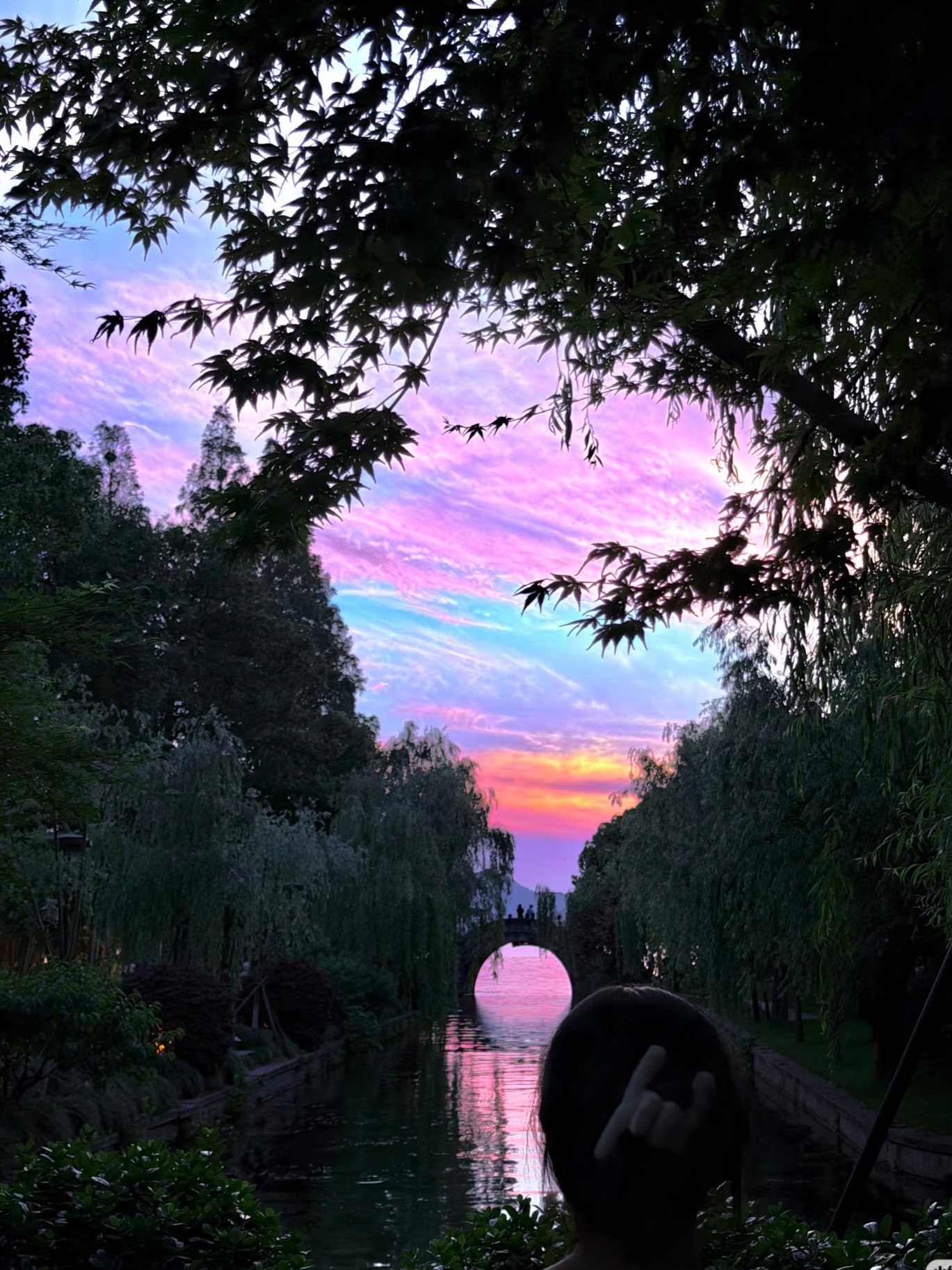
Leifeng Pagoda (雷峰塔, “Thunder Peak Pagoda”) is the most photographed tower in Hangzhou and the most recognizable silhouette on West Lake. The current structure is a 2002 reconstruction, but the site has a 1,000-year history and one of the most famous love stories in Chinese folklore. Foreign visitors who climb the pagoda get the single best view of West Lake, and the basement museum holds the original 1924 pagoda foundation in situ. Worth the ¥40 ticket.
This guide covers the history, the Legend of the White Snake, what to see inside the pagoda, the best photo times, and how to combine a visit with the Su Causeway across the lake. For more on the broader West Lake context, our West Lake: 10 things you can’t miss guide covers the other essential lake experiences.
Before You Go: The Practical Basics
Location and how to get there
Leifeng Pagoda stands on Sunset Hill (南屏山, “South Screen Hill”) on the south shore of West Lake, just west of the south end of the Su Causeway. It is walkable from anywhere in the south lake area:
- From the Su Causeway south entrance — 10-minute walk west along Nanshan Road. The most common arrival route.
- From the West Lake Music Fountain (Third Park) — 15-minute walk south along Nanshan Road.
- From Hefang Street — 20-minute walk west, or a 10-minute taxi (¥15).
- From anywhere else — taxi or DiDi to “雷峰塔景区” (Leifeng Pagoda Scenic Area). The pagoda is visible from much of the city, so any taxi driver knows it.
Opening hours and admission
Leifeng Pagoda is open 8:00 AM to 7:30 PM daily, last entry at 7:00 PM in the warmer months (April-October) and 8:00 AM to 5:30 PM in winter (November-March). Admission is ¥40 (about $5.50).
The ticket includes the pagoda, the basement museum with the original 1924 foundation, and the surrounding landscaped grounds. Allow 60-90 minutes for a full visit.
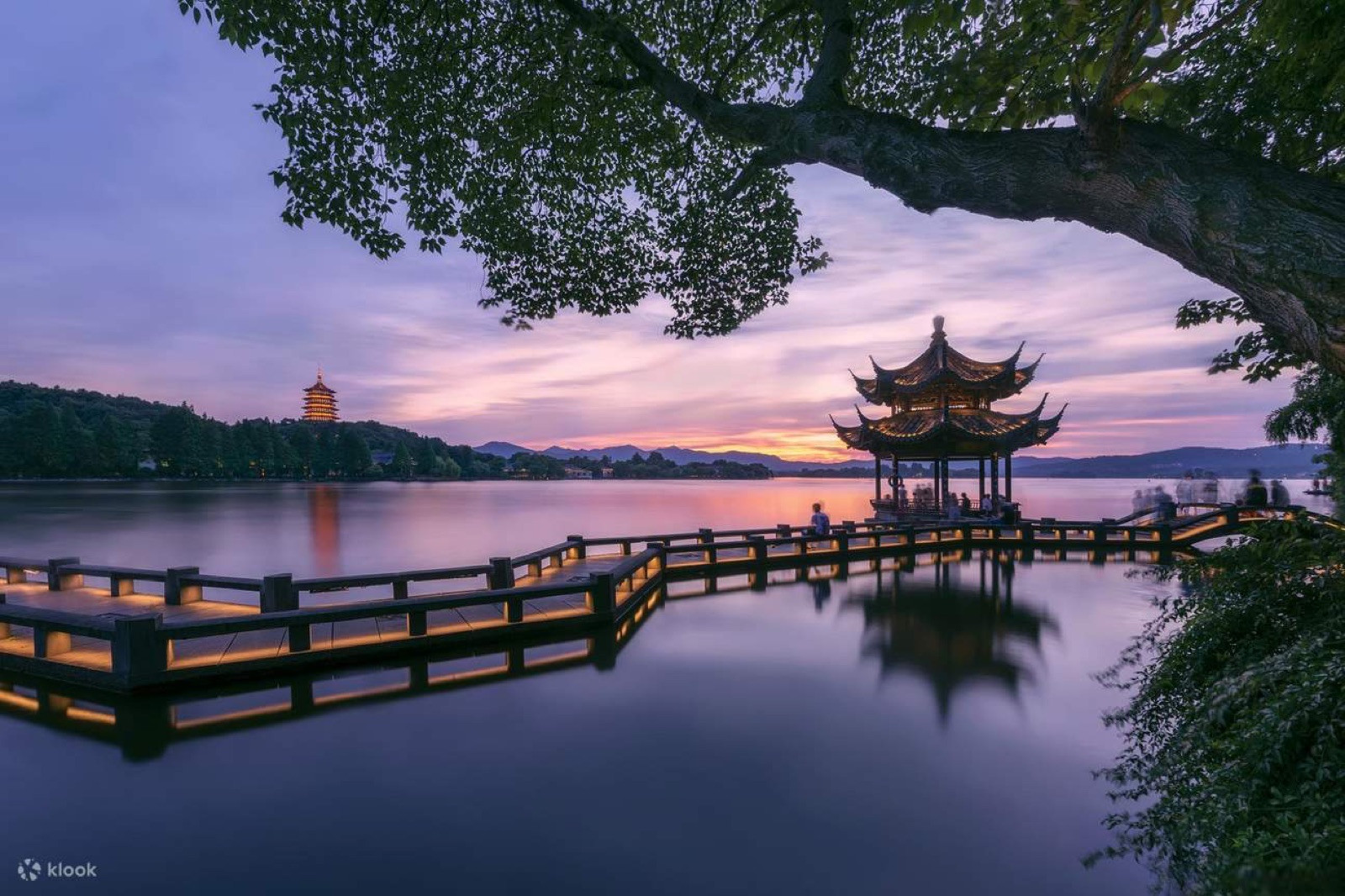
Best photo times: the hour around sunset (varies by season — around 6 PM in summer, 5 PM in winter) for the west-facing view. The view from the pagoda facing west, with the sun setting over the lake and the city beyond, is the iconic Leifeng shot. For a clean photo of just the pagoda itself, the best light is early morning (8-9 AM) when the sun comes from the east.
History: Five Pagodas Over 1,000 Years
The Leifeng Pagoda site has hosted five distinct pagodas, four of them destroyed, the current one a 2002 reconstruction. The pattern of destruction is what gives the pagoda its place in Chinese cultural memory.
1. The Wuyue Kingdom Pagoda (972 AD)
The original Leifeng Pagoda was commissioned by King Qian Chu (钱俶), the last king of the Wuyue Kingdom, in 972 AD. Qian Chu was a Buddhist patron and built the pagoda as a votive offering on the 1,000th day after the death of his favorite consort, the Lady Huang. The pagoda was originally a 5-story wooden-and-brick structure, 71 meters tall, built to “store the Buddhist relics and pacify the waves” of West Lake.
King Qian Chu’s dynasty (Wuyue, 907-978) was one of the ten small kingdoms of the Five Dynasties period. He famously refused to fight the expanding Song dynasty and surrendered peacefully, saving the Wuyue people decades of war. He retired to Hangzhou and lived to age 59, far longer than most medieval Chinese monarchs. He is still remembered in Hangzhou as a wise and merciful king.
2-3. The Two Rebuilds (1023, 1156)
The original pagoda was damaged by fire in 1023 (Song dynasty) and rebuilt. It was damaged again by the Jurchen invasion in 1156 (Southern Song) and rebuilt a second time. By the late Ming dynasty, the pagoda was leaning significantly due to foundation subsidence — a Chinese name for the structure was “the leaning tower” well before the famous Italian example.
4. The 1924 Collapse
On September 25, 1924, the ancient pagoda collapsed entirely. Local legend said this was retribution for a foolish rumor: a Hangzhou rumor in the 1920s claimed that the bricks of Leifeng Pagoda had magical properties — they could cure illness, repel snakes, and bring good luck. Villagers began stealing bricks from the foundation to use as talismans, undermining the structure. The 1924 collapse was the direct result.
The collapse made the front page of every newspaper in China. The story became a national parable about the cost of superstition. Lu Xun, China’s most famous 20th-century writer, wrote a famous short story about the incident, “The Collapse of Leifeng Pagoda,” which is still read in Chinese middle schools today.
For 78 years, the site was a ruin. The foundation and a few large bricks remained. The pagoda became a melancholy symbol of lost heritage.
5. The 2002 Reconstruction (the current pagoda)
In 2000, the Hangzhou government launched a controversial reconstruction project. The plan: rebuild the pagoda on the original foundation, in approximately the same form as the original, using modern materials but traditional techniques. The new pagoda opened on October 25, 2002.
The current pagoda is 5 stories, 71.7 meters tall (1 cm taller than the original — a quiet Chinese architectural joke). It uses modern steel-reinforced brick and a copper-tile roof. Critically, the original 1924 foundation was preserved in the basement as an archaeological museum, accessible to all visitors.
The reconstruction was controversial in its day. Critics argued that the original pagoda’s leaning profile and weathered patina were part of its charm. The Hangzhou government defended the project as cultural preservation — without the reconstruction, the foundation would continue to deteriorate and the pagoda would be lost entirely. Most visitors today consider the rebuilt pagoda worthwhile, though the romance of the original is gone.
The Legend of the White Snake
Leifeng Pagoda is the central location in the Legend of the White Snake (白蛇传), one of the four great folk tales of Chinese culture. The story has been told in opera, film, TV drama, and animation for at least 1,000 years. The 2019 Chinese animated film “White Snake” is a recent international release.
The plot, briefly:
A white snake spirit has been cultivating magical powers for 1,000 years. She transforms into a woman named Bai Suzhen (白素贞) and falls in love with a young apothecary, Xu Xian (许仙). They meet at the Broken Bridge (断桥) on West Lake — the same bridge visible from the top of Leifeng Pagoda — and marry.
The Buddhist monk Fa Hai (法海), who lives at Jinshan Temple (金山寺) across the lake, recognizes Bai Suzhen as a snake spirit. He believes the marriage between a human and a spirit is unnatural and tries to separate them. After a series of disasters (Bai Suzhen accidentally kills Xu Xian in a moment of jealous rage; Xu Xian is resurrected; Bai Suzhen steals a magical herb to revive him; Fa Hai tricks Xu Xian into giving Bai Suzhen wine that reveals her true form), Fa Hai finally defeats Bai Suzhen and imprisons her under Leifeng Pagoda.
Xu Xian and the White Snake spend decades apart. Xu Xian becomes a monk. Bai Suzhen remains imprisoned. Finally, the pagoda collapses (in some versions because of a long drought, in others because Xu Xian’s grief and devotion wear it down), and the lovers are reunited. The story has no “ending” — it is a meditation on love, duty, and the impossibility of separating two people who belong together.
The 1924 collapse of Leifeng Pagoda is often explained in folk culture as the “fulfillment” of the legend: the pagoda fell because the love story demanded it fall.
For a foreign visitor, the legend matters because it is everywhere at Leifeng Pagoda. The reliefs in the first floor of the new pagoda depict scenes from the story. The souvenir shop sells White Snake memorabilia. The audio tour (in Mandarin only) includes the legend. Understanding the story turns a pagoda visit into a cultural event.
What to See Inside the Pagoda
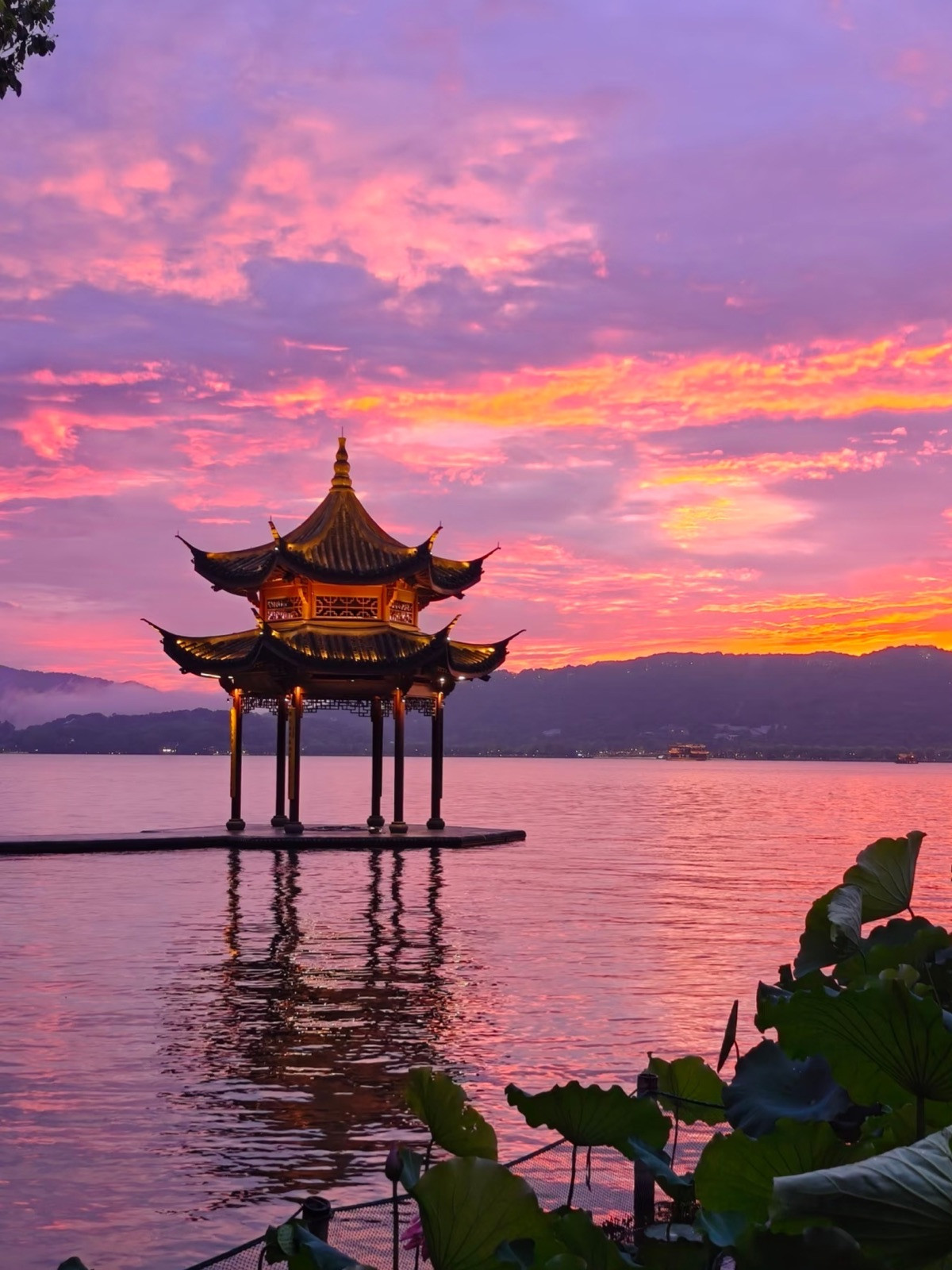
The current Leifeng Pagoda is a 5-story structure. Each floor has a slightly different theme.
First floor: The Legend reliefs and the original foundation
Wrap around the central wall in this floor: a series of carved jade reliefs depicting scenes from the Legend of the White Snake, in chronological order. The reliefs were carved in 2002 and are stylistically mid-2000s Chinese art — not classical but worth a slow walk to understand the story.
The most photogenic single relief: Bai Suzhen and Xu Xian meeting at the Broken Bridge, the first scene of the legend, with West Lake in the background.
Basement level: The original 1924 foundation
Down the stairs from the first floor (separately ticketed, included with admission) is the actual archaeological site of the original pagoda. The 1924 foundation stones are preserved in place, with the original Song-dynasty brick work visible. There is also a small museum with excavated artifacts — Song-dynasty Buddhist statuary, pieces of the original 1156 rebuild, and a few items relating to the legend.
This is the best part of the visit for visitors interested in Chinese architectural history. Plan 20-30 minutes here.
Second through fifth floors: The view
The upper four floors of the pagoda are mostly open viewing platforms with 360-degree views of West Lake and the city. The first two upper floors have small displays on the pagoda’s construction and the Legend, but the real reason to climb is the view.
From the top (fifth floor) on a clear day you can see:
- West Lake in its entirety, with the Su Causeway clearly visible
- The northern hills (including Baochu Pagoda on the north shore)
- The city skyline to the east and south
- On a particularly clear day, the Qiantang River to the south
Allow 30-45 minutes to climb and descend the five floors. The stairs are modern and well-maintained. There is an elevator in the center of the pagoda for visitors with mobility issues.
The View From Below: Sunset Hill Park
The landscaped grounds around Leifeng Pagoda are part of the ticket and worth a 15-20 minute walk. The area was redesigned in 2002 with traditional Chinese garden features — paths, pavilions, koi ponds, and a few teahouses. Most foreign visitors skip this and head straight back to West Lake, which is a mistake. The grounds are the only place in Hangzhou where you can see the pagoda from below in a traditional garden setting.
Best spots in the grounds:
- The south pond — classic pagoda reflection shot, especially good at sunrise when the water is still.
- The east gate — facing the Su Causeway, the pagoda is framed by willow trees.
- The west terrace — facing the city, the pagoda silhouettes against modern Hangzhou in the distance.
How to Combine Leifeng With the Rest of Your West Lake Day
Leifeng sits on the south shore of West Lake, the natural endpoint of a Su Causeway walk. The standard combined visit:
- 8:00 AM — Arrive at the Su Causeway south entrance. Walk the 2.8 km causeway (about 60 minutes at a slow pace).
- 9:30 AM — Reach the south end of the causeway. Leifeng Pagoda is 10 minutes west along Nanshan Road.
- 10:00 AM — Enter Leifeng Pagoda. Climb to the top. Allow 90 minutes including the basement museum.
- 11:30 AM — Exit. Lunch at one of the teahouses in the south lake area, or cross back to the north shore for Louwailou.
For a half-day alternative: arrive at Leifeng 90 minutes before sunset. Climb the pagoda, watch the sunset from the top, exit through the landscaped grounds, dinner at the south lake. The combination is more atmospheric than the morning visit and avoids the midday heat in summer.
For a deeper West Lake itinerary that includes Leifeng, our West Lake: 10 things you can’t miss guide has the full day-by-day plan.
What Leifeng Is Not
To set expectations honestly: Leifeng Pagoda is a great visit, but it is not the only pagoda or the most visually stunning. If you have limited time:
- Want the most atmospheric old pagoda? Go to Liuhe Pagoda (六和塔) in south Hangzhou — a 970-year-old Song-dynaby tower, less renovated, more authentic feel.
- Want the best city view? Skip Leifeng, go to Baochu Pagoda (保俶塔) on the north shore — smaller, less crowded, also a great West Lake view.
- Want a Buddhist temple with a pagoda in the same complex? Go to Lingyin Temple (covered in our Lingyin Temple complete guide) — a working monastery with a smaller but more authentic pagoda.
Leifeng is the right choice for first-timers because of the Legend of the White Snake context and the south-lake view. For second-time visitors, the other three pagodas offer more depth.
Frequently Asked Questions
Is Leifeng Pagoda worth the ¥40 ticket?
Yes. The view from the top is one of the two or three best in Hangzhou, and the basement museum with the original 1924 foundation is genuinely interesting. The ticket is also one of the cheaper major attractions in the city.
Is the White Snake legend real?
No, it is a folk tale with no historical basis. The legend has been told in different forms for at least 1,000 years, and the character of Bai Suzhen is one of the most beloved in Chinese folklore.
Can I climb the pagoda in a wheelchair?
Yes, there is a modern elevator in the center. The pagoda is fully accessible.
Are the reliefs in the White Snake story accurate?
The 2002 reliefs are a stylized modern interpretation, not a classical depiction. For a more authentic representation of the legend, watch one of the 1980s-2000s TV opera adaptations, which are easily found on YouTube (or Bilibili inside China).
What time is least crowded?
The 8:00 AM opening or after 6:00 PM in summer (after 5:00 PM in winter). The 10 AM – 2 PM window is busiest with tour groups.
Is it worth visiting at night?
The pagoda is illuminated after dark, and the reflection in West Lake from the north shore is one of the iconic Hangzhou night views. The pagoda itself closes at 7:30 PM in summer, but you can see it lit up from across the lake for free. The Hefang Street evening stroll + a West Lake view of the lit Leifeng is a romantic Hangzhou evening combination.
Have a specific question about Leifeng Pagoda or the White Snake legend? Drop a comment below — we read every one and usually reply within a day.