
Xixi Wetland Hangzhou: The Complete Guide for 2026
Updated July 2026 — entry prices, boat ticket combos, and 2026 seasonal events verified.
Most visitors to Hangzhou spend their entire trip around West Lake, never realizing that the city has a second, very different landscape on its western edge. Xixi National Wetland Park is a 1,160-hectare wetland reserve, roughly 5 km across, where slow waterways wind between reed beds, persimmon orchards, and restored Ming-era village houses. It’s the largest urban wetland in China, and one of the few places in the Yangtze Delta where you can spend a full day outside without ever leaving the city.
This guide covers what to see at Xixi, when to go, how to get there from central Hangzhou, the boat rides and walking routes, ticket combinations, where to eat inside the park, and the seasonal highlights that make Xixi worth a repeat visit. It’s based on a January 2026 visit and a follow-up in May 2026 — both checked again in early July 2026 for current prices and hours.
Why Xixi Wetland Is Different from West Lake
Three reasons to choose Xixi over a second day at West Lake:
- It’s a working wetland, not a garden. West Lake is a manicured cultural landscape with paved paths, restored pavilions, and a Leifeng Pagoda skyline. Xixi is a floodplain, with actual marshes, kingfisher channels, and 800-year-old persimmon trees. Birders log 100+ species here on migration days, including black-faced spoonbill in spring. The walk is dirt boardwalk, not tile.
- It’s quiet. On a weekday morning in spring, you might see 200 people in the entire park. West Lake at the same time is 10,000. The pace is slow; the boatmen pole, they don’t motor.
- The seasons actually matter. West Lake is good year-round but doesn’t transform. Xixi has a March-April catkin rain, a May-June persimmon-flower bloom, a September-October reed-head and osmanthus season, and a December-February red-canopy winter. Locals come back four times a year to see the changes.
What Xixi Wetland Actually Is
Xixi National Wetland Park (西溪国家湿地公园) sits in the western outskirts of Hangzhou, about 8 km from West Lake’s western edge. It was historically a flood-retention basin and a network of fishing villages that supplied Hangzhou with freshwater fish, river shrimp, and persimmons. The area is documented in Ming dynasty records (1368-1644) as one of the “Three Xis of Hangzhou” — three wetland systems that complemented West Lake.
After the 1990s, the city started acquiring land and designating the basin a protected area. The park opened in 2005 as China’s first national wetland park. About 70% of the area is water or wetland; the rest is restored village, orchard, and reed-belt. The park has six entrance zones, the most useful being Zhoujiacun (West Gate) and Wujiafan (South Gate).
For visitors, this matters because the park is genuinely large. If you walk the full perimeter, it’s about 12 km. Most visitors combine a 90-minute rowboat ride with 3-4 hours of boardwalk walking.
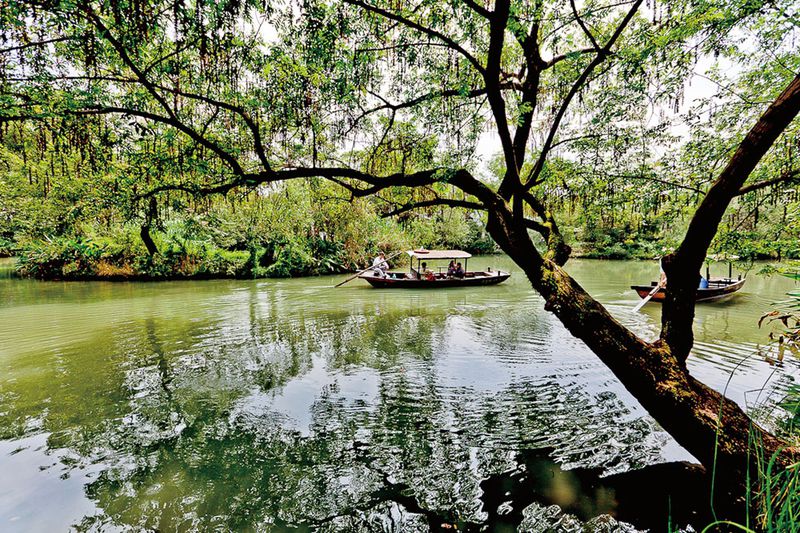
When to Visit: Xixi Through the Seasons
Xixi is one of the few Hangzhou attractions that I think is worth visiting in multiple seasons — the look and feel change dramatically.
Spring (March-May)
Best for: persimmon flowers, fresh green reeds, bird migration. Late March to mid-April is the catkin-rain season, where willow catkins drift through the air like snow (allergy sufferers beware). May is mild and dry, around 18-25°C, with the reed beds bright green. The park hosts a Persimmon Flower Festival in late April-early May.
Summer (June-August)
Hot and humid — 28-36°C, with afternoon thunderstorms. Lotus flowers in the ponds start blooming in mid-June and peak in July. Crowds thin out. Carry water and a hat. The boardwalks provide some shade but not much.
Autumn (September-November)
My pick for the best time. September is warm, the osmanthus flowers bloom across the park, and the reeds turn gold. October is peak autumn — 15-22°C, clear skies, red persimmon fruit hanging on trees. The Mid-Autumn Festival (variable, usually Sept-Oct) brings lantern displays along the water.
Winter (December-February)
Cold (3-10°C) but clear. The reed beds are bronze, the persimmon trees drop their last fruit, and the trees are bare — you can see deep into the channels. Best for photographers who want structure and contrast. The park hosts a winter fishing culture festival in late January.
How to Get to Xixi Wetland from Central Hangzhou
Three practical options. None of them are difficult — Xixi is well-served by metro.
Option 1: Metro (Recommended)
Take Metro Line 3 to Hongzhuang Station (洪庄), exit C. From there it’s a 10-minute walk through restored village streets to the Zhoujiacun (West) entrance. Line 3 connects directly to West Lake cultural area (Wulinmen Station) and Hangzhou East Railway Station.
Travel time from West Lake area: 30-35 minutes door-to-door. From Hangzhou East Station: 40 minutes with one transfer at Xierhuan Lu. Cost: ¥3-6 per person.
Option 2: DiDi / Taxi
A DiDi from West Lake to Xixi is about 25 minutes and ¥40-60. From Hangzhou East Station it’s 35-45 minutes and ¥70-100. The DiDi drops you at the main entrance. Useful if you have kids, lots of gear, or are combining Xixi with another western-side stop (like Lingyin Temple, which is on the way).
Option 3: Bus
Bus 356, 381, and several others stop near the park entrances. Slower (45-60 min from West Lake) and more crowded, but cheapest at ¥2-3. Mostly used by locals.
Driving
There are two parking lots at the main entrances, both around ¥10/day. Driving is reasonable on weekdays but the lots fill up on weekends and holidays.
Tickets, Hours, and the Boat Combo
The park charges a base entry fee plus optional extras:
- Base entry: ¥80 (Jan-Nov) / ¥60 (Dec, off-season). Includes all the boardwalks, the museums, and most walking routes.
- Rowboat ride (60 min, up to 4 people per boat): ¥100 per boat. The signature experience. Boats are poled by boatmen through narrow reed-lined channels you can’t reach on foot. Hours: 8 a.m. to 4 p.m., last boat 4 p.m.
- Electric boat (35 min, large group): ¥60 per person. Faster and covers more area, but you stay on wider channels and see other boats.
- Combined ticket (entry + 60-min rowboat): ¥150 per person. Saves you ¥30 vs separate purchase, and you don’t have to queue twice.
Opening hours: 8:30 a.m. to 5:30 p.m. (April-October), 8:30 a.m. to 5:00 p.m. (November-March). Last entry one hour before close. Closed on certain Chinese holidays for crowd control — check the official WeChat the week before if you’re traveling during a public holiday.
What to See at Xixi: A Tested Walking Route
Xixi is large enough that you need to make choices. The most rewarding half-day route covers the western half of the park, starting at Zhoujiacun entrance and ending at the same place.
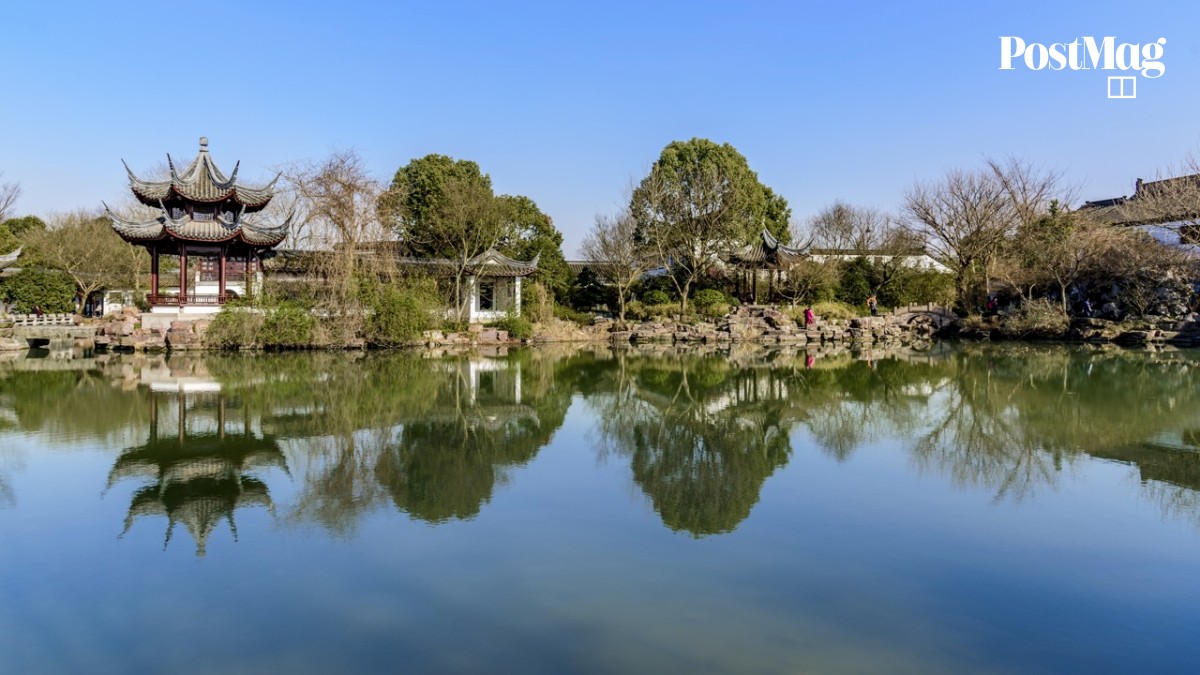
Stop 1: Zhoujiacun Village (周家村)
The starting point. Zhoujiacun is a restored fishing village with three things to see: the Xixi Wetland Museum (small, well-done, with a good intro to the park’s ecology), the Persimmon Culture Museum (less essential, but interesting if you’re a food nerd), and a cluster of restored Ming-era houses that now house tea houses and a craft workshop. Plan 45 minutes here.
Stop 2: Rowboat ride (1 hour)
Pick up your rowboat at the Zhoujiacun dock. The boatman will pole you through narrow channels lined with reeds, persimmon orchards, and occasional kingfisher-blue flashes of birds. The 1-hour route covers about 4 km of water. Most boatmen don’t speak English but will point things out. Best light: late morning (10-11 a.m.) when the sun is angled across the water.
Stop 3: Qushui Shuyuan (曲水书院) and the Osmanthus Garden
A Ming-style scholar’s garden, small but atmospheric. The osmanthus blooms here are best in September-October. A cup of osmanthus tea (¥30-50) is a nice mid-day pause. Plan 30-45 minutes.
Stop 4: Yanshui Yuzhuang (烟水渔庄, “Misty Water Fishing Village”)
A restored fishing hamlet with a working fish restaurant (see eating section below). Walk through the village in 15-20 minutes; eat here for lunch.
Stop 5: Lotus Pond Boardwalk (莲花滩)
From Yanshui Yuzhuang, the boardwalk winds through a large lotus pond. The lotus bloom peaks in mid-July to mid-August — a pink and green field stretching to the horizon. Off-season, the pond is still but less dramatic. Plan 30-45 minutes.
Stop 6: Hezhu Street (河渚街) and the Return Walk
A 1.5-km covered street with craft shops, tea houses, and snack vendors, mostly aimed at tour groups. Skip the food here (overpriced); it’s a gentle walk back to the entrance. Allow 30 minutes.
Total time for this route: 4.5-5 hours including the boat ride and lunch. If you only have half a day, cut the boat ride to 30 minutes and skip the lotus pond — the core experience is the rowboat and the village walk.
Where to Eat Inside Xixi
There are two good options inside the park, plus the generic snack street at the exit:
- Yanshui Yuzhuang Fish Restaurant (烟水渔庄) — the only restaurant in the park that sources from Xixi’s own water. The signature dish is the Xixi freshwater fish soup (¥60-80, serves 2-3). Also good: braised river shrimp, smoked fish, stir-fried lotus root. Mid-range price, ¥120-180 per person with rice. English menu exists but is limited; point at pictures.
- Zhoujiacun Tea House (周家村茶室) — a small tea house in the restored village. Longjing tea, ¥40-60 per pot, served with a small plate of local snacks. Pleasant for a 30-40 minute break.
- Hezhu Street snack vendors — local snacks (Dingsheng cake, scallion pancakes, stinky tofu) at ¥5-15 each. Avoid the “West Lake vinegar fish” and “Dongpo pork” sold here — it’s tourist-grade and not worth it.
What to Skip at Xixi
A few things to be skeptical of:
- The “Xixi Boat Festival” performances (Apr-May, Oct) — staged shows on the water, mostly for domestic tour groups. Skip unless you’re with kids who like stage shows.
- Hezhu Street shopping — silk scarves, fans, and tea sold at 3-5x the price you’ll find in central Hangzhou. The vendors are aggressive.
- Most electric boat tours — the hand-poled rowboat is the whole point. The electric boats are large, crowded, and stay on the boring outer channels.
- Going in peak summer weekend — the park gets genuinely hot and humid, the boardwalks have no shade, and weekend crowds cut the calm. Late September or early May is the sweet spot.
What to Combine Xixi With
Xixi is on Hangzhou’s western side, so it pairs naturally with:
- Lingyin Temple and Feilai Feng (10 km east, 25 min by DiDi). Spend the morning at Lingyin, lunch in the area, then afternoon at Xixi. Both can fill a full day between them, so do this only if you’re not rushed.
- Wuzhen or Shaoxing day trip (1+ hour away) — don’t try to fit Xixi in the same day.
- A second day at West Lake — if you have a third day in Hangzhou, Xixi is the natural next stop after you’ve done the West Lake walk and the Lingyin visit.
Common Mistakes to Avoid
- Showing up at 11 a.m. and expecting to do the full park in 3 hours. You can’t. The rowboat alone takes an hour, and the walking is at least 3 hours. Plan 5 hours minimum, ideally a full day.
- Skipping the rowboat to save money. It’s the only way to get into the deep channels. The walking routes are nice but they’re on the perimeter. If you have to pick one, the rowboat is non-negotiable.
- Forgetting the boat last-call time. The last rowboat departs at 4 p.m. (summer) or 3:30 p.m. (winter). If you arrive at 2 p.m. on a winter day, you might already be too late for the full 60-minute ride.
- Expecting a “wetland safari.” This is a managed urban park, not a wildlife reserve. The birding is real but you won’t see pandas or rare mammals. Bring binoculars and patience, not safari expectations.
The Bottom Line
Xixi Wetland is the one Hangzhou attraction that has the same slow pace as West Lake without the West Lake crowds. It rewards a full half-day or more, especially outside the peak summer weekends. The hand-poled rowboat is the experience, the September-October reed season is the time, and the right plan is to combine it with Lingyin Temple on the same day or as the second day of a Hangzhou trip.
If you’ve already done West Lake and Lingyin, Xixi is the obvious third stop. If you only have one day in Hangzhou, do West Lake. If you have two, do West Lake on day one and Xixi on day two. If you have three, add the Wuzhen or Shaoxing day trip and you’ve covered the best of the region.
Xixi Wetland Hangzhou: The Complete Guide for 2026
Updated July 2026 — entry prices, boat ticket combos, and 2026 seasonal events verified.
Most visitors to Hangzhou spend their entire trip around West Lake, never realizing that the city has a second, very different landscape on its western edge. Xixi National Wetland Park is a 1,160-hectare wetland reserve, roughly 5 km across, where slow waterways wind between reed beds, persimmon orchards, and restored Ming-era village houses. It’s the largest urban wetland in China, and one of the few places in the Yangtze Delta where you can spend a full day outside without ever leaving the city.
This guide covers what to see at Xixi, when to go, how to get there from central Hangzhou, the boat rides and walking routes, ticket combinations, where to eat inside the park, and the seasonal highlights that make Xixi worth a repeat visit. It’s based on a January 2026 visit and a follow-up in May 2026 — both checked again in early July 2026 for current prices and hours.
Why Xixi Wetland Is Different from West Lake
Three reasons to choose Xixi over a second day at West Lake:
- It’s a working wetland, not a garden. West Lake is a manicured cultural landscape with paved paths, restored pavilions, and a Leifeng Pagoda skyline. Xixi is a floodplain, with actual marshes, kingfisher channels, and 800-year-old persimmon trees. Birders log 100+ species here on migration days, including black-faced spoonbill in spring. The walk is dirt boardwalk, not tile.
- It’s quiet. On a weekday morning in spring, you might see 200 people in the entire park. West Lake at the same time is 10,000. The pace is slow; the boatmen pole, they don’t motor.
- The seasons actually matter. West Lake is good year-round but doesn’t transform. Xixi has a March-April catkin rain, a May-June persimmon-flower bloom, a September-October reed-head and osmanthus season, and a December-February red-canopy winter. Locals come back four times a year to see the changes.
What Xixi Wetland Actually Is
Xixi National Wetland Park (西溪国家湿地公园) sits in the western outskirts of Hangzhou, about 8 km from West Lake’s western edge. It was historically a flood-retention basin and a network of fishing villages that supplied Hangzhou with freshwater fish, river shrimp, and persimmons. The area is documented in Ming dynasty records (1368-1644) as one of the “Three Xis of Hangzhou” — three wetland systems that complemented West Lake.
After the 1990s, the city started acquiring land and designating the basin a protected area. The park opened in 2005 as China’s first national wetland park. About 70% of the area is water or wetland; the rest is restored village, orchard, and reed-belt. The park has six entrance zones, the most useful being Zhoujiacun (West Gate) and Wujiafan (South Gate).
For visitors, this matters because the park is genuinely large. If you walk the full perimeter, it’s about 12 km. Most visitors combine a 90-minute rowboat ride with 3-4 hours of boardwalk walking.
When to Visit: Xixi Through the Seasons
Xixi is one of the few Hangzhou attractions that I think is worth visiting in multiple seasons — the look and feel change dramatically.
Spring (March-May)
Best for: persimmon flowers, fresh green reeds, bird migration. Late March to mid-April is the catkin-rain season, where willow catkins drift through the air like snow (allergy sufferers beware). May is mild and dry, around 18-25°C, with the reed beds bright green. The park hosts a Persimmon Flower Festival in late April-early May.
Summer (June-August)
Hot and humid — 28-36°C, with afternoon thunderstorms. Lotus flowers in the ponds start blooming in mid-June and peak in July. Crowds thin out. Carry water and a hat. The boardwalks provide some shade but not much.
Autumn (September-November)
My pick for the best time. September is warm, the osmanthus flowers bloom across the park, and the reeds turn gold. October is peak autumn — 15-22°C, clear skies, red persimmon fruit hanging on trees. The Mid-Autumn Festival (variable, usually Sept-Oct) brings lantern displays along the water.
Winter (December-February)
Cold (3-10°C) but clear. The reed beds are bronze, the persimmon trees drop their last fruit, and the trees are bare — you can see deep into the channels. Best for photographers who want structure and contrast. The park hosts a winter fishing culture festival in late January.
How to Get to Xixi Wetland from Central Hangzhou
Three practical options. None of them are difficult — Xixi is well-served by metro.
Option 1: Metro (Recommended)
Take Metro Line 3 to Hongzhuang Station (洪庄), exit C. From there it’s a 10-minute walk through restored village streets to the Zhoujiacun (West) entrance. Line 3 connects directly to West Lake cultural area (Wulinmen Station) and Hangzhou East Railway Station.
Travel time from West Lake area: 30-35 minutes door-to-door. From Hangzhou East Station: 40 minutes with one transfer at Xierhuan Lu. Cost: ¥3-6 per person.
Option 2: DiDi / Taxi
A DiDi from West Lake to Xixi is about 25 minutes and ¥40-60. From Hangzhou East Station it’s 35-45 minutes and ¥70-100. The DiDi drops you at the main entrance. Useful if you have kids, lots of gear, or are combining Xixi with another western-side stop (like Lingyin Temple, which is on the way).
Option 3: Bus
Bus 356, 381, and several others stop near the park entrances. Slower (45-60 min from West Lake) and more crowded, but cheapest at ¥2-3. Mostly used by locals.
Driving
There are two parking lots at the main entrances, both around ¥10/day. Driving is reasonable on weekdays but the lots fill up on weekends and holidays.
Tickets, Hours, and the Boat Combo
The park charges a base entry fee plus optional extras:
- Base entry: ¥80 (Jan-Nov) / ¥60 (Dec, off-season). Includes all the boardwalks, the museums, and most walking routes.
- Rowboat ride (60 min, up to 4 people per boat): ¥100 per boat. The signature experience. Boats are poled by boatmen through narrow reed-lined channels you can’t reach on foot. Hours: 8 a.m. to 4 p.m., last boat 4 p.m.
- Electric boat (35 min, large group): ¥60 per person. Faster and covers more area, but you stay on wider channels and see other boats.
- Combined ticket (entry + 60-min rowboat): ¥150 per person. Saves you ¥30 vs separate purchase, and you don’t have to queue twice.
Opening hours: 8:30 a.m. to 5:30 p.m. (April-October), 8:30 a.m. to 5:00 p.m. (November-March). Last entry one hour before close. Closed on certain Chinese holidays for crowd control — check the official WeChat the week before if you’re traveling during a public holiday.
What to See at Xixi: A Tested Walking Route
Xixi is large enough that you need to make choices. The most rewarding half-day route covers the western half of the park, starting at Zhoujiacun entrance and ending at the same place.
Stop 1: Zhoujiacun Village (周家村)
The starting point. Zhoujiacun is a restored fishing village with three things to see: the Xixi Wetland Museum (small, well-done, with a good intro to the park’s ecology), the Persimmon Culture Museum (less essential, but interesting if you’re a food nerd), and a cluster of restored Ming-era houses that now house tea houses and a craft workshop. Plan 45 minutes here.
Stop 2: Rowboat ride (1 hour)
Pick up your rowboat at the Zhoujiacun dock. The boatman will pole you through narrow channels lined with reeds, persimmon orchards, and occasional kingfisher-blue flashes of birds. The 1-hour route covers about 4 km of water. Most boatmen don’t speak English but will point things out. Best light: late morning (10-11 a.m.) when the sun is angled across the water.
Stop 3: Qushui Shuyuan (曲水书院) and the Osmanthus Garden
A Ming-style scholar’s garden, small but atmospheric. The osmanthus blooms here are best in September-October. A cup of osmanthus tea (¥30-50) is a nice mid-day pause. Plan 30-45 minutes.
Stop 4: Yanshui Yuzhuang (烟水渔庄, “Misty Water Fishing Village”)
A restored fishing hamlet with a working fish restaurant (see eating section below). Walk through the village in 15-20 minutes; eat here for lunch.
Stop 5: Lotus Pond Boardwalk (莲花滩)
From Yanshui Yuzhuang, the boardwalk winds through a large lotus pond. The lotus bloom peaks in mid-July to mid-August — a pink and green field stretching to the horizon. Off-season, the pond is still but less dramatic. Plan 30-45 minutes.
Stop 6: Hezhu Street (河渚街) and the Return Walk
A 1.5-km covered street with craft shops, tea houses, and snack vendors, mostly aimed at tour groups. Skip the food here (overpriced); it’s a gentle walk back to the entrance. Allow 30 minutes.
Total time for this route: 4.5-5 hours including the boat ride and lunch. If you only have half a day, cut the boat ride to 30 minutes and skip the lotus pond — the core experience is the rowboat and the village walk.
Where to Eat Inside Xixi
There are two good options inside the park, plus the generic snack street at the exit:
- Yanshui Yuzhuang Fish Restaurant (烟水渔庄) — the only restaurant in the park that sources from Xixi’s own water. The signature dish is the Xixi freshwater fish soup (¥60-80, serves 2-3). Also good: braised river shrimp, smoked fish, stir-fried lotus root. Mid-range price, ¥120-180 per person with rice. English menu exists but is limited; point at pictures.
- Zhoujiacun Tea House (周家村茶室) — a small tea house in the restored village. Longjing tea, ¥40-60 per pot, served with a small plate of local snacks. Pleasant for a 30-40 minute break.
- Hezhu Street snack vendors — local snacks (Dingsheng cake, scallion pancakes, stinky tofu) at ¥5-15 each. Avoid the “West Lake vinegar fish” and “Dongpo pork” sold here — it’s tourist-grade and not worth it.
What to Skip at Xixi
A few things to be skeptical of:
- The “Xixi Boat Festival” performances (Apr-May, Oct) — staged shows on the water, mostly for domestic tour groups. Skip unless you’re with kids who like stage shows.
- Hezhu Street shopping — silk scarves, fans, and tea sold at 3-5x the price you’ll find in central Hangzhou. The vendors are aggressive.
- Most electric boat tours — the hand-poled rowboat is the whole point. The electric boats are large, crowded, and stay on the boring outer channels.
- Going in peak summer weekend — the park gets genuinely hot and humid, the boardwalks have no shade, and weekend crowds cut the calm. Late September or early May is the sweet spot.
What to Combine Xixi With
Xixi is on Hangzhou’s western side, so it pairs naturally with:
- Lingyin Temple and Feilai Feng (10 km east, 25 min by DiDi). Spend the morning at Lingyin, lunch in the area, then afternoon at Xixi. Both can fill a full day between them, so do this only if you’re not rushed.
- Wuzhen or Shaoxing day trip (1+ hour away) — don’t try to fit Xixi in the same day.
- A second day at West Lake — if you have a third day in Hangzhou, Xixi is the natural next stop after you’ve done the West Lake walk and the Lingyin visit.
Common Mistakes to Avoid
- Showing up at 11 a.m. and expecting to do the full park in 3 hours. You can’t. The rowboat alone takes an hour, and the walking is at least 3 hours. Plan 5 hours minimum, ideally a full day.
- Skipping the rowboat to save money. It’s the only way to get into the deep channels. The walking routes are nice but they’re on the perimeter. If you have to pick one, the rowboat is non-negotiable.
- Forgetting the boat last-call time. The last rowboat departs at 4 p.m. (summer) or 3:30 p.m. (winter). If you arrive at 2 p.m. on a winter day, you might already be too late for the full 60-minute ride.
- Expecting a “wetland safari.” This is a managed urban park, not a wildlife reserve. The birding is real but you won’t see pandas or rare mammals. Bring binoculars and patience, not safari expectations.
The Bottom Line
Xixi Wetland is the one Hangzhou attraction that has the same slow pace as West Lake without the West Lake crowds. It rewards a full half-day or more, especially outside the peak summer weekends. The hand-poled rowboat is the experience, the September-October reed season is the time, and the right plan is to combine it with Lingyin Temple on the same day or as the second day of a Hangzhou trip.
If you’ve already done West Lake and Lingyin, Xixi is the obvious third stop. If you only have one day in Hangzhou, do West Lake. If you have two, do West Lake on day one and Xixi on day two. If you have three, add the Wuzhen or Shaoxing day trip and you’ve covered the best of the region.
Xixi Wetland Hangzhou: The Complete Guide for 2026
Updated July 2026 — entry prices, boat ticket combos, and 2026 seasonal events verified.
Most visitors to Hangzhou spend their entire trip around West Lake, never realizing that the city has a second, very different landscape on its western edge. Xixi National Wetland Park is a 1,160-hectare wetland reserve, roughly 5 km across, where slow waterways wind between reed beds, persimmon orchards, and restored Ming-era village houses. It’s the largest urban wetland in China, and one of the few places in the Yangtze Delta where you can spend a full day outside without ever leaving the city.
This guide covers what to see at Xixi, when to go, how to get there from central Hangzhou, the boat rides and walking routes, ticket combinations, where to eat inside the park, and the seasonal highlights that make Xixi worth a repeat visit. It’s based on a January 2026 visit and a follow-up in May 2026 — both checked again in early July 2026 for current prices and hours.
Why Xixi Wetland Is Different from West Lake
Three reasons to choose Xixi over a second day at West Lake:
- It’s a working wetland, not a garden. West Lake is a manicured cultural landscape with paved paths, restored pavilions, and a Leifeng Pagoda skyline. Xixi is a floodplain, with actual marshes, kingfisher channels, and 800-year-old persimmon trees. Birders log 100+ species here on migration days, including black-faced spoonbill in spring. The walk is dirt boardwalk, not tile.
- It’s quiet. On a weekday morning in spring, you might see 200 people in the entire park. West Lake at the same time is 10,000. The pace is slow; the boatmen pole, they don’t motor.
- The seasons actually matter. West Lake is good year-round but doesn’t transform. Xixi has a March-April catkin rain, a May-June persimmon-flower bloom, a September-October reed-head and osmanthus season, and a December-February red-canopy winter. Locals come back four times a year to see the changes.
What Xixi Wetland Actually Is
Xixi National Wetland Park (西溪国家湿地公园) sits in the western outskirts of Hangzhou, about 8 km from West Lake’s western edge. It was historically a flood-retention basin and a network of fishing villages that supplied Hangzhou with freshwater fish, river shrimp, and persimmons. The area is documented in Ming dynasty records (1368-1644) as one of the “Three Xis of Hangzhou” — three wetland systems that complemented West Lake.
After the 1990s, the city started acquiring land and designating the basin a protected area. The park opened in 2005 as China’s first national wetland park. About 70% of the area is water or wetland; the rest is restored village, orchard, and reed-belt. The park has six entrance zones, the most useful being Zhoujiacun (West Gate) and Wujiafan (South Gate).
For visitors, this matters because the park is genuinely large. If you walk the full perimeter, it’s about 12 km. Most visitors combine a 90-minute rowboat ride with 3-4 hours of boardwalk walking.
When to Visit: Xixi Through the Seasons
Xixi is one of the few Hangzhou attractions that I think is worth visiting in multiple seasons — the look and feel change dramatically.
Spring (March-May)
Best for: persimmon flowers, fresh green reeds, bird migration. Late March to mid-April is the catkin-rain season, where willow catkins drift through the air like snow (allergy sufferers beware). May is mild and dry, around 18-25°C, with the reed beds bright green. The park hosts a Persimmon Flower Festival in late April-early May.
Summer (June-August)
Hot and humid — 28-36°C, with afternoon thunderstorms. Lotus flowers in the ponds start blooming in mid-June and peak in July. Crowds thin out. Carry water and a hat. The boardwalks provide some shade but not much.
Autumn (September-November)
My pick for the best time. September is warm, the osmanthus flowers bloom across the park, and the reeds turn gold. October is peak autumn — 15-22°C, clear skies, red persimmon fruit hanging on trees. The Mid-Autumn Festival (variable, usually Sept-Oct) brings lantern displays along the water.
Winter (December-February)
Cold (3-10°C) but clear. The reed beds are bronze, the persimmon trees drop their last fruit, and the trees are bare — you can see deep into the channels. Best for photographers who want structure and contrast. The park hosts a winter fishing culture festival in late January.
How to Get to Xixi Wetland from Central Hangzhou
Three practical options. None of them are difficult — Xixi is well-served by metro.
Option 1: Metro (Recommended)
Take Metro Line 3 to Hongzhuang Station (洪庄), exit C. From there it’s a 10-minute walk through restored village streets to the Zhoujiacun (West) entrance. Line 3 connects directly to West Lake cultural area (Wulinmen Station) and Hangzhou East Railway Station.
Travel time from West Lake area: 30-35 minutes door-to-door. From Hangzhou East Station: 40 minutes with one transfer at Xierhuan Lu. Cost: ¥3-6 per person.
Option 2: DiDi / Taxi
A DiDi from West Lake to Xixi is about 25 minutes and ¥40-60. From Hangzhou East Station it’s 35-45 minutes and ¥70-100. The DiDi drops you at the main entrance. Useful if you have kids, lots of gear, or are combining Xixi with another western-side stop (like Lingyin Temple, which is on the way).
Option 3: Bus
Bus 356, 381, and several others stop near the park entrances. Slower (45-60 min from West Lake) and more crowded, but cheapest at ¥2-3. Mostly used by locals.
Driving
There are two parking lots at the main entrances, both around ¥10/day. Driving is reasonable on weekdays but the lots fill up on weekends and holidays.
Tickets, Hours, and the Boat Combo
The park charges a base entry fee plus optional extras:
- Base entry: ¥80 (Jan-Nov) / ¥60 (Dec, off-season). Includes all the boardwalks, the museums, and most walking routes.
- Rowboat ride (60 min, up to 4 people per boat): ¥100 per boat. The signature experience. Boats are poled by boatmen through narrow reed-lined channels you can’t reach on foot. Hours: 8 a.m. to 4 p.m., last boat 4 p.m.
- Electric boat (35 min, large group): ¥60 per person. Faster and covers more area, but you stay on wider channels and see other boats.
- Combined ticket (entry + 60-min rowboat): ¥150 per person. Saves you ¥30 vs separate purchase, and you don’t have to queue twice.
Opening hours: 8:30 a.m. to 5:30 p.m. (April-October), 8:30 a.m. to 5:00 p.m. (November-March). Last entry one hour before close. Closed on certain Chinese holidays for crowd control — check the official WeChat the week before if you’re traveling during a public holiday.
What to See at Xixi: A Tested Walking Route
Xixi is large enough that you need to make choices. The most rewarding half-day route covers the western half of the park, starting at Zhoujiacun entrance and ending at the same place.
Stop 1: Zhoujiacun Village (周家村)
The starting point. Zhoujiacun is a restored fishing village with three things to see: the Xixi Wetland Museum (small, well-done, with a good intro to the park’s ecology), the Persimmon Culture Museum (less essential, but interesting if you’re a food nerd), and a cluster of restored Ming-era houses that now house tea houses and a craft workshop. Plan 45 minutes here.
Stop 2: Rowboat ride (1 hour)
Pick up your rowboat at the Zhoujiacun dock. The boatman will pole you through narrow channels lined with reeds, persimmon orchards, and occasional kingfisher-blue flashes of birds. The 1-hour route covers about 4 km of water. Most boatmen don’t speak English but will point things out. Best light: late morning (10-11 a.m.) when the sun is angled across the water.
Stop 3: Qushui Shuyuan (曲水书院) and the Osmanthus Garden
A Ming-style scholar’s garden, small but atmospheric. The osmanthus blooms here are best in September-October. A cup of osmanthus tea (¥30-50) is a nice mid-day pause. Plan 30-45 minutes.
Stop 4: Yanshui Yuzhuang (烟水渔庄, “Misty Water Fishing Village”)
A restored fishing hamlet with a working fish restaurant (see eating section below). Walk through the village in 15-20 minutes; eat here for lunch.
Stop 5: Lotus Pond Boardwalk (莲花滩)
From Yanshui Yuzhuang, the boardwalk winds through a large lotus pond. The lotus bloom peaks in mid-July to mid-August — a pink and green field stretching to the horizon. Off-season, the pond is still but less dramatic. Plan 30-45 minutes.
Stop 6: Hezhu Street (河渚街) and the Return Walk
A 1.5-km covered street with craft shops, tea houses, and snack vendors, mostly aimed at tour groups. Skip the food here (overpriced); it’s a gentle walk back to the entrance. Allow 30 minutes.
Total time for this route: 4.5-5 hours including the boat ride and lunch. If you only have half a day, cut the boat ride to 30 minutes and skip the lotus pond — the core experience is the rowboat and the village walk.
Where to Eat Inside Xixi
There are two good options inside the park, plus the generic snack street at the exit:
- Yanshui Yuzhuang Fish Restaurant (烟水渔庄) — the only restaurant in the park that sources from Xixi’s own water. The signature dish is the Xixi freshwater fish soup (¥60-80, serves 2-3). Also good: braised river shrimp, smoked fish, stir-fried lotus root. Mid-range price, ¥120-180 per person with rice. English menu exists but is limited; point at pictures.
- Zhoujiacun Tea House (周家村茶室) — a small tea house in the restored village. Longjing tea, ¥40-60 per pot, served with a small plate of local snacks. Pleasant for a 30-40 minute break.
- Hezhu Street snack vendors — local snacks (Dingsheng cake, scallion pancakes, stinky tofu) at ¥5-15 each. Avoid the “West Lake vinegar fish” and “Dongpo pork” sold here — it’s tourist-grade and not worth it.
What to Skip at Xixi
A few things to be skeptical of:
- The “Xixi Boat Festival” performances (Apr-May, Oct) — staged shows on the water, mostly for domestic tour groups. Skip unless you’re with kids who like stage shows.
- Hezhu Street shopping — silk scarves, fans, and tea sold at 3-5x the price you’ll find in central Hangzhou. The vendors are aggressive.
- Most electric boat tours — the hand-poled rowboat is the whole point. The electric boats are large, crowded, and stay on the boring outer channels.
- Going in peak summer weekend — the park gets genuinely hot and humid, the boardwalks have no shade, and weekend crowds cut the calm. Late September or early May is the sweet spot.
What to Combine Xixi With
Xixi is on Hangzhou’s western side, so it pairs naturally with:
- Lingyin Temple and Feilai Feng (10 km east, 25 min by DiDi). Spend the morning at Lingyin, lunch in the area, then afternoon at Xixi. Both can fill a full day between them, so do this only if you’re not rushed.
- Wuzhen or Shaoxing day trip (1+ hour away) — don’t try to fit Xixi in the same day.
- A second day at West Lake — if you have a third day in Hangzhou, Xixi is the natural next stop after you’ve done the West Lake walk and the Lingyin visit.
Common Mistakes to Avoid
- Showing up at 11 a.m. and expecting to do the full park in 3 hours. You can’t. The rowboat alone takes an hour, and the walking is at least 3 hours. Plan 5 hours minimum, ideally a full day.
- Skipping the rowboat to save money. It’s the only way to get into the deep channels. The walking routes are nice but they’re on the perimeter. If you have to pick one, the rowboat is non-negotiable.
- Forgetting the boat last-call time. The last rowboat departs at 4 p.m. (summer) or 3:30 p.m. (winter). If you arrive at 2 p.m. on a winter day, you might already be too late for the full 60-minute ride.
- Expecting a “wetland safari.” This is a managed urban park, not a wildlife reserve. The birding is real but you won’t see pandas or rare mammals. Bring binoculars and patience, not safari expectations.
The Bottom Line
Xixi Wetland is the one Hangzhou attraction that has the same slow pace as West Lake without the West Lake crowds. It rewards a full half-day or more, especially outside the peak summer weekends. The hand-poled rowboat is the experience, the September-October reed season is the time, and the right plan is to combine it with Lingyin Temple on the same day or as the second day of a Hangzhou trip.
If you’ve already done West Lake and Lingyin, Xixi is the obvious third stop. If you only have one day in Hangzhou, do West Lake. If you have two, do West Lake on day one and Xixi on day two. If you have three, add the Wuzhen or Shaoxing day trip and you’ve covered the best of the region.
Xixi Wetland Hangzhou: The Complete Guide for 2026
Updated July 2026 — entry prices, boat ticket combos, and 2026 seasonal events verified.
Most visitors to Hangzhou spend their entire trip around West Lake, never realizing that the city has a second, very different landscape on its western edge. Xixi National Wetland Park is a 1,160-hectare wetland reserve, roughly 5 km across, where slow waterways wind between reed beds, persimmon orchards, and restored Ming-era village houses. It’s the largest urban wetland in China, and one of the few places in the Yangtze Delta where you can spend a full day outside without ever leaving the city.
This guide covers what to see at Xixi, when to go, how to get there from central Hangzhou, the boat rides and walking routes, ticket combinations, where to eat inside the park, and the seasonal highlights that make Xixi worth a repeat visit. It’s based on a January 2026 visit and a follow-up in May 2026 — both checked again in early July 2026 for current prices and hours.
Why Xixi Wetland Is Different from West Lake
Three reasons to choose Xixi over a second day at West Lake:
- It’s a working wetland, not a garden. West Lake is a manicured cultural landscape with paved paths, restored pavilions, and a Leifeng Pagoda skyline. Xixi is a floodplain, with actual marshes, kingfisher channels, and 800-year-old persimmon trees. Birders log 100+ species here on migration days, including black-faced spoonbill in spring. The walk is dirt boardwalk, not tile.
- It’s quiet. On a weekday morning in spring, you might see 200 people in the entire park. West Lake at the same time is 10,000. The pace is slow; the boatmen pole, they don’t motor.
- The seasons actually matter. West Lake is good year-round but doesn’t transform. Xixi has a March-April catkin rain, a May-June persimmon-flower bloom, a September-October reed-head and osmanthus season, and a December-February red-canopy winter. Locals come back four times a year to see the changes.
What Xixi Wetland Actually Is
Xixi National Wetland Park (西溪国家湿地公园) sits in the western outskirts of Hangzhou, about 8 km from West Lake’s western edge. It was historically a flood-retention basin and a network of fishing villages that supplied Hangzhou with freshwater fish, river shrimp, and persimmons. The area is documented in Ming dynasty records (1368-1644) as one of the “Three Xis of Hangzhou” — three wetland systems that complemented West Lake.
After the 1990s, the city started acquiring land and designating the basin a protected area. The park opened in 2005 as China’s first national wetland park. About 70% of the area is water or wetland; the rest is restored village, orchard, and reed-belt. The park has six entrance zones, the most useful being Zhoujiacun (West Gate) and Wujiafan (South Gate).
For visitors, this matters because the park is genuinely large. If you walk the full perimeter, it’s about 12 km. Most visitors combine a 90-minute rowboat ride with 3-4 hours of boardwalk walking.
When to Visit: Xixi Through the Seasons
Xixi is one of the few Hangzhou attractions that I think is worth visiting in multiple seasons — the look and feel change dramatically.
Spring (March-May)
Best for: persimmon flowers, fresh green reeds, bird migration. Late March to mid-April is the catkin-rain season, where willow catkins drift through the air like snow (allergy sufferers beware). May is mild and dry, around 18-25°C, with the reed beds bright green. The park hosts a Persimmon Flower Festival in late April-early May.
Summer (June-August)
Hot and humid — 28-36°C, with afternoon thunderstorms. Lotus flowers in the ponds start blooming in mid-June and peak in July. Crowds thin out. Carry water and a hat. The boardwalks provide some shade but not much.
Autumn (September-November)
My pick for the best time. September is warm, the osmanthus flowers bloom across the park, and the reeds turn gold. October is peak autumn — 15-22°C, clear skies, red persimmon fruit hanging on trees. The Mid-Autumn Festival (variable, usually Sept-Oct) brings lantern displays along the water.
Winter (December-February)
Cold (3-10°C) but clear. The reed beds are bronze, the persimmon trees drop their last fruit, and the trees are bare — you can see deep into the channels. Best for photographers who want structure and contrast. The park hosts a winter fishing culture festival in late January.
How to Get to Xixi Wetland from Central Hangzhou
Three practical options. None of them are difficult — Xixi is well-served by metro.
Option 1: Metro (Recommended)
Take Metro Line 3 to Hongzhuang Station (洪庄), exit C. From there it’s a 10-minute walk through restored village streets to the Zhoujiacun (West) entrance. Line 3 connects directly to West Lake cultural area (Wulinmen Station) and Hangzhou East Railway Station.
Travel time from West Lake area: 30-35 minutes door-to-door. From Hangzhou East Station: 40 minutes with one transfer at Xierhuan Lu. Cost: ¥3-6 per person.
Option 2: DiDi / Taxi
A DiDi from West Lake to Xixi is about 25 minutes and ¥40-60. From Hangzhou East Station it’s 35-45 minutes and ¥70-100. The DiDi drops you at the main entrance. Useful if you have kids, lots of gear, or are combining Xixi with another western-side stop (like Lingyin Temple, which is on the way).
Option 3: Bus
Bus 356, 381, and several others stop near the park entrances. Slower (45-60 min from West Lake) and more crowded, but cheapest at ¥2-3. Mostly used by locals.
Driving
There are two parking lots at the main entrances, both around ¥10/day. Driving is reasonable on weekdays but the lots fill up on weekends and holidays.
Tickets, Hours, and the Boat Combo
The park charges a base entry fee plus optional extras:
- Base entry: ¥80 (Jan-Nov) / ¥60 (Dec, off-season). Includes all the boardwalks, the museums, and most walking routes.
- Rowboat ride (60 min, up to 4 people per boat): ¥100 per boat. The signature experience. Boats are poled by boatmen through narrow reed-lined channels you can’t reach on foot. Hours: 8 a.m. to 4 p.m., last boat 4 p.m.
- Electric boat (35 min, large group): ¥60 per person. Faster and covers more area, but you stay on wider channels and see other boats.
- Combined ticket (entry + 60-min rowboat): ¥150 per person. Saves you ¥30 vs separate purchase, and you don’t have to queue twice.
Opening hours: 8:30 a.m. to 5:30 p.m. (April-October), 8:30 a.m. to 5:00 p.m. (November-March). Last entry one hour before close. Closed on certain Chinese holidays for crowd control — check the official WeChat the week before if you’re traveling during a public holiday.
What to See at Xixi: A Tested Walking Route
Xixi is large enough that you need to make choices. The most rewarding half-day route covers the western half of the park, starting at Zhoujiacun entrance and ending at the same place.
Stop 1: Zhoujiacun Village (周家村)
The starting point. Zhoujiacun is a restored fishing village with three things to see: the Xixi Wetland Museum (small, well-done, with a good intro to the park’s ecology), the Persimmon Culture Museum (less essential, but interesting if you’re a food nerd), and a cluster of restored Ming-era houses that now house tea houses and a craft workshop. Plan 45 minutes here.
Stop 2: Rowboat ride (1 hour)
Pick up your rowboat at the Zhoujiacun dock. The boatman will pole you through narrow channels lined with reeds, persimmon orchards, and occasional kingfisher-blue flashes of birds. The 1-hour route covers about 4 km of water. Most boatmen don’t speak English but will point things out. Best light: late morning (10-11 a.m.) when the sun is angled across the water.
Stop 3: Qushui Shuyuan (曲水书院) and the Osmanthus Garden
A Ming-style scholar’s garden, small but atmospheric. The osmanthus blooms here are best in September-October. A cup of osmanthus tea (¥30-50) is a nice mid-day pause. Plan 30-45 minutes.
Stop 4: Yanshui Yuzhuang (烟水渔庄, “Misty Water Fishing Village”)
A restored fishing hamlet with a working fish restaurant (see eating section below). Walk through the village in 15-20 minutes; eat here for lunch.
Stop 5: Lotus Pond Boardwalk (莲花滩)
From Yanshui Yuzhuang, the boardwalk winds through a large lotus pond. The lotus bloom peaks in mid-July to mid-August — a pink and green field stretching to the horizon. Off-season, the pond is still but less dramatic. Plan 30-45 minutes.
Stop 6: Hezhu Street (河渚街) and the Return Walk
A 1.5-km covered street with craft shops, tea houses, and snack vendors, mostly aimed at tour groups. Skip the food here (overpriced); it’s a gentle walk back to the entrance. Allow 30 minutes.
Total time for this route: 4.5-5 hours including the boat ride and lunch. If you only have half a day, cut the boat ride to 30 minutes and skip the lotus pond — the core experience is the rowboat and the village walk.
Where to Eat Inside Xixi
There are two good options inside the park, plus the generic snack street at the exit:
- Yanshui Yuzhuang Fish Restaurant (烟水渔庄) — the only restaurant in the park that sources from Xixi’s own water. The signature dish is the Xixi freshwater fish soup (¥60-80, serves 2-3). Also good: braised river shrimp, smoked fish, stir-fried lotus root. Mid-range price, ¥120-180 per person with rice. English menu exists but is limited; point at pictures.
- Zhoujiacun Tea House (周家村茶室) — a small tea house in the restored village. Longjing tea, ¥40-60 per pot, served with a small plate of local snacks. Pleasant for a 30-40 minute break.
- Hezhu Street snack vendors — local snacks (Dingsheng cake, scallion pancakes, stinky tofu) at ¥5-15 each. Avoid the “West Lake vinegar fish” and “Dongpo pork” sold here — it’s tourist-grade and not worth it.
What to Skip at Xixi
A few things to be skeptical of:
- The “Xixi Boat Festival” performances (Apr-May, Oct) — staged shows on the water, mostly for domestic tour groups. Skip unless you’re with kids who like stage shows.
- Hezhu Street shopping — silk scarves, fans, and tea sold at 3-5x the price you’ll find in central Hangzhou. The vendors are aggressive.
- Most electric boat tours — the hand-poled rowboat is the whole point. The electric boats are large, crowded, and stay on the boring outer channels.
- Going in peak summer weekend — the park gets genuinely hot and humid, the boardwalks have no shade, and weekend crowds cut the calm. Late September or early May is the sweet spot.
What to Combine Xixi With
Xixi is on Hangzhou’s western side, so it pairs naturally with:
- Lingyin Temple and Feilai Feng (10 km east, 25 min by DiDi). Spend the morning at Lingyin, lunch in the area, then afternoon at Xixi. Both can fill a full day between them, so do this only if you’re not rushed.
- Wuzhen or Shaoxing day trip (1+ hour away) — don’t try to fit Xixi in the same day.
- A second day at West Lake — if you have a third day in Hangzhou, Xixi is the natural next stop after you’ve done the West Lake walk and the Lingyin visit.
Common Mistakes to Avoid
- Showing up at 11 a.m. and expecting to do the full park in 3 hours. You can’t. The rowboat alone takes an hour, and the walking is at least 3 hours. Plan 5 hours minimum, ideally a full day.
- Skipping the rowboat to save money. It’s the only way to get into the deep channels. The walking routes are nice but they’re on the perimeter. If you have to pick one, the rowboat is non-negotiable.
- Forgetting the boat last-call time. The last rowboat departs at 4 p.m. (summer) or 3:30 p.m. (winter). If you arrive at 2 p.m. on a winter day, you might already be too late for the full 60-minute ride.
- Expecting a “wetland safari.” This is a managed urban park, not a wildlife reserve. The birding is real but you won’t see pandas or rare mammals. Bring binoculars and patience, not safari expectations.
The Bottom Line
Xixi Wetland is the one Hangzhou attraction that has the same slow pace as West Lake without the West Lake crowds. It rewards a full half-day or more, especially outside the peak summer weekends. The hand-poled rowboat is the experience, the September-October reed season is the time, and the right plan is to combine it with Lingyin Temple on the same day or as the second day of a Hangzhou trip.
If you’ve already done West Lake and Lingyin, Xixi is the obvious third stop. If you only have one day in Hangzhou, do West Lake. If you have two, do West Lake on day one and Xixi on day two. If you have three, add the Wuzhen or Shaoxing day trip and you’ve covered the best of the region.
Xixi Wetland Hangzhou: The Complete Guide for 2026
Updated July 2026 — entry prices, boat ticket combos, and 2026 seasonal events verified.
Most visitors to Hangzhou spend their entire trip around West Lake, never realizing that the city has a second, very different landscape on its western edge. Xixi National Wetland Park is a 1,160-hectare wetland reserve, roughly 5 km across, where slow waterways wind between reed beds, persimmon orchards, and restored Ming-era village houses. It’s the largest urban wetland in China, and one of the few places in the Yangtze Delta where you can spend a full day outside without ever leaving the city.
This guide covers what to see at Xixi, when to go, how to get there from central Hangzhou, the boat rides and walking routes, ticket combinations, where to eat inside the park, and the seasonal highlights that make Xixi worth a repeat visit. It’s based on a January 2026 visit and a follow-up in May 2026 — both checked again in early July 2026 for current prices and hours.
Why Xixi Wetland Is Different from West Lake
Three reasons to choose Xixi over a second day at West Lake:
- It’s a working wetland, not a garden. West Lake is a manicured cultural landscape with paved paths, restored pavilions, and a Leifeng Pagoda skyline. Xixi is a floodplain, with actual marshes, kingfisher channels, and 800-year-old persimmon trees. Birders log 100+ species here on migration days, including black-faced spoonbill in spring. The walk is dirt boardwalk, not tile.
- It’s quiet. On a weekday morning in spring, you might see 200 people in the entire park. West Lake at the same time is 10,000. The pace is slow; the boatmen pole, they don’t motor.
- The seasons actually matter. West Lake is good year-round but doesn’t transform. Xixi has a March-April catkin rain, a May-June persimmon-flower bloom, a September-October reed-head and osmanthus season, and a December-February red-canopy winter. Locals come back four times a year to see the changes.
What Xixi Wetland Actually Is
Xixi National Wetland Park (西溪国家湿地公园) sits in the western outskirts of Hangzhou, about 8 km from West Lake’s western edge. It was historically a flood-retention basin and a network of fishing villages that supplied Hangzhou with freshwater fish, river shrimp, and persimmons. The area is documented in Ming dynasty records (1368-1644) as one of the “Three Xis of Hangzhou” — three wetland systems that complemented West Lake.
After the 1990s, the city started acquiring land and designating the basin a protected area. The park opened in 2005 as China’s first national wetland park. About 70% of the area is water or wetland; the rest is restored village, orchard, and reed-belt. The park has six entrance zones, the most useful being Zhoujiacun (West Gate) and Wujiafan (South Gate).
For visitors, this matters because the park is genuinely large. If you walk the full perimeter, it’s about 12 km. Most visitors combine a 90-minute rowboat ride with 3-4 hours of boardwalk walking.
When to Visit: Xixi Through the Seasons
Xixi is one of the few Hangzhou attractions that I think is worth visiting in multiple seasons — the look and feel change dramatically.
Spring (March-May)
Best for: persimmon flowers, fresh green reeds, bird migration. Late March to mid-April is the catkin-rain season, where willow catkins drift through the air like snow (allergy sufferers beware). May is mild and dry, around 18-25°C, with the reed beds bright green. The park hosts a Persimmon Flower Festival in late April-early May.
Summer (June-August)
Hot and humid — 28-36°C, with afternoon thunderstorms. Lotus flowers in the ponds start blooming in mid-June and peak in July. Crowds thin out. Carry water and a hat. The boardwalks provide some shade but not much.
Autumn (September-November)
My pick for the best time. September is warm, the osmanthus flowers bloom across the park, and the reeds turn gold. October is peak autumn — 15-22°C, clear skies, red persimmon fruit hanging on trees. The Mid-Autumn Festival (variable, usually Sept-Oct) brings lantern displays along the water.
Winter (December-February)
Cold (3-10°C) but clear. The reed beds are bronze, the persimmon trees drop their last fruit, and the trees are bare — you can see deep into the channels. Best for photographers who want structure and contrast. The park hosts a winter fishing culture festival in late January.
How to Get to Xixi Wetland from Central Hangzhou
Three practical options. None of them are difficult — Xixi is well-served by metro.
Option 1: Metro (Recommended)
Take Metro Line 3 to Hongzhuang Station (洪庄), exit C. From there it’s a 10-minute walk through restored village streets to the Zhoujiacun (West) entrance. Line 3 connects directly to West Lake cultural area (Wulinmen Station) and Hangzhou East Railway Station.
Travel time from West Lake area: 30-35 minutes door-to-door. From Hangzhou East Station: 40 minutes with one transfer at Xierhuan Lu. Cost: ¥3-6 per person.
Option 2: DiDi / Taxi
A DiDi from West Lake to Xixi is about 25 minutes and ¥40-60. From Hangzhou East Station it’s 35-45 minutes and ¥70-100. The DiDi drops you at the main entrance. Useful if you have kids, lots of gear, or are combining Xixi with another western-side stop (like Lingyin Temple, which is on the way).
Option 3: Bus
Bus 356, 381, and several others stop near the park entrances. Slower (45-60 min from West Lake) and more crowded, but cheapest at ¥2-3. Mostly used by locals.
Driving
There are two parking lots at the main entrances, both around ¥10/day. Driving is reasonable on weekdays but the lots fill up on weekends and holidays.
Tickets, Hours, and the Boat Combo
The park charges a base entry fee plus optional extras:
- Base entry: ¥80 (Jan-Nov) / ¥60 (Dec, off-season). Includes all the boardwalks, the museums, and most walking routes.
- Rowboat ride (60 min, up to 4 people per boat): ¥100 per boat. The signature experience. Boats are poled by boatmen through narrow reed-lined channels you can’t reach on foot. Hours: 8 a.m. to 4 p.m., last boat 4 p.m.
- Electric boat (35 min, large group): ¥60 per person. Faster and covers more area, but you stay on wider channels and see other boats.
- Combined ticket (entry + 60-min rowboat): ¥150 per person. Saves you ¥30 vs separate purchase, and you don’t have to queue twice.
Opening hours: 8:30 a.m. to 5:30 p.m. (April-October), 8:30 a.m. to 5:00 p.m. (November-March). Last entry one hour before close. Closed on certain Chinese holidays for crowd control — check the official WeChat the week before if you’re traveling during a public holiday.
What to See at Xixi: A Tested Walking Route
Xixi is large enough that you need to make choices. The most rewarding half-day route covers the western half of the park, starting at Zhoujiacun entrance and ending at the same place.
Stop 1: Zhoujiacun Village (周家村)
The starting point. Zhoujiacun is a restored fishing village with three things to see: the Xixi Wetland Museum (small, well-done, with a good intro to the park’s ecology), the Persimmon Culture Museum (less essential, but interesting if you’re a food nerd), and a cluster of restored Ming-era houses that now house tea houses and a craft workshop. Plan 45 minutes here.
Stop 2: Rowboat ride (1 hour)
Pick up your rowboat at the Zhoujiacun dock. The boatman will pole you through narrow channels lined with reeds, persimmon orchards, and occasional kingfisher-blue flashes of birds. The 1-hour route covers about 4 km of water. Most boatmen don’t speak English but will point things out. Best light: late morning (10-11 a.m.) when the sun is angled across the water.
Stop 3: Qushui Shuyuan (曲水书院) and the Osmanthus Garden
A Ming-style scholar’s garden, small but atmospheric. The osmanthus blooms here are best in September-October. A cup of osmanthus tea (¥30-50) is a nice mid-day pause. Plan 30-45 minutes.
Stop 4: Yanshui Yuzhuang (烟水渔庄, “Misty Water Fishing Village”)
A restored fishing hamlet with a working fish restaurant (see eating section below). Walk through the village in 15-20 minutes; eat here for lunch.
Stop 5: Lotus Pond Boardwalk (莲花滩)
From Yanshui Yuzhuang, the boardwalk winds through a large lotus pond. The lotus bloom peaks in mid-July to mid-August — a pink and green field stretching to the horizon. Off-season, the pond is still but less dramatic. Plan 30-45 minutes.
Stop 6: Hezhu Street (河渚街) and the Return Walk
A 1.5-km covered street with craft shops, tea houses, and snack vendors, mostly aimed at tour groups. Skip the food here (overpriced); it’s a gentle walk back to the entrance. Allow 30 minutes.
Total time for this route: 4.5-5 hours including the boat ride and lunch. If you only have half a day, cut the boat ride to 30 minutes and skip the lotus pond — the core experience is the rowboat and the village walk.
Where to Eat Inside Xixi
There are two good options inside the park, plus the generic snack street at the exit:
- Yanshui Yuzhuang Fish Restaurant (烟水渔庄) — the only restaurant in the park that sources from Xixi’s own water. The signature dish is the Xixi freshwater fish soup (¥60-80, serves 2-3). Also good: braised river shrimp, smoked fish, stir-fried lotus root. Mid-range price, ¥120-180 per person with rice. English menu exists but is limited; point at pictures.
- Zhoujiacun Tea House (周家村茶室) — a small tea house in the restored village. Longjing tea, ¥40-60 per pot, served with a small plate of local snacks. Pleasant for a 30-40 minute break.
- Hezhu Street snack vendors — local snacks (Dingsheng cake, scallion pancakes, stinky tofu) at ¥5-15 each. Avoid the “West Lake vinegar fish” and “Dongpo pork” sold here — it’s tourist-grade and not worth it.
What to Skip at Xixi
A few things to be skeptical of:
- The “Xixi Boat Festival” performances (Apr-May, Oct) — staged shows on the water, mostly for domestic tour groups. Skip unless you’re with kids who like stage shows.
- Hezhu Street shopping — silk scarves, fans, and tea sold at 3-5x the price you’ll find in central Hangzhou. The vendors are aggressive.
- Most electric boat tours — the hand-poled rowboat is the whole point. The electric boats are large, crowded, and stay on the boring outer channels.
- Going in peak summer weekend — the park gets genuinely hot and humid, the boardwalks have no shade, and weekend crowds cut the calm. Late September or early May is the sweet spot.
What to Combine Xixi With
Xixi is on Hangzhou’s western side, so it pairs naturally with:
- Lingyin Temple and Feilai Feng (10 km east, 25 min by DiDi). Spend the morning at Lingyin, lunch in the area, then afternoon at Xixi. Both can fill a full day between them, so do this only if you’re not rushed.
- Wuzhen or Shaoxing day trip (1+ hour away) — don’t try to fit Xixi in the same day.
- A second day at West Lake — if you have a third day in Hangzhou, Xixi is the natural next stop after you’ve done the West Lake walk and the Lingyin visit.
Common Mistakes to Avoid
- Showing up at 11 a.m. and expecting to do the full park in 3 hours. You can’t. The rowboat alone takes an hour, and the walking is at least 3 hours. Plan 5 hours minimum, ideally a full day.
- Skipping the rowboat to save money. It’s the only way to get into the deep channels. The walking routes are nice but they’re on the perimeter. If you have to pick one, the rowboat is non-negotiable.
- Forgetting the boat last-call time. The last rowboat departs at 4 p.m. (summer) or 3:30 p.m. (winter). If you arrive at 2 p.m. on a winter day, you might already be too late for the full 60-minute ride.
- Expecting a “wetland safari.” This is a managed urban park, not a wildlife reserve. The birding is real but you won’t see pandas or rare mammals. Bring binoculars and patience, not safari expectations.
The Bottom Line
Xixi Wetland is the one Hangzhou attraction that has the same slow pace as West Lake without the West Lake crowds. It rewards a full half-day or more, especially outside the peak summer weekends. The hand-poled rowboat is the experience, the September-October reed season is the time, and the right plan is to combine it with Lingyin Temple on the same day or as the second day of a Hangzhou trip.
If you’ve already done West Lake and Lingyin, Xixi is the obvious third stop. If you only have one day in Hangzhou, do West Lake. If you have two, do West Lake on day one and Xixi on day two. If you have three, add the Wuzhen or Shaoxing day trip and you’ve covered the best of the region.
Xixi Wetland Hangzhou: The Complete Guide for 2026
Updated July 2026 — entry prices, boat ticket combos, and 2026 seasonal events verified.
Most visitors to Hangzhou spend their entire trip around West Lake, never realizing that the city has a second, very different landscape on its western edge. Xixi National Wetland Park is a 1,160-hectare wetland reserve, roughly 5 km across, where slow waterways wind between reed beds, persimmon orchards, and restored Ming-era village houses. It’s the largest urban wetland in China, and one of the few places in the Yangtze Delta where you can spend a full day outside without ever leaving the city.
This guide covers what to see at Xixi, when to go, how to get there from central Hangzhou, the boat rides and walking routes, ticket combinations, where to eat inside the park, and the seasonal highlights that make Xixi worth a repeat visit. It’s based on a January 2026 visit and a follow-up in May 2026 — both checked again in early July 2026 for current prices and hours.
Why Xixi Wetland Is Different from West Lake
Three reasons to choose Xixi over a second day at West Lake:
- It’s a working wetland, not a garden. West Lake is a manicured cultural landscape with paved paths, restored pavilions, and a Leifeng Pagoda skyline. Xixi is a floodplain, with actual marshes, kingfisher channels, and 800-year-old persimmon trees. Birders log 100+ species here on migration days, including black-faced spoonbill in spring. The walk is dirt boardwalk, not tile.
- It’s quiet. On a weekday morning in spring, you might see 200 people in the entire park. West Lake at the same time is 10,000. The pace is slow; the boatmen pole, they don’t motor.
- The seasons actually matter. West Lake is good year-round but doesn’t transform. Xixi has a March-April catkin rain, a May-June persimmon-flower bloom, a September-October reed-head and osmanthus season, and a December-February red-canopy winter. Locals come back four times a year to see the changes.
What Xixi Wetland Actually Is
Xixi National Wetland Park (西溪国家湿地公园) sits in the western outskirts of Hangzhou, about 8 km from West Lake’s western edge. It was historically a flood-retention basin and a network of fishing villages that supplied Hangzhou with freshwater fish, river shrimp, and persimmons. The area is documented in Ming dynasty records (1368-1644) as one of the “Three Xis of Hangzhou” — three wetland systems that complemented West Lake.
After the 1990s, the city started acquiring land and designating the basin a protected area. The park opened in 2005 as China’s first national wetland park. About 70% of the area is water or wetland; the rest is restored village, orchard, and reed-belt. The park has six entrance zones, the most useful being Zhoujiacun (West Gate) and Wujiafan (South Gate).
For visitors, this matters because the park is genuinely large. If you walk the full perimeter, it’s about 12 km. Most visitors combine a 90-minute rowboat ride with 3-4 hours of boardwalk walking.
When to Visit: Xixi Through the Seasons
Xixi is one of the few Hangzhou attractions that I think is worth visiting in multiple seasons — the look and feel change dramatically.
Spring (March-May)
Best for: persimmon flowers, fresh green reeds, bird migration. Late March to mid-April is the catkin-rain season, where willow catkins drift through the air like snow (allergy sufferers beware). May is mild and dry, around 18-25°C, with the reed beds bright green. The park hosts a Persimmon Flower Festival in late April-early May.
Summer (June-August)
Hot and humid — 28-36°C, with afternoon thunderstorms. Lotus flowers in the ponds start blooming in mid-June and peak in July. Crowds thin out. Carry water and a hat. The boardwalks provide some shade but not much.
Autumn (September-November)
My pick for the best time. September is warm, the osmanthus flowers bloom across the park, and the reeds turn gold. October is peak autumn — 15-22°C, clear skies, red persimmon fruit hanging on trees. The Mid-Autumn Festival (variable, usually Sept-Oct) brings lantern displays along the water.
Winter (December-February)
Cold (3-10°C) but clear. The reed beds are bronze, the persimmon trees drop their last fruit, and the trees are bare — you can see deep into the channels. Best for photographers who want structure and contrast. The park hosts a winter fishing culture festival in late January.
How to Get to Xixi Wetland from Central Hangzhou
Three practical options. None of them are difficult — Xixi is well-served by metro.
Option 1: Metro (Recommended)
Take Metro Line 3 to Hongzhuang Station (洪庄), exit C. From there it’s a 10-minute walk through restored village streets to the Zhoujiacun (West) entrance. Line 3 connects directly to West Lake cultural area (Wulinmen Station) and Hangzhou East Railway Station.
Travel time from West Lake area: 30-35 minutes door-to-door. From Hangzhou East Station: 40 minutes with one transfer at Xierhuan Lu. Cost: ¥3-6 per person.
Option 2: DiDi / Taxi
A DiDi from West Lake to Xixi is about 25 minutes and ¥40-60. From Hangzhou East Station it’s 35-45 minutes and ¥70-100. The DiDi drops you at the main entrance. Useful if you have kids, lots of gear, or are combining Xixi with another western-side stop (like Lingyin Temple, which is on the way).
Option 3: Bus
Bus 356, 381, and several others stop near the park entrances. Slower (45-60 min from West Lake) and more crowded, but cheapest at ¥2-3. Mostly used by locals.
Driving
There are two parking lots at the main entrances, both around ¥10/day. Driving is reasonable on weekdays but the lots fill up on weekends and holidays.
Tickets, Hours, and the Boat Combo
The park charges a base entry fee plus optional extras:
- Base entry: ¥80 (Jan-Nov) / ¥60 (Dec, off-season). Includes all the boardwalks, the museums, and most walking routes.
- Rowboat ride (60 min, up to 4 people per boat): ¥100 per boat. The signature experience. Boats are poled by boatmen through narrow reed-lined channels you can’t reach on foot. Hours: 8 a.m. to 4 p.m., last boat 4 p.m.
- Electric boat (35 min, large group): ¥60 per person. Faster and covers more area, but you stay on wider channels and see other boats.
- Combined ticket (entry + 60-min rowboat): ¥150 per person. Saves you ¥30 vs separate purchase, and you don’t have to queue twice.
Opening hours: 8:30 a.m. to 5:30 p.m. (April-October), 8:30 a.m. to 5:00 p.m. (November-March). Last entry one hour before close. Closed on certain Chinese holidays for crowd control — check the official WeChat the week before if you’re traveling during a public holiday.
What to See at Xixi: A Tested Walking Route
Xixi is large enough that you need to make choices. The most rewarding half-day route covers the western half of the park, starting at Zhoujiacun entrance and ending at the same place.
Stop 1: Zhoujiacun Village (周家村)
The starting point. Zhoujiacun is a restored fishing village with three things to see: the Xixi Wetland Museum (small, well-done, with a good intro to the park’s ecology), the Persimmon Culture Museum (less essential, but interesting if you’re a food nerd), and a cluster of restored Ming-era houses that now house tea houses and a craft workshop. Plan 45 minutes here.
Stop 2: Rowboat ride (1 hour)
Pick up your rowboat at the Zhoujiacun dock. The boatman will pole you through narrow channels lined with reeds, persimmon orchards, and occasional kingfisher-blue flashes of birds. The 1-hour route covers about 4 km of water. Most boatmen don’t speak English but will point things out. Best light: late morning (10-11 a.m.) when the sun is angled across the water.
Stop 3: Qushui Shuyuan (曲水书院) and the Osmanthus Garden
A Ming-style scholar’s garden, small but atmospheric. The osmanthus blooms here are best in September-October. A cup of osmanthus tea (¥30-50) is a nice mid-day pause. Plan 30-45 minutes.
Stop 4: Yanshui Yuzhuang (烟水渔庄, “Misty Water Fishing Village”)
A restored fishing hamlet with a working fish restaurant (see eating section below). Walk through the village in 15-20 minutes; eat here for lunch.
Stop 5: Lotus Pond Boardwalk (莲花滩)
From Yanshui Yuzhuang, the boardwalk winds through a large lotus pond. The lotus bloom peaks in mid-July to mid-August — a pink and green field stretching to the horizon. Off-season, the pond is still but less dramatic. Plan 30-45 minutes.
Stop 6: Hezhu Street (河渚街) and the Return Walk
A 1.5-km covered street with craft shops, tea houses, and snack vendors, mostly aimed at tour groups. Skip the food here (overpriced); it’s a gentle walk back to the entrance. Allow 30 minutes.
Total time for this route: 4.5-5 hours including the boat ride and lunch. If you only have half a day, cut the boat ride to 30 minutes and skip the lotus pond — the core experience is the rowboat and the village walk.
Where to Eat Inside Xixi
There are two good options inside the park, plus the generic snack street at the exit:
- Yanshui Yuzhuang Fish Restaurant (烟水渔庄) — the only restaurant in the park that sources from Xixi’s own water. The signature dish is the Xixi freshwater fish soup (¥60-80, serves 2-3). Also good: braised river shrimp, smoked fish, stir-fried lotus root. Mid-range price, ¥120-180 per person with rice. English menu exists but is limited; point at pictures.
- Zhoujiacun Tea House (周家村茶室) — a small tea house in the restored village. Longjing tea, ¥40-60 per pot, served with a small plate of local snacks. Pleasant for a 30-40 minute break.
- Hezhu Street snack vendors — local snacks (Dingsheng cake, scallion pancakes, stinky tofu) at ¥5-15 each. Avoid the “West Lake vinegar fish” and “Dongpo pork” sold here — it’s tourist-grade and not worth it.
What to Skip at Xixi
A few things to be skeptical of:
- The “Xixi Boat Festival” performances (Apr-May, Oct) — staged shows on the water, mostly for domestic tour groups. Skip unless you’re with kids who like stage shows.
- Hezhu Street shopping — silk scarves, fans, and tea sold at 3-5x the price you’ll find in central Hangzhou. The vendors are aggressive.
- Most electric boat tours — the hand-poled rowboat is the whole point. The electric boats are large, crowded, and stay on the boring outer channels.
- Going in peak summer weekend — the park gets genuinely hot and humid, the boardwalks have no shade, and weekend crowds cut the calm. Late September or early May is the sweet spot.
What to Combine Xixi With
Xixi is on Hangzhou’s western side, so it pairs naturally with:
- Lingyin Temple and Feilai Feng (10 km east, 25 min by DiDi). Spend the morning at Lingyin, lunch in the area, then afternoon at Xixi. Both can fill a full day between them, so do this only if you’re not rushed.
- Wuzhen or Shaoxing day trip (1+ hour away) — don’t try to fit Xixi in the same day.
- A second day at West Lake — if you have a third day in Hangzhou, Xixi is the natural next stop after you’ve done the West Lake walk and the Lingyin visit.
Common Mistakes to Avoid
- Showing up at 11 a.m. and expecting to do the full park in 3 hours. You can’t. The rowboat alone takes an hour, and the walking is at least 3 hours. Plan 5 hours minimum, ideally a full day.
- Skipping the rowboat to save money. It’s the only way to get into the deep channels. The walking routes are nice but they’re on the perimeter. If you have to pick one, the rowboat is non-negotiable.
- Forgetting the boat last-call time. The last rowboat departs at 4 p.m. (summer) or 3:30 p.m. (winter). If you arrive at 2 p.m. on a winter day, you might already be too late for the full 60-minute ride.
- Expecting a “wetland safari.” This is a managed urban park, not a wildlife reserve. The birding is real but you won’t see pandas or rare mammals. Bring binoculars and patience, not safari expectations.
The Bottom Line
Xixi Wetland is the one Hangzhou attraction that has the same slow pace as West Lake without the West Lake crowds. It rewards a full half-day or more, especially outside the peak summer weekends. The hand-poled rowboat is the experience, the September-October reed season is the time, and the right plan is to combine it with Lingyin Temple on the same day or as the second day of a Hangzhou trip.
If you’ve already done West Lake and Lingyin, Xixi is the obvious third stop. If you only have one day in Hangzhou, do West Lake. If you have two, do West Lake on day one and Xixi on day two. If you have three, add the Wuzhen or Shaoxing day trip and you’ve covered the best of the region.
Xixi Wetland Hangzhou: The Complete Guide for 2026
Updated July 2026 — entry prices, boat ticket combos, and 2026 seasonal events verified.
Most visitors to Hangzhou spend their entire trip around West Lake, never realizing that the city has a second, very different landscape on its western edge. Xixi National Wetland Park is a 1,160-hectare wetland reserve, roughly 5 km across, where slow waterways wind between reed beds, persimmon orchards, and restored Ming-era village houses. It’s the largest urban wetland in China, and one of the few places in the Yangtze Delta where you can spend a full day outside without ever leaving the city.
This guide covers what to see at Xixi, when to go, how to get there from central Hangzhou, the boat rides and walking routes, ticket combinations, where to eat inside the park, and the seasonal highlights that make Xixi worth a repeat visit. It’s based on a January 2026 visit and a follow-up in May 2026 — both checked again in early July 2026 for current prices and hours.
Why Xixi Wetland Is Different from West Lake
Three reasons to choose Xixi over a second day at West Lake:
- It’s a working wetland, not a garden. West Lake is a manicured cultural landscape with paved paths, restored pavilions, and a Leifeng Pagoda skyline. Xixi is a floodplain, with actual marshes, kingfisher channels, and 800-year-old persimmon trees. Birders log 100+ species here on migration days, including black-faced spoonbill in spring. The walk is dirt boardwalk, not tile.
- It’s quiet. On a weekday morning in spring, you might see 200 people in the entire park. West Lake at the same time is 10,000. The pace is slow; the boatmen pole, they don’t motor.
- The seasons actually matter. West Lake is good year-round but doesn’t transform. Xixi has a March-April catkin rain, a May-June persimmon-flower bloom, a September-October reed-head and osmanthus season, and a December-February red-canopy winter. Locals come back four times a year to see the changes.
What Xixi Wetland Actually Is
Xixi National Wetland Park (西溪国家湿地公园) sits in the western outskirts of Hangzhou, about 8 km from West Lake’s western edge. It was historically a flood-retention basin and a network of fishing villages that supplied Hangzhou with freshwater fish, river shrimp, and persimmons. The area is documented in Ming dynasty records (1368-1644) as one of the “Three Xis of Hangzhou” — three wetland systems that complemented West Lake.
After the 1990s, the city started acquiring land and designating the basin a protected area. The park opened in 2005 as China’s first national wetland park. About 70% of the area is water or wetland; the rest is restored village, orchard, and reed-belt. The park has six entrance zones, the most useful being Zhoujiacun (West Gate) and Wujiafan (South Gate).
For visitors, this matters because the park is genuinely large. If you walk the full perimeter, it’s about 12 km. Most visitors combine a 90-minute rowboat ride with 3-4 hours of boardwalk walking.
When to Visit: Xixi Through the Seasons
Xixi is one of the few Hangzhou attractions that I think is worth visiting in multiple seasons — the look and feel change dramatically.
Spring (March-May)
Best for: persimmon flowers, fresh green reeds, bird migration. Late March to mid-April is the catkin-rain season, where willow catkins drift through the air like snow (allergy sufferers beware). May is mild and dry, around 18-25°C, with the reed beds bright green. The park hosts a Persimmon Flower Festival in late April-early May.
Summer (June-August)
Hot and humid — 28-36°C, with afternoon thunderstorms. Lotus flowers in the ponds start blooming in mid-June and peak in July. Crowds thin out. Carry water and a hat. The boardwalks provide some shade but not much.
Autumn (September-November)
My pick for the best time. September is warm, the osmanthus flowers bloom across the park, and the reeds turn gold. October is peak autumn — 15-22°C, clear skies, red persimmon fruit hanging on trees. The Mid-Autumn Festival (variable, usually Sept-Oct) brings lantern displays along the water.
Winter (December-February)
Cold (3-10°C) but clear. The reed beds are bronze, the persimmon trees drop their last fruit, and the trees are bare — you can see deep into the channels. Best for photographers who want structure and contrast. The park hosts a winter fishing culture festival in late January.
How to Get to Xixi Wetland from Central Hangzhou
Three practical options. None of them are difficult — Xixi is well-served by metro.
Option 1: Metro (Recommended)
Take Metro Line 3 to Hongzhuang Station (洪庄), exit C. From there it’s a 10-minute walk through restored village streets to the Zhoujiacun (West) entrance. Line 3 connects directly to West Lake cultural area (Wulinmen Station) and Hangzhou East Railway Station.
Travel time from West Lake area: 30-35 minutes door-to-door. From Hangzhou East Station: 40 minutes with one transfer at Xierhuan Lu. Cost: ¥3-6 per person.
Option 2: DiDi / Taxi
A DiDi from West Lake to Xixi is about 25 minutes and ¥40-60. From Hangzhou East Station it’s 35-45 minutes and ¥70-100. The DiDi drops you at the main entrance. Useful if you have kids, lots of gear, or are combining Xixi with another western-side stop (like Lingyin Temple, which is on the way).
Option 3: Bus
Bus 356, 381, and several others stop near the park entrances. Slower (45-60 min from West Lake) and more crowded, but cheapest at ¥2-3. Mostly used by locals.
Driving
There are two parking lots at the main entrances, both around ¥10/day. Driving is reasonable on weekdays but the lots fill up on weekends and holidays.
Tickets, Hours, and the Boat Combo
The park charges a base entry fee plus optional extras:
- Base entry: ¥80 (Jan-Nov) / ¥60 (Dec, off-season). Includes all the boardwalks, the museums, and most walking routes.
- Rowboat ride (60 min, up to 4 people per boat): ¥100 per boat. The signature experience. Boats are poled by boatmen through narrow reed-lined channels you can’t reach on foot. Hours: 8 a.m. to 4 p.m., last boat 4 p.m.
- Electric boat (35 min, large group): ¥60 per person. Faster and covers more area, but you stay on wider channels and see other boats.
- Combined ticket (entry + 60-min rowboat): ¥150 per person. Saves you ¥30 vs separate purchase, and you don’t have to queue twice.
Opening hours: 8:30 a.m. to 5:30 p.m. (April-October), 8:30 a.m. to 5:00 p.m. (November-March). Last entry one hour before close. Closed on certain Chinese holidays for crowd control — check the official WeChat the week before if you’re traveling during a public holiday.
What to See at Xixi: A Tested Walking Route
Xixi is large enough that you need to make choices. The most rewarding half-day route covers the western half of the park, starting at Zhoujiacun entrance and ending at the same place.
Stop 1: Zhoujiacun Village (周家村)
The starting point. Zhoujiacun is a restored fishing village with three things to see: the Xixi Wetland Museum (small, well-done, with a good intro to the park’s ecology), the Persimmon Culture Museum (less essential, but interesting if you’re a food nerd), and a cluster of restored Ming-era houses that now house tea houses and a craft workshop. Plan 45 minutes here.
Stop 2: Rowboat ride (1 hour)
Pick up your rowboat at the Zhoujiacun dock. The boatman will pole you through narrow channels lined with reeds, persimmon orchards, and occasional kingfisher-blue flashes of birds. The 1-hour route covers about 4 km of water. Most boatmen don’t speak English but will point things out. Best light: late morning (10-11 a.m.) when the sun is angled across the water.
Stop 3: Qushui Shuyuan (曲水书院) and the Osmanthus Garden
A Ming-style scholar’s garden, small but atmospheric. The osmanthus blooms here are best in September-October. A cup of osmanthus tea (¥30-50) is a nice mid-day pause. Plan 30-45 minutes.
Stop 4: Yanshui Yuzhuang (烟水渔庄, “Misty Water Fishing Village”)
A restored fishing hamlet with a working fish restaurant (see eating section below). Walk through the village in 15-20 minutes; eat here for lunch.
Stop 5: Lotus Pond Boardwalk (莲花滩)
From Yanshui Yuzhuang, the boardwalk winds through a large lotus pond. The lotus bloom peaks in mid-July to mid-August — a pink and green field stretching to the horizon. Off-season, the pond is still but less dramatic. Plan 30-45 minutes.
Stop 6: Hezhu Street (河渚街) and the Return Walk
A 1.5-km covered street with craft shops, tea houses, and snack vendors, mostly aimed at tour groups. Skip the food here (overpriced); it’s a gentle walk back to the entrance. Allow 30 minutes.
Total time for this route: 4.5-5 hours including the boat ride and lunch. If you only have half a day, cut the boat ride to 30 minutes and skip the lotus pond — the core experience is the rowboat and the village walk.
Where to Eat Inside Xixi
There are two good options inside the park, plus the generic snack street at the exit:
- Yanshui Yuzhuang Fish Restaurant (烟水渔庄) — the only restaurant in the park that sources from Xixi’s own water. The signature dish is the Xixi freshwater fish soup (¥60-80, serves 2-3). Also good: braised river shrimp, smoked fish, stir-fried lotus root. Mid-range price, ¥120-180 per person with rice. English menu exists but is limited; point at pictures.
- Zhoujiacun Tea House (周家村茶室) — a small tea house in the restored village. Longjing tea, ¥40-60 per pot, served with a small plate of local snacks. Pleasant for a 30-40 minute break.
- Hezhu Street snack vendors — local snacks (Dingsheng cake, scallion pancakes, stinky tofu) at ¥5-15 each. Avoid the “West Lake vinegar fish” and “Dongpo pork” sold here — it’s tourist-grade and not worth it.
What to Skip at Xixi
A few things to be skeptical of:
- The “Xixi Boat Festival” performances (Apr-May, Oct) — staged shows on the water, mostly for domestic tour groups. Skip unless you’re with kids who like stage shows.
- Hezhu Street shopping — silk scarves, fans, and tea sold at 3-5x the price you’ll find in central Hangzhou. The vendors are aggressive.
- Most electric boat tours — the hand-poled rowboat is the whole point. The electric boats are large, crowded, and stay on the boring outer channels.
- Going in peak summer weekend — the park gets genuinely hot and humid, the boardwalks have no shade, and weekend crowds cut the calm. Late September or early May is the sweet spot.
What to Combine Xixi With
Xixi is on Hangzhou’s western side, so it pairs naturally with:
- Lingyin Temple and Feilai Feng (10 km east, 25 min by DiDi). Spend the morning at Lingyin, lunch in the area, then afternoon at Xixi. Both can fill a full day between them, so do this only if you’re not rushed.
- Wuzhen or Shaoxing day trip (1+ hour away) — don’t try to fit Xixi in the same day.
- A second day at West Lake — if you have a third day in Hangzhou, Xixi is the natural next stop after you’ve done the West Lake walk and the Lingyin visit.
Common Mistakes to Avoid
- Showing up at 11 a.m. and expecting to do the full park in 3 hours. You can’t. The rowboat alone takes an hour, and the walking is at least 3 hours. Plan 5 hours minimum, ideally a full day.
- Skipping the rowboat to save money. It’s the only way to get into the deep channels. The walking routes are nice but they’re on the perimeter. If you have to pick one, the rowboat is non-negotiable.
- Forgetting the boat last-call time. The last rowboat departs at 4 p.m. (summer) or 3:30 p.m. (winter). If you arrive at 2 p.m. on a winter day, you might already be too late for the full 60-minute ride.
- Expecting a “wetland safari.” This is a managed urban park, not a wildlife reserve. The birding is real but you won’t see pandas or rare mammals. Bring binoculars and patience, not safari expectations.
The Bottom Line
Xixi Wetland is the one Hangzhou attraction that has the same slow pace as West Lake without the West Lake crowds. It rewards a full half-day or more, especially outside the peak summer weekends. The hand-poled rowboat is the experience, the September-October reed season is the time, and the right plan is to combine it with Lingyin Temple on the same day or as the second day of a Hangzhou trip.
If you’ve already done West Lake and Lingyin, Xixi is the obvious third stop. If you only have one day in Hangzhou, do West Lake. If you have two, do West Lake on day one and Xixi on day two. If you have three, add the Wuzhen or Shaoxing day trip and you’ve covered the best of the region.
Xixi Wetland Hangzhou: The Complete Guide for 2026
Updated July 2026 — entry prices, boat ticket combos, and 2026 seasonal events verified.
Most visitors to Hangzhou spend their entire trip around West Lake, never realizing that the city has a second, very different landscape on its western edge. Xixi National Wetland Park is a 1,160-hectare wetland reserve, roughly 5 km across, where slow waterways wind between reed beds, persimmon orchards, and restored Ming-era village houses. It’s the largest urban wetland in China, and one of the few places in the Yangtze Delta where you can spend a full day outside without ever leaving the city.
This guide covers what to see at Xixi, when to go, how to get there from central Hangzhou, the boat rides and walking routes, ticket combinations, where to eat inside the park, and the seasonal highlights that make Xixi worth a repeat visit. It’s based on a January 2026 visit and a follow-up in May 2026 — both checked again in early July 2026 for current prices and hours.
Why Xixi Wetland Is Different from West Lake
Three reasons to choose Xixi over a second day at West Lake:
- It’s a working wetland, not a garden. West Lake is a manicured cultural landscape with paved paths, restored pavilions, and a Leifeng Pagoda skyline. Xixi is a floodplain, with actual marshes, kingfisher channels, and 800-year-old persimmon trees. Birders log 100+ species here on migration days, including black-faced spoonbill in spring. The walk is dirt boardwalk, not tile.
- It’s quiet. On a weekday morning in spring, you might see 200 people in the entire park. West Lake at the same time is 10,000. The pace is slow; the boatmen pole, they don’t motor.
- The seasons actually matter. West Lake is good year-round but doesn’t transform. Xixi has a March-April catkin rain, a May-June persimmon-flower bloom, a September-October reed-head and osmanthus season, and a December-February red-canopy winter. Locals come back four times a year to see the changes.
What Xixi Wetland Actually Is
Xixi National Wetland Park (西溪国家湿地公园) sits in the western outskirts of Hangzhou, about 8 km from West Lake’s western edge. It was historically a flood-retention basin and a network of fishing villages that supplied Hangzhou with freshwater fish, river shrimp, and persimmons. The area is documented in Ming dynasty records (1368-1644) as one of the “Three Xis of Hangzhou” — three wetland systems that complemented West Lake.
After the 1990s, the city started acquiring land and designating the basin a protected area. The park opened in 2005 as China’s first national wetland park. About 70% of the area is water or wetland; the rest is restored village, orchard, and reed-belt. The park has six entrance zones, the most useful being Zhoujiacun (West Gate) and Wujiafan (South Gate).
For visitors, this matters because the park is genuinely large. If you walk the full perimeter, it’s about 12 km. Most visitors combine a 90-minute rowboat ride with 3-4 hours of boardwalk walking.
When to Visit: Xixi Through the Seasons
Xixi is one of the few Hangzhou attractions that I think is worth visiting in multiple seasons — the look and feel change dramatically.
Spring (March-May)
Best for: persimmon flowers, fresh green reeds, bird migration. Late March to mid-April is the catkin-rain season, where willow catkins drift through the air like snow (allergy sufferers beware). May is mild and dry, around 18-25°C, with the reed beds bright green. The park hosts a Persimmon Flower Festival in late April-early May.
Summer (June-August)
Hot and humid — 28-36°C, with afternoon thunderstorms. Lotus flowers in the ponds start blooming in mid-June and peak in July. Crowds thin out. Carry water and a hat. The boardwalks provide some shade but not much.
Autumn (September-November)
My pick for the best time. September is warm, the osmanthus flowers bloom across the park, and the reeds turn gold. October is peak autumn — 15-22°C, clear skies, red persimmon fruit hanging on trees. The Mid-Autumn Festival (variable, usually Sept-Oct) brings lantern displays along the water.
Winter (December-February)
Cold (3-10°C) but clear. The reed beds are bronze, the persimmon trees drop their last fruit, and the trees are bare — you can see deep into the channels. Best for photographers who want structure and contrast. The park hosts a winter fishing culture festival in late January.
How to Get to Xixi Wetland from Central Hangzhou
Three practical options. None of them are difficult — Xixi is well-served by metro.
Option 1: Metro (Recommended)
Take Metro Line 3 to Hongzhuang Station (洪庄), exit C. From there it’s a 10-minute walk through restored village streets to the Zhoujiacun (West) entrance. Line 3 connects directly to West Lake cultural area (Wulinmen Station) and Hangzhou East Railway Station.
Travel time from West Lake area: 30-35 minutes door-to-door. From Hangzhou East Station: 40 minutes with one transfer at Xierhuan Lu. Cost: ¥3-6 per person.
Option 2: DiDi / Taxi
A DiDi from West Lake to Xixi is about 25 minutes and ¥40-60. From Hangzhou East Station it’s 35-45 minutes and ¥70-100. The DiDi drops you at the main entrance. Useful if you have kids, lots of gear, or are combining Xixi with another western-side stop (like Lingyin Temple, which is on the way).
Option 3: Bus
Bus 356, 381, and several others stop near the park entrances. Slower (45-60 min from West Lake) and more crowded, but cheapest at ¥2-3. Mostly used by locals.
Driving
There are two parking lots at the main entrances, both around ¥10/day. Driving is reasonable on weekdays but the lots fill up on weekends and holidays.
Tickets, Hours, and the Boat Combo
The park charges a base entry fee plus optional extras:
- Base entry: ¥80 (Jan-Nov) / ¥60 (Dec, off-season). Includes all the boardwalks, the museums, and most walking routes.
- Rowboat ride (60 min, up to 4 people per boat): ¥100 per boat. The signature experience. Boats are poled by boatmen through narrow reed-lined channels you can’t reach on foot. Hours: 8 a.m. to 4 p.m., last boat 4 p.m.
- Electric boat (35 min, large group): ¥60 per person. Faster and covers more area, but you stay on wider channels and see other boats.
- Combined ticket (entry + 60-min rowboat): ¥150 per person. Saves you ¥30 vs separate purchase, and you don’t have to queue twice.
Opening hours: 8:30 a.m. to 5:30 p.m. (April-October), 8:30 a.m. to 5:00 p.m. (November-March). Last entry one hour before close. Closed on certain Chinese holidays for crowd control — check the official WeChat the week before if you’re traveling during a public holiday.
What to See at Xixi: A Tested Walking Route
Xixi is large enough that you need to make choices. The most rewarding half-day route covers the western half of the park, starting at Zhoujiacun entrance and ending at the same place.
Stop 1: Zhoujiacun Village (周家村)
The starting point. Zhoujiacun is a restored fishing village with three things to see: the Xixi Wetland Museum (small, well-done, with a good intro to the park’s ecology), the Persimmon Culture Museum (less essential, but interesting if you’re a food nerd), and a cluster of restored Ming-era houses that now house tea houses and a craft workshop. Plan 45 minutes here.
Stop 2: Rowboat ride (1 hour)
Pick up your rowboat at the Zhoujiacun dock. The boatman will pole you through narrow channels lined with reeds, persimmon orchards, and occasional kingfisher-blue flashes of birds. The 1-hour route covers about 4 km of water. Most boatmen don’t speak English but will point things out. Best light: late morning (10-11 a.m.) when the sun is angled across the water.
Stop 3: Qushui Shuyuan (曲水书院) and the Osmanthus Garden
A Ming-style scholar’s garden, small but atmospheric. The osmanthus blooms here are best in September-October. A cup of osmanthus tea (¥30-50) is a nice mid-day pause. Plan 30-45 minutes.
Stop 4: Yanshui Yuzhuang (烟水渔庄, “Misty Water Fishing Village”)
A restored fishing hamlet with a working fish restaurant (see eating section below). Walk through the village in 15-20 minutes; eat here for lunch.
Stop 5: Lotus Pond Boardwalk (莲花滩)
From Yanshui Yuzhuang, the boardwalk winds through a large lotus pond. The lotus bloom peaks in mid-July to mid-August — a pink and green field stretching to the horizon. Off-season, the pond is still but less dramatic. Plan 30-45 minutes.
Stop 6: Hezhu Street (河渚街) and the Return Walk
A 1.5-km covered street with craft shops, tea houses, and snack vendors, mostly aimed at tour groups. Skip the food here (overpriced); it’s a gentle walk back to the entrance. Allow 30 minutes.
Total time for this route: 4.5-5 hours including the boat ride and lunch. If you only have half a day, cut the boat ride to 30 minutes and skip the lotus pond — the core experience is the rowboat and the village walk.
Where to Eat Inside Xixi
There are two good options inside the park, plus the generic snack street at the exit:
- Yanshui Yuzhuang Fish Restaurant (烟水渔庄) — the only restaurant in the park that sources from Xixi’s own water. The signature dish is the Xixi freshwater fish soup (¥60-80, serves 2-3). Also good: braised river shrimp, smoked fish, stir-fried lotus root. Mid-range price, ¥120-180 per person with rice. English menu exists but is limited; point at pictures.
- Zhoujiacun Tea House (周家村茶室) — a small tea house in the restored village. Longjing tea, ¥40-60 per pot, served with a small plate of local snacks. Pleasant for a 30-40 minute break.
- Hezhu Street snack vendors — local snacks (Dingsheng cake, scallion pancakes, stinky tofu) at ¥5-15 each. Avoid the “West Lake vinegar fish” and “Dongpo pork” sold here — it’s tourist-grade and not worth it.
What to Skip at Xixi
A few things to be skeptical of:
- The “Xixi Boat Festival” performances (Apr-May, Oct) — staged shows on the water, mostly for domestic tour groups. Skip unless you’re with kids who like stage shows.
- Hezhu Street shopping — silk scarves, fans, and tea sold at 3-5x the price you’ll find in central Hangzhou. The vendors are aggressive.
- Most electric boat tours — the hand-poled rowboat is the whole point. The electric boats are large, crowded, and stay on the boring outer channels.
- Going in peak summer weekend — the park gets genuinely hot and humid, the boardwalks have no shade, and weekend crowds cut the calm. Late September or early May is the sweet spot.
What to Combine Xixi With
Xixi is on Hangzhou’s western side, so it pairs naturally with:
- Lingyin Temple and Feilai Feng (10 km east, 25 min by DiDi). Spend the morning at Lingyin, lunch in the area, then afternoon at Xixi. Both can fill a full day between them, so do this only if you’re not rushed.
- Wuzhen or Shaoxing day trip (1+ hour away) — don’t try to fit Xixi in the same day.
- A second day at West Lake — if you have a third day in Hangzhou, Xixi is the natural next stop after you’ve done the West Lake walk and the Lingyin visit.
Common Mistakes to Avoid
- Showing up at 11 a.m. and expecting to do the full park in 3 hours. You can’t. The rowboat alone takes an hour, and the walking is at least 3 hours. Plan 5 hours minimum, ideally a full day.
- Skipping the rowboat to save money. It’s the only way to get into the deep channels. The walking routes are nice but they’re on the perimeter. If you have to pick one, the rowboat is non-negotiable.
- Forgetting the boat last-call time. The last rowboat departs at 4 p.m. (summer) or 3:30 p.m. (winter). If you arrive at 2 p.m. on a winter day, you might already be too late for the full 60-minute ride.
- Expecting a “wetland safari.” This is a managed urban park, not a wildlife reserve. The birding is real but you won’t see pandas or rare mammals. Bring binoculars and patience, not safari expectations.
The Bottom Line
Xixi Wetland is the one Hangzhou attraction that has the same slow pace as West Lake without the West Lake crowds. It rewards a full half-day or more, especially outside the peak summer weekends. The hand-poled rowboat is the experience, the September-October reed season is the time, and the right plan is to combine it with Lingyin Temple on the same day or as the second day of a Hangzhou trip.
If you’ve already done West Lake and Lingyin, Xixi is the obvious third stop. If you only have one day in Hangzhou, do West Lake. If you have two, do West Lake on day one and Xixi on day two. If you have three, add the Wuzhen or Shaoxing day trip and you’ve covered the best of the region.