
Hangzhou summers run hot and humid. By mid-July the city sits under a damp 35°C blanket, and West Lake at noon can feel like a steam bath. Most guidebooks either tell you to skip the season or warn you away in one breath. That’s a mistake.
Summer is when Hangzhou does three things better than anywhere else in China: lotus flowers at Quyuan Fenghe, the West Lake Music Fountain at night, and the Qiantang River tidal bore. It’s also when hotel rates drop 30-40% from peak spring, lines thin out, and the locals finally have their city back. The trick is knowing which hours to be outside and which to be in a museum.
This guide covers what actually blooms when, where the evening breeze comes off the lake, which West Lake sights are bearable in the heat, and the two or three summer-only experiences worth planning a trip around. Read it as a working plan, not a list of sights.
What Summer in Hangzhou Actually Feels Like
From late May to early September, Hangzhou averages 28-34°C during the day and 24-27°C at night. Humidity sits at 75-85%. Rain is concentrated in the Meiyu plum-rain season (mid-June to mid-July) — two to three weeks of almost daily showers — and in the typhoon weeks of late July and August, when a storm rolls through every seven to ten days.
Between those wet windows are the good days: clear, hot, with a late-afternoon breeze off the lake. Locals call them 出梅 days (after the plum rains) and 台风眼 days (the calm inside a typhoon’s reach). These are the days to book West Lake boat rides, queue for Longjing tea at the source, and walk the causeways. Everything in this guide assumes you’re hitting Hangzhou in one of those windows, not in a typhoon.
If your dates are fixed and they fall in the worst of the plum-rain stretch, the city’s indoor life is more developed than you’d think: the National Silk Museum, the China Tea Museum, the Zhejiang Provincial Museum, and the Liangzhu Museum complex are all air-conditioned and almost empty in summer.
Lotus Season: The Real Reason to Come
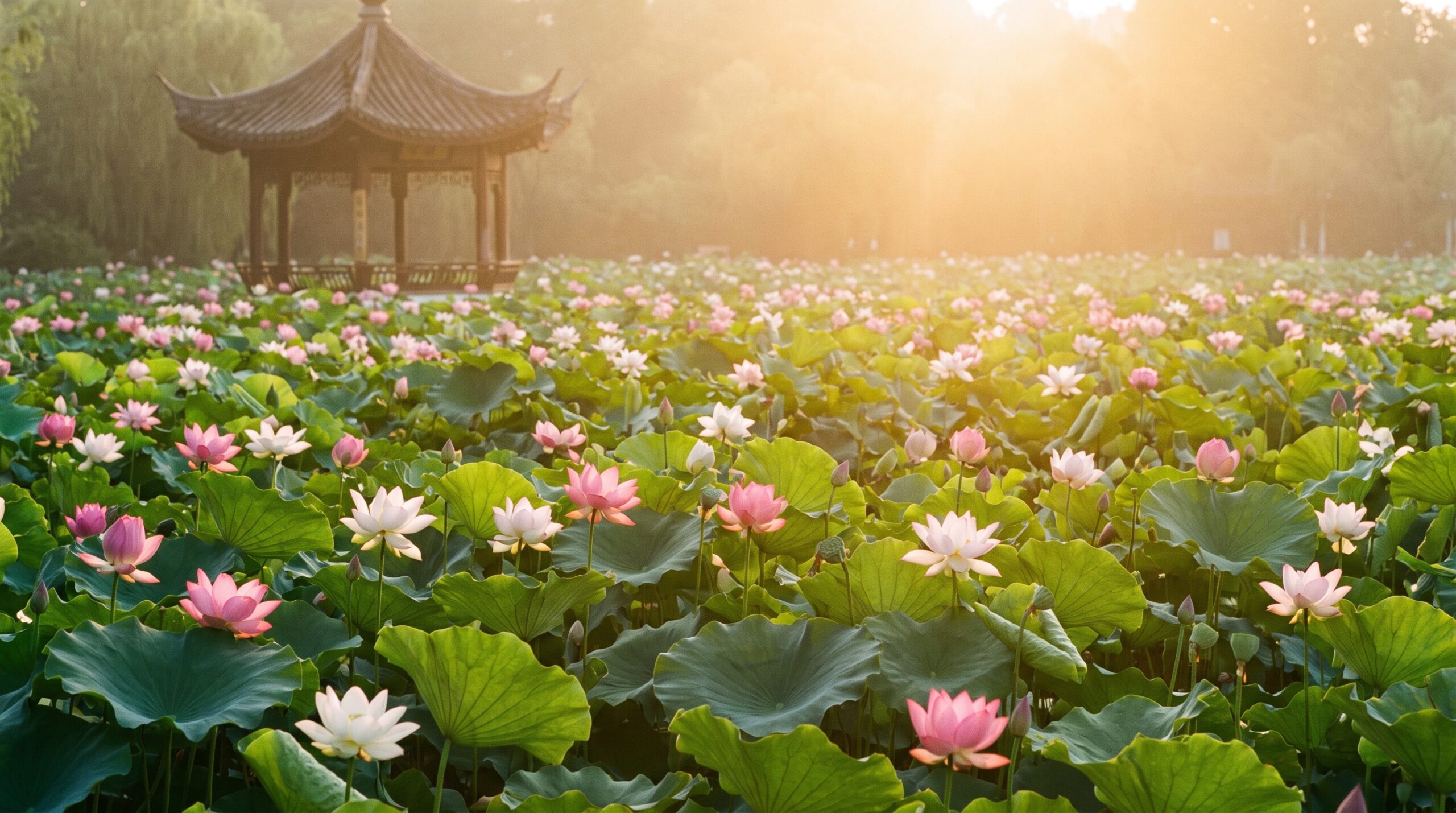
Lotus at Quyuan Fenghe (曲院风荷, Curved Yard and Lotus Pool) opens in mid-June and peaks from late June through late July. By August the petals are dropping and the seed heads are forming — beautiful in a different way, but not the postcard image you came for. Aim for the first half of the window if you can.
The best viewing is from the eastern causeway at sunrise, when the flowers open and the air is still cool enough to breathe. By 10 a.m. the heat haze blurs the petals and the mosquitoes find you. The west side of the park, near the old winery gate, is where the densest flowers cluster and where most photographers set up.
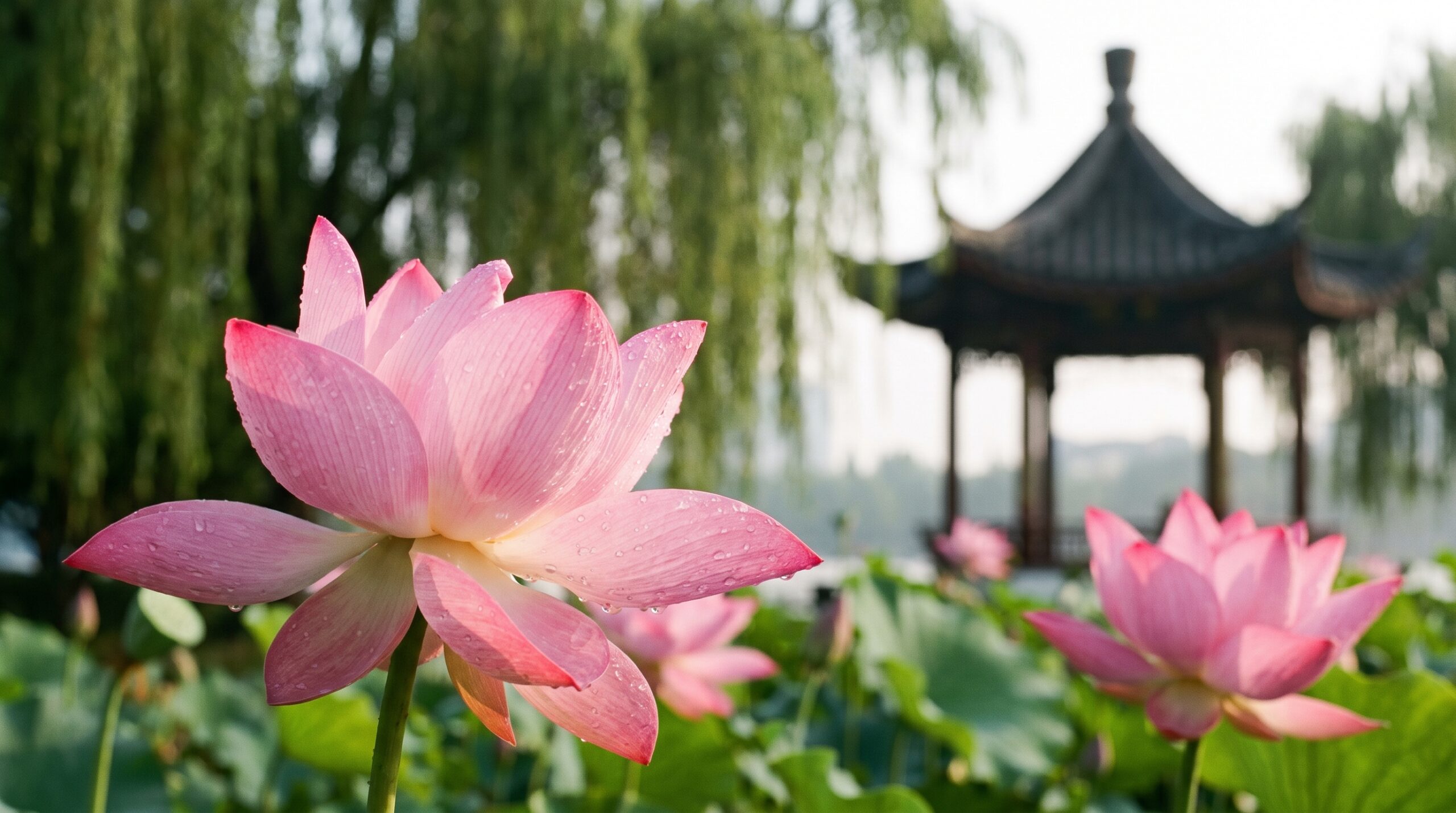
For a less crowded alternative, the lotus ponds at Zhanbiao Mountain ( Zhanbiao Shan ) on the north shore of the lake bloom on a slightly later schedule and almost no foreign visitors know about them. Take bus 194 or a DiDi to the Zhanbiao Shan stop and walk five minutes west.
If you want to combine lotus with a longer walk, the inner-loop Xixi Wetland boat ride passes through smaller lotus channels that bloom about ten days later than Quyuan Fenghe — useful if your trip falls in mid-July and the main park is past peak.
The Music Fountain and Other Summer Evenings
The West Lake Music Fountain (湖滨音乐喷泉) on the east shore runs three shows every evening from mid-June to mid-October: 19:00, 20:00, and 21:00. Each show is about 15 minutes. Arrive 30 minutes early to get a front-row spot along the railing. The fountain is paired with a Chinese pop song playlist that’s been largely the same for five years — don’t expect Mozart — but the choreography is genuinely good and the kids love it.
After the 21:00 show, walk north along Beishan Road for about 20 minutes. This is the only time of year the lakeside air moves enough to feel cool. The street vendors along the way sell cold chrysanthemum tea in plastic bottles for 5 yuan — cheap, sweet, and exactly what the heat wants.
For a quieter evening, the Hefang Ancient Street night market (河坊街) stays open past 22:00 in summer. It’s touristy but the lanterns look better against the dark, and you can find street food that doesn’t appear on the daytime menu. The peanut-shell-smoked lotus root, in particular, is a Hangzhou summer thing.
What to Do During the Hottest Hours
From 11:00 to 16:00, treat the city like a desert. Don’t walk. Don’t queue for West Lake. Don’t ride a bike. Either rest at your hotel, eat a long lunch, or be inside a museum.
The China National Tea Museum (中国茶叶博物馆) on the west side of the lake has air conditioning, free entry, a working tea house, and a hillside garden that catches every breeze off the lake. The China National Silk Museum (中国丝绸博物馆) near Yuetan Temple is bigger and almost no one visits. The Zhejiang Provincial Museum (浙江省博物馆) at Gushan has a permanent Song dynasty exhibition that justifies two hours indoors. None of these cost more than a DiDi to reach.
If you want to be outside but in the water, the Hangzhou Polar Ocean Park on the east side of the city is the obvious family choice, and the Jiuxi Eighteen Streams (九溪十八涧) wading path on the south edge of town is a locals’ favorite — you walk about 30 minutes up a shallow stream, shoes off, feet in cold mountain water. Take bus 39 or 308 to Jiuxi stop. Bring a towel.
The Qiantang River Tidal Bore
The Qiantang tidal bore (钱塘江大潮) is one of the world’s largest, a wall of seawater that rolls up the river at speeds up to 40 km/h. It happens every day, but the bore is dramatic only on the 1st, 15th, and around the 18th day of each lunar month, and it’s at its biggest on the 18th day of the eighth lunar month (usually late September or early October — borderline summer-autumn).
The main viewing spot is the Yanguan tidal wall (盐官观潮) in Haining, about 50 km east of Hangzhou. You can take a high-speed train from Hangzhou East to Haining West (15 minutes) and then a bus to the site. The bore arrives in a window of about 30 minutes around the published time, so don’t plan a tight schedule after it.
The spectacle is real, but be careful: people have died standing on the lower wall when a secondary wave caught them. Stay on the upper platform, follow the marshals’ instructions, and don’t try to get the perfect selfie at the waterline.
Where to Stay in Summer
The best areas to stay shift slightly with the season. In summer specifically:
- West Lake east side (Hubin) is the most convenient but the most expensive and the most crowded. Pick this if you’ll be hitting the Music Fountain and walking the lake in the evening.
- Xixi Wetland is cooler (it’s a swamp, basically) and has more space per yuan. Pick this for families who want a quieter base and a place to swim.
- Wulin Square / downtown is the best value for chain hotels and puts you 15 minutes from anywhere by metro. Pick this if your itinerary splits between West Lake, Lingyin, and the canal.
- Near Lingyin / West Lake west is mid-range and quiet. The downside is fewer restaurants open late.
Book at least a week ahead for late July and August — domestic tourism peaks in the school holiday window, and lake-view rooms sell out two weeks out.
Practical Summer Tips
- Bring a folding umbrella. Both for typhoon rain and for shade. The Chinese-style oil-paper umbrellas (15-25 yuan in any shop) double as photoshoot props.
- Drink hot, not cold. Locals drink hot chrysanthemum tea or warm water in summer; cold drinks worsen the heat-dampness. This is one traditional belief that holds up to the science of thermal comfort.
- Pack a refillable bottle. Public water fountains (直饮水) are everywhere around West Lake — look for the green-and-white tap stations.
- Wear quick-dry clothes. Cotton stays wet and miserable. Light synthetic tees and shorts dry in 20 minutes.
- Download DiDi and Alipay before arrival. In a typhoon week, taxi queues at tourist sites are 40+ minutes; DiDi from the same spot takes 5.
Summer Hangzhou rewards the prepared. With the right plan — lotus at dawn, indoors at noon, fountain and lotus-root street food at night — the heat becomes part of the trip, not a problem to survive. For a fuller day-by-day structure, the 3-day Hangzhou itinerary works in summer with the timing adjustments above; for a longer lay, the 4-day version gives you the typhoon-day museum backup built in.